⚠ BOXED WARNING – Distant Spread of Toxin Effect
The effects of LETYBO may spread from the injection area to produce botulinum toxin symptoms hours to weeks after injection. Swallowing and breathing difficulties can be life-threatening, with reports of death. LETYBO is not approved for spasticity or any condition other than glabellar lines.
Drug Overview
Generic nameletibotulinumtoxinA-wlbg
Brand nameLETYBO
Drug classAcetylcholine release inhibitor / Neuromuscular blocking agent
Toxin typeBotulinum toxin type A, 900 kDa complex
Source organismClostridium botulinum
Molecular targetSNAP-25 (synaptosomal-associated protein 25)
Route of administrationIntramuscular injection
Dosage formFreeze-dried powder, 50U or 100U single-dose vials
Inactive ingredientsAlbumin human, sodium chloride
ManufacturerHugel, Inc. (Korea); U.S. License No. 2237
NDC50U: 81165-050-01 / 100U: 81165-100-01
Storage (unopened)2–8°C; do not freeze; protect from light
FDA-Approved Indication
Glabellar Lines (Frown Lines)
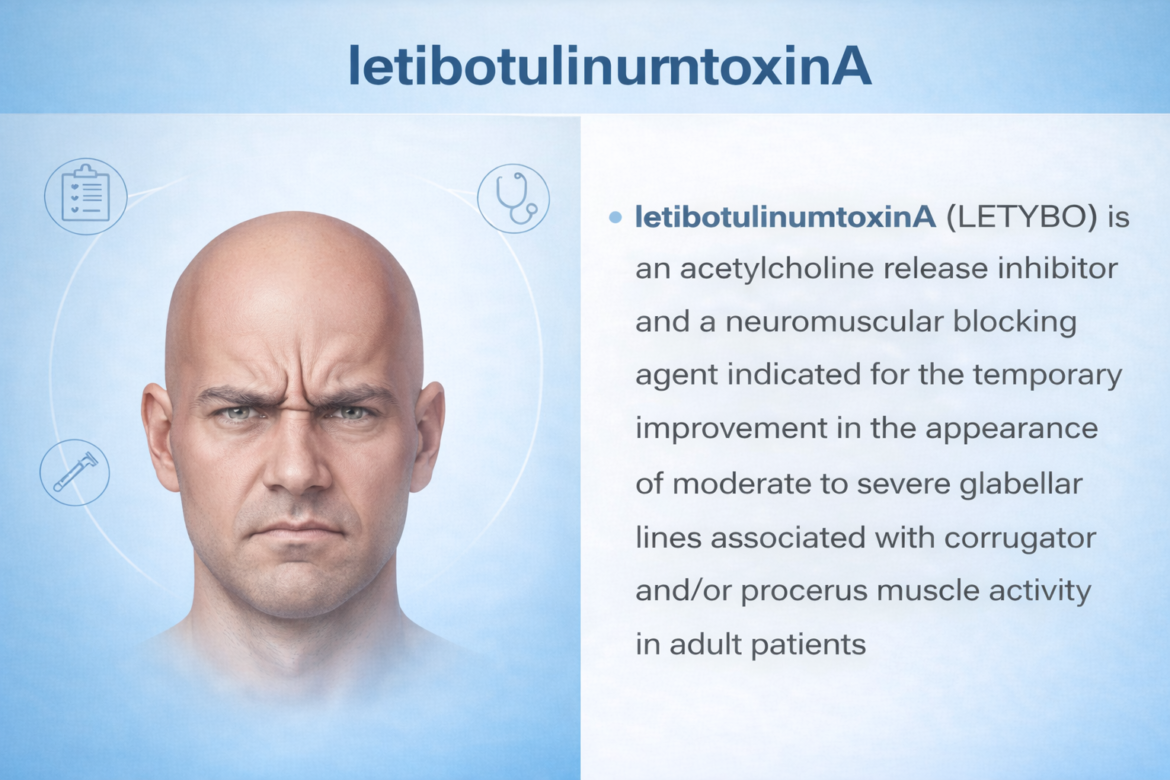
Temporary improvement in the appearance of
moderate to severe glabellar lines associated with corrugator and/or procerus muscle activity in
adult patients.
Mechanism of Action
LETYBO blocks cholinergic transmission at the neuromuscular junction by inhibiting acetylcholine release. Following IM injection, the toxin is internalized into the nerve terminal and translocates into the neuronal cytosol, where it cleaves SNAP-25 — a protein essential for synaptic vesicle docking and acetylcholine exocytosis. This produces a dose-dependent reduction in muscle contractility. Recovery is gradual, driven by neurotoxin degradation, axonal sprouting, and eventual muscle reinnervation.
Contraindications
- Known hypersensitivity to any botulinum toxin preparation or LETYBO formulation components
- Active infection at the proposed injection site(s)
Key Regulatory Milestones
| Milestone | Date | Detail |
|---|
| Initial U.S. Approval (NDA 761237) | February 2024 | Glabellar lines in adults |
| Label Revision | 02/2024 | Initial labeling; current revision |
| Manufacturer U.S. License | — | No. 2237 (Hugel, Inc., Korea) |
Competing BoNT-A Products (Glabellar Lines)
| INN | Brand | Approved Dose (Glabellar) |
|---|
| onabotulinumtoxinA | BOTOX Cosmetic | 20 U |
| abobotulinumtoxinA | Dysport | 50 U |
| incobotulinumtoxinA | Xeomin | 20 U |
| prabotulinumtoxinA-xvfs | Jeuveau | 20 U |
| daxibotulinumtoxinA-lanm | Daxxify | 40 U |
| letibotulinumtoxinA-wlbg | LETYBO | 20 U |
Pivotal Trial Programme – BLESS I, II, III
Trial Design
Three randomized, multicenter, double-blind, placebo-controlled trials of
identical design (BLESS I [NCT02677298], BLESS II [NCT02677805], BLESS III [NCT03985982]). Enrolled 1,276 adults randomized 3:1 to LETYBO 20U (n=957) or placebo (n=319). FAS: LETYBO n=954, placebo n=317.
Study Population
Age range19–75 years (mean 50)
Sex91% women
Race91% White
Age ≥65152 subjects (12%)
InclusionModerate–severe glabellar lines at maximum frown (GLS ≥2)
Key exclusionsPtosis, deep dermal scarring, lines not spreadable by palpation
Randomization3:1 (LETYBO:Placebo)
Primary Efficacy Endpoint
Proportion of subjects achieving GLS score 0 or 1 (none/mild) AND improvement of ≥2 points from baseline at maximum frown at Week 4, assessed concurrently by both investigator and subject (Glabellar Line Scale, 0–3).
Primary Endpoint Results — Week 4 (Treatment Success, FAS)
| Endpoint | LETYBO | Placebo | Treatment Difference (95% CI) |
|---|
| Multi-component success (investigator + subject) | 246 (47%) | 0 (0%) | 47% (43%, 51%) |
| Investigator assessment only | 348 (66%) | 1 (1%) | — |
| Subject assessment only | 290 (55%) | 0 (0%) | — |
Multi-component success rate
| Endpoint | LETYBO | Placebo | Treatment Difference (95% CI) |
|---|
| Multi-component success | 78 (49%) | 1 (2%) | 45% (36%, 54%) |
| Investigator assessment only | 120 (75%) | 1 (2%) | — |
| Subject assessment only | 83 (52%) | 1 (2%) | — |
Multi-component success rate
| Endpoint | LETYBO | Placebo | Treatment Difference (95% CI) |
|---|
| Multi-component success | 172 (65%) | 0 (0%) | 65% (59%, 71%) |
| Investigator assessment only | 209 (79%) | 1 (1%) | — |
| Subject assessment only | 183 (69%) | 0 (0%) | — |
Multi-component success rate
Efficacy Assessment Scale
| GLS Score | Description |
|---|
| 0 | None |
| 1 | Mild |
| 2 | Moderate |
| 3 | Severe |
Open-Label Extension (BLESS I–III)
1,129 subjects enrolled; up to 3 additional LETYBO 20U treatments over 48 weeks (minimum 3-month intervals). Median 3 treatments. Adverse reaction profile comparable to double-blind phase. Incidence of adverse reactions did not increase with repeat treatments.
⚠ BOXED WARNING – Distant Spread of Toxin Effect
Botulinum toxin effects may spread from the injection site. Symptoms — including dysphagia, dysphonia, dyspnea — have been reported hours to weeks post-injection. Life-threatening complications and deaths have been reported. LETYBO is not approved for spasticity or any indication other than glabellar lines.
Adverse Reactions – Phase 3 Placebo-Controlled Data (BLESS I–III)
| Adverse Reaction | LETYBO (N=911) | Placebo (N=310) |
|---|
| Headache* | 17 (2%) | 2 (1%) |
| Brow ptosis** | 3 (<1%) | 0 |
| Eyelid ptosis | 3 (<1%) | 0 |
| Blepharospasm | 2 (<1%) | 0 |
Injection Site Reactions
Most frequently reported injection site reactions included administration site swelling, facial pain, folliculitis, periorbital hematoma, injection site bruising, reaction, pain, hematoma, nodule, pruritus, and mass. Overall incidence ~1% in open-label extension.
Warnings & Precautions
| W&P | Key Points |
|---|
| 5.1 Spread of Toxin Effects | Asthenia, muscle weakness, diplopia, ptosis, dysphagia, dysphonia, dysarthria, urinary incontinence, blurred vision, dyspnea — hours to weeks post-injection. Seek immediate care for respiratory/speech/swallowing symptoms. |
| 5.2 Non-interchangeability | LETYBO Units are specific to this preparation and cannot be compared to or converted into units of any other BoNT product. |
| 5.3 Unapproved Use Reactions | Serious AEs including excessive weakness, dysphagia, and aspiration pneumonia (some fatal) reported with BoNT products used off-label. |
| 5.4 Hypersensitivity | Anaphylaxis, serum sickness, urticaria, soft tissue edema, dyspnea. Discontinue and treat immediately if reactions occur. |
| 5.5 Cardiovascular | Arrhythmia and MI (some fatal) reported post-BoNT injection. Use caution in patients with pre-existing cardiovascular disease. |
| 5.6 Neuromuscular Disorders | Patients with peripheral motor neuropathy, ALS, myasthenia gravis, Lambert-Eaton syndrome at increased risk of clinically significant effects. Monitor closely. |
| 5.7 Dysphagia / Dyspnea | Can result in respiratory failure. Deaths from severe dysphagia reported. Pre-existing dysphagia/dyspnea increases risk. Dysphagia may persist for months. |
| 5.8 Pre-existing Injection Site Conditions | Use caution with inflammation, marked facial asymmetry, prior facial surgery, ptosis, excessive dermatochalasis, deep dermal scarring, or thick sebaceous skin. |
| 5.9 Ophthalmic AEs | Dry eye, reduced tear production, reduced blinking, corneal disorders. Refer to ophthalmologist if persistent dry eye symptoms. |
| 5.10 Human Albumin | Contains albumin (human blood derivative). Remote risk of viral disease transmission or CJD/vCJD; no cases identified to date. |
Drug Interactions
No formal drug interaction studies conducted with LETYBO. The following may potentiate effects (excessive NMJ weakness / anticholinergic effects):
- Aminoglycosides or other agents interfering with neuromuscular transmission
- Anticholinergic drugs
- Other botulinum neurotoxin products administered concurrently or within several months
- Muscle relaxants (before or after LETYBO)
Immunogenicity
Among 1,195 subjects treated with letibotulinumtoxinA-wlbg, 4 (0.3%) developed anti-drug antibodies. In samples further tested, no neutralizing anti-drug antibodies were detected. Antibody formation may reduce efficacy of subsequent treatments.
Use in Special Populations
| Population | Recommendation |
|---|
| Pregnancy (8.1) | Insufficient human data. Animal data: adverse fetal effects (↓body weight, ↓skeletal ossification) at 3× MRHD (≥1 U/kg) associated with maternal toxicity. Category not assigned under current labeling framework. |
| Lactation (8.2) | No data on presence in human/animal milk. Weigh benefits vs. potential risks. |
| Pediatric (8.4) | Safety and effectiveness not established. |
| Geriatric (8.5) | 148 subjects ≥65 years; no clinically meaningful differences vs. younger subjects. Insufficient numbers for definitive conclusions. |
Overdosage
Excessive doses produce neuromuscular weakness; respiratory support may be needed. Symptoms may be delayed. If suspected, observe medically for several weeks. Antitoxin available via CDC (1-770-488-7100) — will not reverse established effects.
Mechanism of Action
Primary Target
SNAP-25 Cleavage
Prevents acetylcholine exocytosis at NMJ
Toxin Complex
900 kDa
Botulinum toxin type A from C. botulinum
LETYBO is internalized into the presynaptic nerve terminal via receptor-mediated endocytosis. Following endosomal escape, the light chain translocates into the neuronal cytosol and proteolytically cleaves SNAP-25, a SNARE protein required for synaptic vesicle fusion with the plasma membrane. Without functional SNAP-25, acetylcholine vesicles cannot dock and fuse at the nerve terminal, halting neurotransmitter release. This results in a localized, dose-dependent flaccid muscle paralysis. Recovery occurs gradually as SNAP-25 is replenished, new axonal sprouts form, and muscle reinnervation occurs.
Pharmacodynamics (Section 12.2)
No formal pharmacodynamic studies have been conducted with LETYBO.
Pharmacokinetics (Section 12.3)
| PK Parameter | Data |
|---|
| Systemic detection | LETYBO cannot be detected in peripheral blood following IM injection at recommended doses using currently available analytical technology |
| Systemic exposure | Not formally assessed at therapeutic doses |
| Distribution | Local; intended effect confined to injection site muscles |
| Elimination / Recovery | Gradual via neurotoxin degradation, axonal sprouting, and muscle reinnervation |
| Duration of effect | ~3 months (basis for minimum re-treatment interval) |
Composition & Formulation
| Vial Size | Active (letibotulinumtoxinA-wlbg) | Albumin Human | Sodium Chloride |
|---|
| 50 Units | 50 U | 0.25 mg | 0.45 mg |
| 100 Units | 100 U | 0.50 mg | 0.90 mg |
Nonclinical Toxicology (Section 13.1)
Animal studies to evaluate carcinogenic, mutagenic, or fertility impairment potential of letibotulinumtoxinA-wlbg have not been conducted.
Embryofetal development (rat): Once-daily IM dosing during organogenesis (GD5–16) caused decreased fetal body weight and decreased skeletal ossification at doses ≥1 U/kg (3× MRHD of 0.34 U/kg for 60 kg subject). Effects were associated with maternal toxicity.
Recommended Dosage
Total Dose
20 Units
Per treatment session
Per Injection Site
4 Units
0.1 mL per site × 5 sites
Min. Re-treatment Interval
3 Months
No more than q3 months
Injection Sites (5 Total)
- Corrugator muscle (bilateral): 2 sites per side (inferomedial + superior middle) = 4 injections
- Procerus muscle: 1 injection in the mid-line
Inject 0.1 mL (4 Units) IM per site using a 30–31 gauge needle. Total = 20 Units / 0.5 mL.
Reconstitution Instructions
| Vial | Diluent to Add* | Resulting Concentration |
|---|
| 50 Units | 1.25 mL | 4 Units / 0.1 mL |
| 100 Units | 2.5 mL | 4 Units / 0.1 mL |
Reconstituted Solution
- Appearance: clear, colorless, particulate-free. Do not use if cloudy, discolored, or contains particles.
- Use within 24 hours of reconstitution
- Store reconstituted product at 2–8°C; protect from light; do not freeze
- Single-use only; discard any remaining solution after injection session
- One vial per patient per injection session
Administration Technique
- Draw ≥0.5 mL of reconstituted toxin into sterile syringe; expel air bubbles
- Remove reconstitution needle; attach 30–31 gauge needle; confirm patency
- Inject 0.1 mL (4 Units) IM at each of 5 sites (inferomedial corrugator, superior middle corrugator ×2, procerus midline)
Ptosis Prevention — Pre-injection Assessment
Pre-treatment Levator Function Assessment
Examine upper eyelid margin for separation/weakness of levator palpebrae superioris. Evaluate eyelid excursion while manually immobilizing frontalis to assess levator function and frontalis compensation.
- Avoid injection near levator palpebrae superioris (especially patients with larger brow depressor complexes)
- Ensure injected volume/dose is accurate; administer in a steady, controlled manner
- Lateral corrugator injections: place ≥1 cm above bony supraorbital ridge
- Do not inject toxin closer than 1 cm above the central eyebrow
Cumulative Dose Considerations
When patients receive LETYBO for glabellar lines while also using other botulinum toxin products for other approved indications, the cumulative dose across all products must be considered. LETYBO Units are not interchangeable with Units of other BoNT products.
Cautions for Specific Patients
- Marked facial asymmetry or prior facial surgery
- Pre-existing eyelid or eyebrow ptosis
- Excessive dermatochalasis
- Deep dermal scarring or thick sebaceous skin
- Excessive weakness or atrophy in target muscles
- Inflammation at proposed injection site
Regulatory Summary
NDA Number761237
Application TypeBiologics License Application (BLA)
Initial U.S. ApprovalFebruary 2024
Label Revision Date02/2024
Reference ID5337801
Sponsor / ManufacturerHugel, Inc. (Korea); U.S. License No. 2237
Approved IndicationModerate–severe glabellar lines, adult patients
Special DesignationsNone listed
Boxed WarningYes – Distant Spread of Toxin Effect
REMSNot required
Pivotal Trials Supporting Approval
| Trial | NCT | Design | N (LETYBO:Placebo) | Primary Endpoint Met |
|---|
| BLESS I | NCT02677298 | DB, PC, MC, RCT | 528:175 | Yes (47% vs 0%) |
| BLESS II | NCT02677805 | DB, PC, MC, RCT | 160:53 | Yes (49% vs 2%) |
| BLESS III | NCT03985982 | DB, PC, MC, RCT | 266:89 | Yes (65% vs 0%) |
How Supplied
| Pack | NDC | Description |
|---|
| 50 Units/vial (carton of 1) | 81165-050-01 | Sterile, white, freeze-dried powder; single-dose vial |
| 100 Units/vial (carton of 1) | 81165-100-01 | Sterile, white, freeze-dried powder; single-dose vial |
Storage & Handling
- Unopened: 2–8°C (36–46°F); original carton; protect from light
- Do not freeze (unopened or reconstituted)
- Reconstituted: Use within 24 hours; store at 2–8°C; original carton
- Single-use vial; discard remainder immediately after injection session
Adverse Event Reporting
HUGEL: 1-888-674-5355
FDA MedWatch: 1-800-FDA-1088 | www.fda.gov/medwatch
Patient AE Reporting: Hugel, Inc. 1-877-390-2906
Regulatory Context – BoNT-A Class (U.S.)
| Product | INN | Glabellar Lines Approval |
|---|
| BOTOX Cosmetic | onabotulinumtoxinA | 2002 |
| Dysport | abobotulinumtoxinA | 2009 |
| Xeomin | incobotulinumtoxinA | 2011 |
| Jeuveau | prabotulinumtoxinA-xvfs | 2019 |
| Daxxify | daxibotulinumtoxinA-lanm | 2022 |
| LETYBO | letibotulinumtoxinA-wlbg | 2024 |