DaxibotulinumtoxinA-lanm (DAXXIFY) — Drug Profile | TrialistMD
TRIALISTMD.COMDRUG PROFILE
Botulinum Neurotoxin Type A · Neuromuscular Blocking Agent · Dermatology / Aesthetics
DaxibotulinumtoxinA-lanm
DAXXIFY™ · Revance Therapeutics, Inc.
A 150 kDa botulinum toxin type A without accessory proteins, formulated with a novel 35-amino acid stabilizing peptide excipient (RTP004), indicated for the temporary improvement in the appearance of moderate to severe glabellar lines in adult patients. The first injectable neuromodulator approved with an albumin-free formulation, demonstrating extended duration of effect (~24 weeks median treatment success in pivotal trials). Carries the class Boxed Warning for distant spread of toxin effect.
⚠ BOXED WARNING — DISTANT SPREAD OF TOXIN EFFECT: The effects of DAXXIFY and all botulinum toxin products may spread from the area of injection to produce symptoms consistent with botulinum toxin effects, reported hours to weeks after injection. Swallowing and breathing difficulties can be life threatening; deaths have been reported. DAXXIFY is not approved for spasticity or any condition other than glabellar lines. (PI §5.1)
Indication
Glabellar Lines
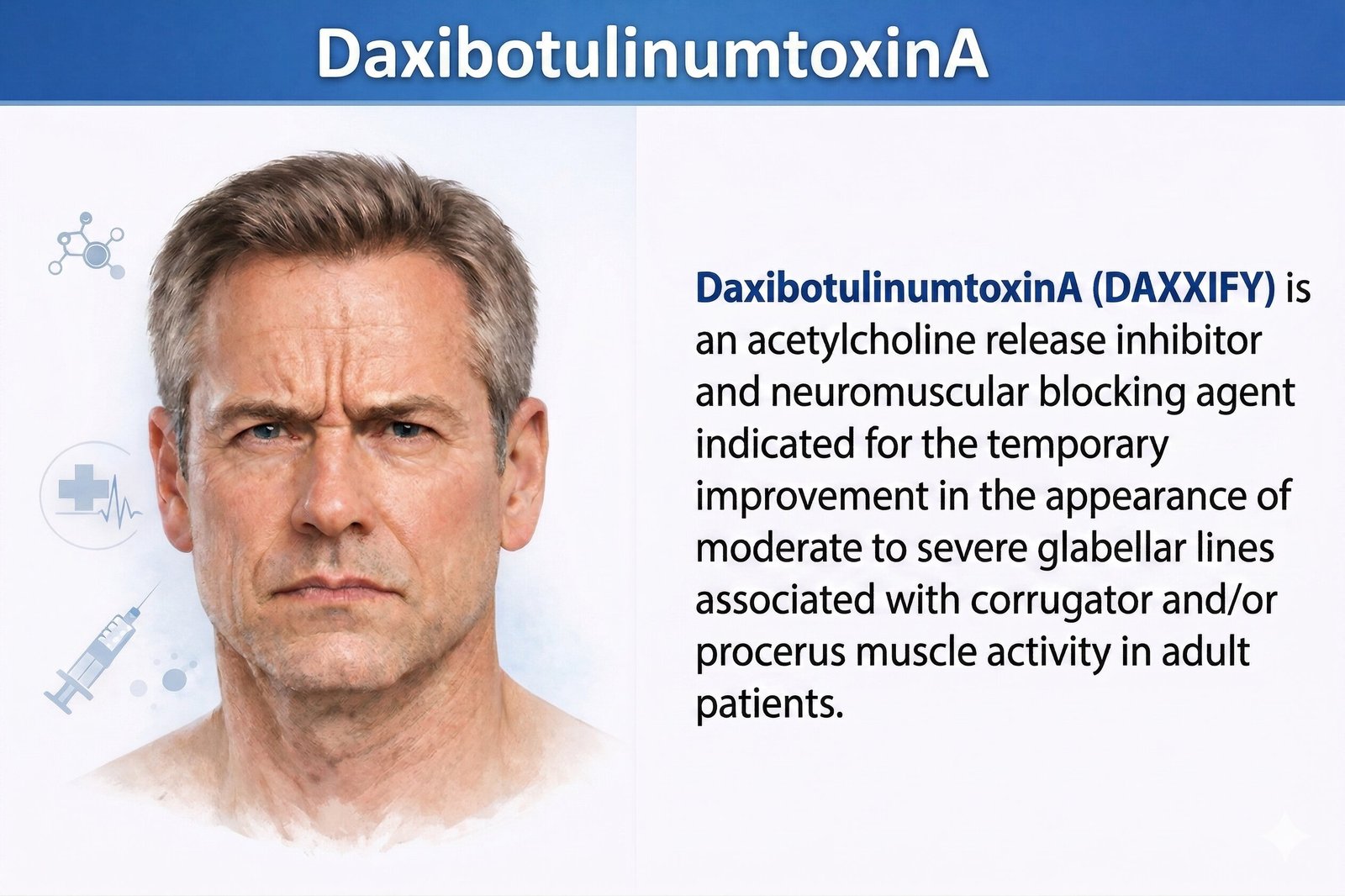
Temporary improvement in moderate-to-severe glabellar lines associated with corrugator and/or procerus muscle activity in adult patients (PI §1)
Mechanism
BoNT-A / SNAP25 Cleavage
Inhibits acetylcholine release at the neuromuscular junction; cleaves SNAP25, blocking synaptic vesicle docking and ACh release (PI §12.1)
Approved Dose
40 Units
5 equal IM injections of 8 Units (0.1 mL each) into corrugator and procerus muscles; no more than every 3 months (PI §2.2)
Mechanism of Action (PI §12.1): DaxibotulinumtoxinA-lanm blocks cholinergic transmission at the neuromuscular junction by inhibiting the release of acetylcholine. When injected into skeletal muscle, it is internalized into the nerve terminal and translocates into the neuronal cytosol where it cleaves SNAP25 — a SNARE protein essential for synaptic vesicle membrane docking and subsequent release of acetylcholine — producing a dose-dependent decrease of muscle function. Recovery of activity is gradual and results from the degradation of neurotoxin light chain in the neurons with a contribution from the formation of axonal sprouts, leading to slow reversal of pharmacological effects.
Clinical Trial Programme
§1.2
Trial Name
Design
N Randomised
Duration
Comparator
Primary Endpoint
GL-1 (Study 1620301)
R, DB, PC Phase 3
303 (201 DAXXIFY / 102 placebo)
24–36 weeks follow-up
Placebo (vehicle)
2-point composite response (IGA-FWS + PFWS ≤1 AND ≥2-grade improvement) at Week 4
GL-2 (Study 1620302)
R, DB, PC Phase 3
306 (204 DAXXIFY / 102 placebo)
24–36 weeks follow-up
Placebo (vehicle)
2-point composite response (IGA-FWS + PFWS ≤1 AND ≥2-grade improvement) at Week 4
SAKURA-OLS (Study 1620303)
Open-label, repeat-dose safety
2,691 subjects (up to 3 treatment cycles)
84 weeks
None (single-arm)
Long-term safety (adverse events, immunogenicity)
R=randomised; DB=double-blind; PC=placebo-controlled; IGA-FWS=Investigator Global Assessment-Frown Wrinkle Severity; PFWS=Patient Frown Wrinkle Severity. Source: FDA PI BLA 761127 §14.1, Ref ID 5042005.
Competitive Landscape — Injectable Neuromodulators for Glabellar Lines (US)
§1.3
Drug (INN + Brand)
Target / Toxin Type
Formulation / Stabilizer
US Approval (GL)
Approved Population
DaxibotulinumtoxinA-lanm (DAXXIFY) ← this drug
BoNT-A, 150 kDa, no accessory proteins
RTP004 peptide (albumin-free); lyophilized powder
Sep 8, 2022 (BLA 761127)
Adults ≥18 years
OnabotulinumtoxinA (BOTOX Cosmetic, AbbVie)
BoNT-A (with accessory proteins)
Human serum albumin, NaCl
Apr 15, 2002
Adults 18–65 years
AbobotulinumtoxinA (DYSPORT, Galderma)
BoNT-A (with accessory proteins)
Human serum albumin, lactose
Apr 29, 2009
Adults ≤65 years
IncobotulinumtoxinA (XEOMIN, Merz)
BoNT-A (naked toxin, no complexing proteins)
Human serum albumin, sucrose
Jul 20, 2011
Adults ≥18 years
PrabotulinumtoxinA-xvfs (JEUVEAU, Evolus)
BoNT-A (with accessory proteins)
Human serum albumin, NaCl
Feb 1, 2019
Adults ≥18 years
Key Drug Information
§1.4
Parameter
Detail
Proprietary Name
DAXXIFY™
INN / Generic Name
DaxibotulinumtoxinA-lanm
Code Names
RT002; daxibotulinumtoxinA
Manufacturer
Revance Therapeutics, Inc., Newark, CA 94560. U.S. License Number 2101.
Pharmacologic Class
Acetylcholine release inhibitor and neuromuscular blocking agent
Dosage Forms & Strengths
For injection: 50 Units or 100 Units sterile lyophilized powder in a single-dose vial (PI §3)
NDC — 50 Units/Vial
72960-111-01
NDC — 100 Units/Vial
72960-112-01
Storage (Unopened)
Room temperature 20°C–25°C (68°F–77°F) OR refrigerated 2°C–8°C (36°F–46°F); in original carton, protect from light (PI §16)
Storage (After Reconstitution)
Use within 72 hours; store at 2°C–8°C, protected from light; do not freeze (PI §2.3)
Source: FDA PI BLA 761127, Ref ID 5042005, Revised 9/2022. All values extracted directly from PI §§1, 2, 3, 4, 11, 16.
Baseline Characteristics
§2
Pooled Trial Summary: Efficacy data from GL-1 (Study 1620301, N=303) and GL-2 (Study 1620302, N=306), totalling 609 subjects. Combined DAXXIFY N=406 (from pooled label Table 3) and Placebo N=203 in the controlled trials. Randomization 2:1 (DAXXIFY:Placebo). Enrolled subjects were 21–75 years old, mean age 50 years, predominantly female (87%) and Caucasian (86%) per PI §14.1. Arms were well balanced at baseline.
Discontinued after Week 24 when both IGA-FWS and PFWS returned to baseline; counted as non-responders after discontinuation (PI §14.1)
Same as GL-1
Demographics — Pooled GL-1 + GL-2
§2.2 · PI §14.1
Parameter
DAXXIFY (N=406)
Placebo (N=203)
Mean age (range)
50 years (21–75)
Not reported separately for pooled placebo
Female, n (%)
~87%
~87%
Caucasian, n (%)
~86%
~86%
Prior BoNT-A use
Not reported in PI (reported ~45–59% in individual trial arms)
Not reported in PI
Baseline IGA-FWS: Moderate (score 2)
~62% (pooled estimate)
~65%
Baseline IGA-FWS: Severe (score 3)
~38% (pooled estimate)
~35%
Glabellar Line Severity Scale
§2.3 · PI §14.1
Score
Descriptor
Definition (at Maximum Frown)
0 — None
No wrinkles
No visible glabellar wrinkles at maximum frown
1 — Mild
Very shallow wrinkles
Barely perceptible wrinkles at maximum frown
2 — Moderate
Moderate wrinkles
Moderate visible wrinkles at maximum frown
3 — Severe
Deep/furrowed wrinkles
Deep, furrowed glabellar wrinkles at maximum frown
Inclusion criteria (PI §14.1): Adults aged ≥18 years with glabellar lines of at least moderate severity (score ≥2) at maximum frown. Enrolled subjects were 21–75 years. Exclusion criteria: eyelid ptosis, deep dermal scarring, excessive dermatochalasis, or inability to lessen glabellar lines by physically spreading them apart.
Source: FDA PI BLA 761127, Ref ID 5042005, §14.1. Pooled demographics (87% female, 86% Caucasian, mean age 50 years) reported in PI narrative; individual arm breakdowns not explicitly tabulated in the PI. Note: the PI reports N=405 randomized and N=406 treated with DAXXIFY (1 subject was randomized to placebo but treated with DAXXIFY).
Clinical Efficacy
§3
Primary Endpoint and Statistical Framework: The primary endpoint was the proportion of subjects achieving a score of 0 or 1 (none or mild) on both the Investigator Assessment (IGA-FWS) and Subject Assessment (PFWS) AND an improvement of ≥2 points from baseline on both scales at Week 4. Assessed using a 4-point scale (0=none, 1=mild, 2=moderate, 3=severe). Treatment success defined per PI §14.1. Both pivotal trials (GL-1 and GL-2) used an identical design with 2:1 randomization. No formal FWER control method explicitly described in PI; both trials required to demonstrate efficacy independently. P<0.0001 in both trials.
Primary Endpoint Wk 4 — GL-1
74%
148/201 DAXXIFY vs 0/102 placebo (0%); treatment difference 74% (95% CI 68–80%); p<0.0001 (PI Table 4)
Primary Endpoint Wk 4 — GL-2
74%
152/205 DAXXIFY vs 0/101 placebo (0%); treatment difference 74% (95% CI 68–80%); p<0.0001 (PI Table 4)
Investigator Assessment Wk 4 — GL-2
92%
IGA-FWS ≤1 (none/mild): 187/205 DAXXIFY vs 2/101 placebo (2%) — individual component; GL-1: 86% (172/201) vs 1% (PI Table 4)
Subject Assessment Wk 4
76–77%
PFWS ≤1: GL-1: 152/201 (76%), GL-2: 156/205 (76%); placebo: 0 in GL-1, 0 in GL-2 (PI Table 4)
Primary Efficacy — 2-Point Composite Response at Week 4
§3.1 · PI Table 4 · ITT Population
STUDY GL-1 (1620301) — N=303 · Primary Endpoint Week 4Randomized, DB, PC · 2:1 ratio · ITT · p<0.0001
Treatment success: score ≤1 (none/mild) on both IGA-FWS and PFWS AND ≥2-grade improvement from baseline on both scales at Week 4. N=201 DAXXIFY (40 U), N=102 placebo.
DaxibotulinumtoxinA-lanm 40 U (N=201)
74%
Placebo (N=102)
0%
Treatment difference: 74% (95% CI 68%, 80%). Investigator Assessment only (IGA-FWS ≤1): 172/201 = 86% DAXXIFY vs 1/102 = 1% placebo. Subject Assessment only (PFWS ≤1): 152/201 = 76% DAXXIFY vs 0/102 = 0% placebo.
STUDY GL-2 (1620302) — N=306 · Primary Endpoint Week 4Randomized, DB, PC · 2:1 ratio · ITT · p<0.0001
Identical design to GL-1. Note: N=205 DAXXIFY (N=204 randomized + 1 placebo subject inadvertently treated with DAXXIFY; as-treated). N=101 placebo.
DaxibotulinumtoxinA-lanm 40 U (N=205)
74%
Placebo (N=101)
0%
Treatment difference: 74% (95% CI 68%, 80%). Investigator Assessment only (IGA-FWS ≤1): 187/205 = 92% DAXXIFY vs 2/101 = 2% placebo. Subject Assessment only (PFWS ≤1): 156/205 = 76% DAXXIFY vs 0/101 = 0% placebo.
Efficacy Summary Table
§3.2 · PI Table 4 (Label)
Endpoint at Week 4
GL-1 DaxibotulinumtoxinA-lanm (N=201) n (%)
GL-1 Placebo (N=102) n (%)
GL-1 Treatment Difference (95% CI)
GL-2 DaxibotulinumtoxinA-lanm (N=205) n (%)
GL-2 Placebo (N=101) n (%)
GL-2 Treatment Difference (95% CI)
Treatment Success (composite) IGA-FWS + PFWS ≤1 AND ≥2-grade improvement
148 (74%)
0 (0%)
74% (68%, 80%)
152 (74%)
0 (0%)
74% (68%, 80%)
Investigator Assessment IGA-FWS ≤1 (none or mild)
172 (86%)
1 (1%)
—
187 (92%)
2 (2%)
—
Subject Assessment PFWS ≤1 (none or mild)
152 (76%)
0 (0%)
—
156 (76%)
0 (0%)
—
Patient-Reported Outcomes
§3.4 · PI §14.1
PRO Instrument
Finding
Timepoint
PFWS (Patient Frown Wrinkle Severity)
76% of DAXXIFY subjects vs 0% placebo achieved ≤1 (none/mild) in both GL-1 and GL-2
Week 4 (primary)
PFWS — response durability
Response rate declined over time consistent with investigator assessment; median maintained approximately through Weeks 20–24 per Figure 2 (PI)
Weeks 2–36 (secondary)
Source: FDA PI BLA 761127, Ref ID 5042005, §14.1 (Table 4, Figure 2). ITT = intent-to-treat (as-randomized). Treatment success (composite) defined as IGA-FWS score ≤1 AND PFWS score ≤1 AND ≥2-grade improvement from baseline on both scales simultaneously. This stringent composite endpoint accounts for both investigator and patient perception. N=405 randomized to DAXXIFY (N=406 treated; 1 placebo subject inadvertently treated); N=204 randomized to placebo (N=203 treated).
Safety & ADRs
§4
⚠ BOXED WARNING — DISTANT SPREAD OF TOXIN EFFECT (PI §5.1): The effects of all botulinum toxin products, including DAXXIFY, may spread from the area of injection to produce symptoms consistent with botulinum toxin effects. These symptoms have been reported hours to weeks after injection. Swallowing and breathing difficulties can be life threatening and there have been reports of death. DAXXIFY is not approved for treatment of spasticity or any conditions other than glabellar lines. Symptoms may include: asthenia, generalized muscle weakness, diplopia, blurred vision, ptosis, dysphagia, dysphonia, dysarthria, urinary incontinence, breathing difficulties. Although no serious adverse reactions of distant spread of toxin effect associated with DAXXIFY have been reported in clinical studies of 40 Units for glabellar lines, these reactions are possible.
Safety Population (Controlled)
406
Subjects receiving DAXXIFY 40 U in pooled GL-1 + GL-2 placebo-controlled trials; N=203 placebo (PI §6.1)
Long-Term Exposure
2,691
Subjects in 84-week open-label SAKURA-OLS repeat-dose safety study (up to 3 treatment cycles) (PI §6.1)
Follow-Up Duration
24–36 wks
Minimum 24 weeks per subject in controlled trials; up to 84 weeks in SAKURA-OLS (PI §6.1)
Most Common ADR (≥1%)
Headache 6%
Most frequent ADR in pooled controlled trials; eyelid ptosis 2%; facial paresis 1% (PI Table 3)
Most Common Adverse Reactions ≥1% — Pooled Controlled Trials
§4.1 · PI Table 3 (Label §6.1)
Adverse Reaction
DaxibotulinumtoxinA-lanm N=406 n (%)
Placebo N=203 n (%)
Notes
Headache
26 (6%)
4 (2%)
Most common ADR; includes tension headache. Risk higher in DAXXIFY arm.
Eyelid ptosis
9 (2%)
0 (0%)
Local spread to levator palpebrae superioris. Also 1% in SAKURA-OLS repeat-dose. Risk mitigation: avoid injecting <1 cm above superior orbital rim.
Facial paresis*
5 (1%)
0 (0%)
*Including facial asymmetry. Also 1.2% in SAKURA-OLS. Incidence did not increase with multiple retreatments.
Injection site reactions (all)
6%
6%
Rates similar to placebo; includes ISR pain, erythema, oedema, bruising, hematoma, papule, pruritus. Not listed as excess ADR in PI Table 3.
Repeat-Dose Safety — SAKURA-OLS (N=2,691)
§4.2 · PI §6.1
84-week open-label repeat-dose safety study: 2,691 subjects received ≥1 treatment with DAXXIFY 40 Units; 882 received 2 treatments; 568 received 3 treatments. Adverse reactions reported in 535/2,691 subjects (20%). The adverse reaction profile was similar to single-dose pivotal trials. Injection site reactions were the most common adverse reactions, reported in 9% of subjects (pain 4%, erythema 3%, oedema 3%, bruising 1%, papule <1%, pruritus <1%), followed by headache (5%), edema (2%), erythema (2%), and eyelid ptosis (1%). The incidence of adverse reactions did not increase with multiple retreatments (PI §6.1).
Serious Adverse Events & Deaths
§4.3 / §4.4
Category
Detail
Treatment-related SAEs (controlled trials)
0 treatment-related serious adverse events in pooled GL-1 + GL-2 (N=609)
Distant spread of toxin (controlled trials)
No serious adverse reactions of distant spread of toxin effect reported in DAXXIFY clinical studies of 40 Units for glabellar lines (PI §5.1) — though reactions remain possible
Deaths (controlled trials)
Not reported in PI controlled trial section
Deaths (SAKURA-OLS)
1 death occurred in SAKURA-OLS; not considered treatment-related (per medical review)
Warnings & Precautions
§4.5 · PI §5
Spread of Toxin Effect (§5.1) — BOXED WARNING: Toxin effects may spread from injection site; symptoms hours to weeks post-injection including dysphagia, respiratory difficulties, generalized weakness. Deaths reported (class effect from other botulinum toxin products). Not approved for spasticity or any condition other than glabellar lines.
Non-Interchangeability (§5.2): Units of DAXXIFY are NOT interchangeable with onabotulinumtoxinA, abobotulinumtoxinA, incobotulinumtoxinA, rimabotulinumtoxinB, or prabotulinumtoxinA-xvfs. Units cannot be compared or converted across products.
Serious ADRs with Unapproved Use (§5.3): Excessive weakness, dysphagia, aspiration pneumonia including fatal outcomes reported with unapproved botulinum toxin use. DAXXIFY not approved for any condition other than glabellar lines.
Hypersensitivity Reactions (§5.4): Anaphylaxis, serum sickness, urticaria, soft tissue edema, dyspnea reported with BoNT products. Discontinue and institute immediate medical therapy.
Cardiovascular System (§5.5): Arrhythmia and myocardial infarction, including fatal outcomes, reported with BoNT products. Use caution in patients with pre-existing cardiovascular disease.
Pre-Existing Neuromuscular Disorders (§5.6): Monitor patients with peripheral motor neuropathic diseases, ALS, myasthenia gravis, or Lambert-Eaton syndrome. At increased risk of severe dysphagia and respiratory compromise from typical doses.
Dysphagia and Breathing Difficulties (§5.7): Can occur hours to weeks post-injection. Deaths as complication of severe dysphagia reported with BoNT products. Aspiration risk in patients with pre-existing swallowing compromise. DAXXIFY may weaken neck muscles serving as accessory muscles of ventilation (PI §5.7).
Pre-existing Conditions at Injection Site (§5.8): Caution with surgical alterations to facial anatomy, marked facial asymmetry, excessive dermatochalasis, deep dermal scarring, thick sebaceous skin, inflammation at injection sites, pre-existing eyelid/eyebrow ptosis, or excessive muscle weakness/atrophy.
Ophthalmic Adverse Reactions (§5.9): Dry eye, reduced blinking, corneal disorders reported with BoNT products in glabellar lines treatment. If persistent eye symptoms: refer to ophthalmologist.
Immunogenicity
§4.6 · PI §6.2
Pre-existing Binding Abs to Toxin
12/2,786 subjects (0.4%) had pre-existing binding antibodies to daxibotulinumtoxinA-lanm at baseline (PI §6.2).
Pre-existing Binding Abs to RTP004
75/2,786 subjects (3%) had pre-existing binding antibodies to the RTP004 peptide excipient at baseline (PI §6.2).
Treatment-Emergent Binding Abs (Toxin)
20/2,786 subjects (0.8%) developed treatment-emergent binding antibodies to daxibotulinumtoxinA-lanm across up to 3 treatment cycles (PI §6.2).
Neutralizing AntibodiesNo subjects developed neutralizing antibodies to DAXXIFY across all Phase 3 studies (N=2,786). Treatment-emergent binding antibodies to RTP004 peptide: 33/2,786 subjects (1.2%) (PI §6.2).
Special Populations Safety
§4.7 · PI §8
Population
Guidance / Data
Pregnancy (§8.1)
No human data. Animal IM studies in rats: fetal growth effects (decreased body weight and skeletal ossification) at doses associated with maternal toxicity (~40× MRHD at 30 Units/kg). NOAEL in rats: 10 Units/kg (15× MRHD). No embryofetal developmental toxicity in rabbits at doses up to ~MRHD (0.48 Units/kg/day). Weigh risks vs. benefits (PI §8.1).
Lactation (§8.2)
No data on presence in human or animal milk, effects on breastfed infant, or effects on milk production. Consider developmental and health benefits of breastfeeding alongside maternal clinical need (PI §8.2).
Pediatric Use (§8.4)
Safety and effectiveness in patients <18 years not established. Not approved for pediatric use (PI §8.4).
Geriatric Use (§8.5)
36/406 (9%) subjects in placebo-controlled trials were ≥65 years. No increase in treatment-related AEs in patients >65 years. Insufficient numbers to determine whether elderly respond differently from younger subjects (PI §8.5).
Renal Impairment
Not studied; not applicable given undetectable systemic levels at recommended dose (PI §12.3).
Hepatic Impairment
Not studied; not applicable given undetectable systemic levels at recommended dose (PI §12.3).
Nonclinical Safety Summary
§4.8 · PI §13.1
Carcinogenicity
Long-term studies in animals have not been performed to evaluate the carcinogenic potential of DAXXIFY (PI §13.1).
Genotoxicity
Genotoxicity studies have not been conducted for DAXXIFY (PI §13.1).
Reproductive Toxicity (Rats)
Reduced fertility at doses associated with parental toxicity (≥10 Units/kg males, ≥30 Units/kg females in fertility studies). No effects on fertility at 3 Units/kg in males (~4× MRHD) or 10 Units/kg in females (~15× MRHD) (PI §13.1).
Embryofetal Toxicity
Decreased fetal body weight and skeletal ossification in rats at 30 Units/kg (maternally toxic dose, ~40× MRHD). No embryofetal developmental toxicity in rats at ≤10 Units/kg or in rabbits at ≤0.48 Units/kg/day (~MRHD) (PI §8.1).
Source: FDA PI BLA 761127, Ref ID 5042005 (§§5, 6.1, 6.2, 8, 13). No formal drug interaction studies conducted. Pooled controlled trial safety population: N=406 DAXXIFY, N=203 placebo. SAKURA-OLS safety population: N=2,691 subjects (up to 3 treatment cycles). Total safety database for daxibotulinumtoxinA-lanm: 2,994 subjects exposed at any dose, 2,839 at 40 Units (per medical review).
Pharmacology & PK
§5
Systemic Detection
Undetectable
Cannot be detected in peripheral blood following IM injection at the recommended dose (40 Units) using currently available analytical technology (PI §12.3)
Formal PK Studies
None
No clinical pharmacokinetic studies conducted. Consistent with all approved botulinum toxin products at therapeutic doses (PI §12.3)
Molecular Weight
150 kDa
Pure 150 kDa neurotoxin without accessory proteins. Purified from Clostridium botulinum type A. No hemagglutinins or non-toxic non-hemagglutinin proteins (PI §11)
No formal pharmacodynamics studies have been conducted with DAXXIFY (PI §12.2)
Drug Interactions (Formal)
Not Studied
No formal drug interaction studies conducted with DAXXIFY (PI §7). Caution warranted with certain drug classes.
Mechanism of Action
§5.7 · PI §12.1
DAXXIFY (daxibotulinumtoxinA-lanm) blocks cholinergic transmission at the neuromuscular junction by inhibiting the release of acetylcholine. When injected into skeletal muscle, DAXXIFY is internalized into the nerve terminal and translocates into the neuronal cytosol where it cleaves SNAP25 — a protein necessary for synaptic vesicle membrane docking and subsequent release of acetylcholine — producing a dose-dependent decrease of muscle function. Recovery of activity is gradual and results from the degradation of neurotoxin light chain in the neurons, with a contribution from the formation of axonal sprouts. Muscle reinnervation occurs, leading to a slow reversal of the pharmacological effects of DAXXIFY (PI §12.1).
RTP004 Peptide Excipient (PI §11): DAXXIFY is formulated with a proprietary 35 amino acid peptide excipient (RTP004) that prevents surface adsorption and promotes thermal stability of DAXXIFY. Each vial contains RTP004 peptide (11.7 mcg) alongside L-histidine (0.14 mg), L-histidine-HCl monohydrate (0.65 mg), polysorbate 20 (0.1 mg), and trehalose dihydrate (36 mg). The formulation is albumin-free — a key differentiator from onabotulinumtoxinA and other licensed neuromodulators that rely on human serum albumin as stabilizer.
Pharmacokinetics
§5.1–§5.4 · PI §12.3
PK Parameter
Details
Absorption
Locally distributed from IM injection site. Systemic absorption is minimal or undetectable at 40 Units. Using currently available analytical technology, DAXXIFY cannot be detected in peripheral blood following IM injection at the recommended dose (PI §12.3).
Distribution
Local diffusion from injection site into adjacent muscle and connective tissue. Extent of diffusion is dose- and volume-dependent; higher doses or larger injection volumes may increase risk of spread to adjacent muscles (basis for local spread AEs). Retrograde axonal transport occurs after receptor binding at NMJ.
Metabolism
Degraded by normal protein catabolism. The neurotoxin light chain undergoes intraneuronal proteolysis. No involvement of hepatic CYP enzymes identified; no systemic metabolic pathway applicable given undetectable systemic levels.
Elimination
Recovery of neuromuscular function occurs via biological mechanisms: axonal sprouting and muscle reinnervation. This is not classical drug elimination. Duration of pharmacological effect in glabellar muscles approximately 24 weeks (median treatment success in pivotal trials per PI §14.1).
Protein Binding
Not studied; not applicable given undetectable systemic levels (PI §12.3).
Half-life
Not reported (not measurable at therapeutic doses; PI §12.3).
Pharmacodynamics
§5.8 · PI §12.2
No formal pharmacodynamics studies have been conducted with DAXXIFY (PI §12.2). Pharmacodynamic effect is inferred from mechanism of action (SNAP25 cleavage → inhibition of ACh release → dose-dependent decrease in muscle contractile function) and clinical outcomes in pivotal trials. Duration of effect on glabellar muscles: approximately 24 weeks (median treatment success on composite IGA-FWS + PFWS endpoint). Individual components of efficacy (IGA-FWS alone) showed longer-lasting response in Figure 2 of the PI.
Drug–Drug Interactions
§5.6 · PI §7
No formal DDI studies conducted (PI §7). No pharmacokinetic DDI is possible given undetectable systemic levels at therapeutic doses. However, the following drug classes may potentiate the effects of DAXXIFY and should be co-administered only with caution and close observation:
Co-administer only with caution and close observation (PI §7)
Anticholinergic drugs
Reduce cholinergic transmission at NMJ and autonomic synapses
Potentiation
Co-administer only with caution and close observation (PI §7)
Other botulinum neurotoxin products
Additive neuromuscular blockade at NMJ
Potentiation
Co-administer only with caution and close observation; be aware of prior BoNT use (PI §7)
Muscle relaxants
Central or peripheral inhibition of muscle contraction
Potentiation
Co-administer only with caution and close observation (PI §7)
Source: FDA PI BLA 761127, Ref ID 5042005 (§§7, 11, 12.1, 12.2, 12.3). No clinical PK data available for daxibotulinumtoxinA-lanm at 40 Units due to undetectable systemic concentrations. This is consistent with the class pharmacology of all approved botulinum toxin products. Reversal in overdose: botulinum antitoxin available from CDC (1-770-488-7100); will not reverse effects already manifest.
Dosing & Contraindications
§6
Total Recommended Dose
40 Units
Per treatment session; 5 equal IM injections of 8 Units (0.1 mL) each (PI §2.2)
Route
Intramuscular
Reconstituted DAXXIFY for intramuscular injection only. Single patient, single session use (PI §2.1, 2.4)
Retreatment Interval
≥3 Months
Administer no more frequently than every 3 months. Consider cumulative dose and concurrent BoNT use for other indications (PI §2.1)
Duration of Therapy
Not Defined
No defined maximum duration; retreatment every ≥3 months per indication. Long-term safety established in SAKURA-OLS (up to 3 cycles, 84 weeks) (PI §6.1)
Standard Dosing and Preparation
§6.1–§6.3 · PI §2
Standard Dosing (PI §2.2)
Total dose: 40 Units per treatment session
Divided into five equal injections of 8 Units (0.1 mL) each
2 injections into medial corrugator muscle (L+R)
2 injections into lateral corrugator muscle (L+R)
1 injection into the procerus muscle
Retreatment: no more frequently than every 3 months
No loading dose; no titration schedule defined in PI
Reconstitution (PI §2.3)
50 Unit vial: add 0.6 mL preservative-free 0.9% NaCl → 8 Units/0.1 mL
100 Unit vial: add 1.2 mL preservative-free 0.9% NaCl → 8 Units/0.1 mL
Discard vial if vacuum does not pull diluent in
Gently rotate to mix; do not shake
Reconstituted solution: clear to slightly opalescent, colorless, free of particulates
Do not use if cloudy, discolored, or contains flakes/particles
Use within 72 hours; store unused at 2°C–8°C, protected from light; do not freeze
Injection Technique (PI §2.4)
Examine upper eyelid margin for levator palpebrae superioris separation/weakness before injection
Evaluate levator function and frontalis compensation manually
Clean vial stopper with alcohol swab; aseptically withdraw ≥0.5 mL with sterile syringe
Replace withdrawal needle with 30–33 gauge sterile needle for injection
Expel air bubbles; apply finger pressure on superior medial orbital rim during injection
Ptosis prevention: Do not inject <1 cm above superior orbital rim; avoid levator palpebrae superioris area; use accurate volumes with steady, controlled technique
Dose Modifications & Special Populations (PI §8)
No dose modifications defined in PI for any population
Renal impairment: not studied; no dose adjustment defined
Hepatic impairment: not studied; no dose adjustment defined
Geriatric (≥65 years): no increase in AEs observed in 36 subjects ≥65 years; no specific dose adjustment recommended
Pediatric (<18 years): not approved; safety and efficacy not established
Pregnancy/Lactation: no data; weigh risks vs. benefits
Consider cumulative dose if patient is also receiving BoNT for other indications (PI §2.1)
Contraindications
§6.4 · PI §4
CONTRAINDICATIONS (PI §4):
Hypersensitivity (§4.1): Known hypersensitivity to any botulinum toxin preparation, DAXXIFY, or any of the components in the DAXXIFY formulation (active or inactive). Cross-reactive hypersensitivity with other BoNT products is a contraindication.
Infection at Injection Site (§4.2): Presence of infection at the proposed injection sites.
Warnings Relevant to Dosing
§6.5 · PI §5
Non-Interchangeability (PI §5.2): The potency Units of DAXXIFY are specific to the preparation and assay method utilized. They are NOT interchangeable with other preparations of botulinum toxin products. Units of biological activity of DAXXIFY cannot be compared to or converted into units of any other botulinum toxin product assessed with any other specific assay method. Prescribers must be aware of prior botulinum toxin product use in patients.
Drug Interactions Affecting Dosing
§6.6 · PI §7
Drug/Class
Interaction
Aminoglycosides
May potentiate effect of DAXXIFY; co-administer only with caution and close observation (PI §7)
Anticholinergic agents
May potentiate effect of DAXXIFY; co-administer only with caution and close observation (PI §7)
Botulinum neurotoxin products
Additive neuromuscular blockade; patients receiving DAXXIFY should be assessed for prior BoNT use within last 4 months (PI §7)
Muscle relaxants
May potentiate effect of DAXXIFY; co-administer only with caution and close observation (PI §7)
Administration Instructions
§6.7 · PI §2.1–§2.4
Parameter
Recommendation
Injection type
Intramuscular injection only (PI §2.1)
Single-use
One DAXXIFY vial per injection session, per patient only; discard remaining solution immediately after administration (PI §2.4)
Needle gauge
30–33 gauge sterile needle for injection (PI §2.4)
Injection sites
5 sites: 2 medial corrugator (L+R), 2 lateral corrugator (L+R), 1 procerus muscle — see PI Figure 1 for site diagram (PI §2.4)
Minimum distance from orbital rim
Do not inject less than 1 cm above the superior orbital rim (PI §2.4)
Missed dose
No specific missed-dose instruction in PI; next treatment should not be given more frequently than every 3 months
Source: FDA PI BLA 761127, Ref ID 5042005 (§§2, 4, 5, 7, 8). No dose adjustment recommendations provided for any special population. All dosing parameters are specifically validated for the 40-Unit intramuscular dose for glabellar lines only. Contact Revance Therapeutics at 1-877-373-8669 for AE reporting; FDA MedWatch: 1-800-FDA-1088.
Regulatory History
§7
BLA Key Facts
§7.1
Parameter
Detail
Application Number
BLA 761127 (Orig-1/S-000)
Application Type
Biologics License Application (BLA) under 351(a) of the Public Health Service Act
Applicant
Revance Therapeutics, Inc., Newark, CA 94560
Submission Date
November 24, 2019
Receipt Date
November 25, 2019
Original PDUFA Goal Date
November 25, 2020
Actual Approval Date
September 8, 2022
Review Division
Division of Dermatology and Dentistry (DDD), Office of Immunology and Inflammation (OII), CDER
Review Type
Standard Review
Breakthrough Therapy Designation
Not reported in FDA label or medical review documents provided
Fast Track Designation
Not reported in FDA label or medical review documents provided
Orphan Drug Designation
N/A (glabellar lines is not an orphan indication)
Advisory Committee
Not reported in documents provided
Complete Response Letter
October 14, 2021 — manufacturing deficiencies (CMC/PLI) only; no clinical deficiencies
Revance Therapeutics submitted BLA 761127 for daxibotulinumtoxinA-lanm (DAXXIFY) for the temporary improvement in moderate-to-severe glabellar lines. Standard Review. Original PDUFA goal: November 25, 2020.
NOVEMBER 25, 2020
Original PDUFA Goal Date
Cycle 1 clinical efficacy and safety review of pivotal trials GL-1 (Study 1620301) and GL-2 (Study 1620302) and SAKURA-OLS (Study 1620303) conducted. Efficacy established from two adequate and well-controlled Phase 3 trials: 74% treatment success vs 0% placebo at Week 4 (both trials).
OCTOBER 14, 2021
Complete Response (CR) Letter Issued
FDA issued a Complete Response Letter to BLA 761127. All deficiencies were related exclusively to drug substance and drug product manufacturing facilities — pre-licensure inspection (PLI) observations. No clinical efficacy or safety deficiencies were identified. No new clinical data were requested.
MARCH 8, 2022
BLA 761127 Resubmission
Revance resubmitted BLA 761127 with Complete Response to all PLI/manufacturing observations. No new clinical efficacy or safety data included in resubmission. Review completion date target: September 6, 2022.
SEPTEMBER 6, 2022
Multi-Disciplinary Review Completed
Clinical Review Memorandum (Supporting Document #49, Ref ID 5041615) signed by Tong Li-Masters MD, PhD, DDD. All CMC manufacturing deficiencies resolved. Product quality team recommended approval. Recommendation: Approval.
SEPTEMBER 8, 2022
FDA Approval — BLA 761127
DAXXIFY (daxibotulinumtoxinA-lanm) approved for the temporary improvement in the appearance of moderate to severe glabellar lines associated with corrugator and/or procerus muscle activity in adult patients. First injectable neuromodulator approved with a novel peptide excipient (RTP004) instead of albumin. Label Revised: 9/2022 (PI761127-0.8). Ref IDs: 5042005 (label), 5041522, 5041615.
Key Review Issues
§7.4
Efficacy Endpoint Design (Composite)
The primary endpoint was a stringent 2-point composite requiring both investigator (IGA-FWS) and subject (PFWS) assessments to score ≤1 AND show ≥2-grade improvement from baseline simultaneously at Week 4. This co-composite design was FDA-endorsed as appropriately rigorous. Both GL-1 and GL-2 met this endpoint with 74% vs 0% response rates (p<0.0001).
Manufacturing / CMC Deficiencies (CRL Basis)
The October 2021 Complete Response Letter identified manufacturing facility deficiencies during pre-licensure inspection (PLI). These were exclusively CMC/manufacturing issues with no clinical safety or efficacy deficiencies. Revance resolved all manufacturing observations in the March 2022 resubmission, enabling approval in September 2022 — approximately 22 months after the original PDUFA date.
Novel Excipient RTP004 — Immunogenicity
The 35-amino acid peptide excipient RTP004 was reviewed for immunogenicity risk. Pre-existing binding antibodies to RTP004 were found in 3% of subjects (75/2,786), suggesting prior exposure to structurally related peptides. Treatment-emergent binding antibodies to RTP004 developed in 1.2% (33/2,786 subjects). No neutralizing antibodies to DAXXIFY developed in any subject across the development program.
Duration of Effect Claim
Extended duration (~24 weeks median treatment success) was established as an objective efficacy observation from the pivotal trials, not as a promotional claim requiring separate substantiation. Label Figure 2 captures the durability data over 36 weeks. No head-to-head comparisons with other BoNT-A products are reflected in the label.
Postmarketing Requirements & Commitments
§7.5
Note: Specific postmarketing requirement (PMR) and postmarketing commitment (PMC) identifiers and study details were not included in the PI (PI761127-0.8, Ref ID 5042005) or the medical review documents provided. The PI carries the standard class Boxed Warning and patient counseling requirements (PI §17) but no additional pharmacovigilance systems (e.g., REMS) are mentioned in the provided source documents.
PMR/PMC Identifier
Study Type
Objective
Key Design Elements
No PMR/PMC identifiers explicitly reported in the provided source documents (PI Ref ID 5042005 / Medical Review Ref ID 5041522 / 5041615). Refer to FDA Drugs@FDA for current postmarketing requirement status.
Regulatory Notes
§7.6
Domain
Note
Benefit–risk conclusion
FDA concluded that the benefits of DAXXIFY for temporary improvement in the appearance of moderate to severe glabellar lines outweigh the risks. Efficacy established in two adequate and well-controlled Phase 3 trials. Safety database of ~3,000 subjects with no new safety signals identified.
Labelling — Boxed Warning
Standard class Boxed Warning for distant spread of toxin effect applied (consistent with all approved botulinum toxin products). Explicit notation that no serious adverse reactions of distant spread were reported in DAXXIFY clinical studies at 40 Units for glabellar lines.
Non-interchangeability
PI §5.2 and §2.1 explicitly state Units of DAXXIFY are NOT interchangeable with any other botulinum toxin product. This is a standard class labeling requirement.
Immunogenicity labelling
Immunogenicity section (PI §6.2) reports 0.8% treatment-emergent binding antibodies to toxin; 1.2% to RTP004 peptide; no neutralizing antibodies across 2,786 subjects in Phase 3. Pre-existing binding antibodies to RTP004 in 3% of baseline samples.
Statistical issues
No major statistical issues reported in provided documents. Primary endpoint (composite response at Week 4) met in both trials with p<0.0001. Secondary endpoints sequentially tested and met.
CRL basis
Complete Response Letter (Oct 2021) was exclusively manufacturing/CMC-related. Clinical efficacy and safety review from original cycle was satisfactory. No new clinical data submitted or required in resubmission.
Review team lead
Tong Li-Masters MD, PhD, Division of Dermatology and Dentistry (DDD). Project Manager: Kimberle Searcy (per medical review Ref ID 5041615).
Source: FDA PI BLA 761127, Ref ID 5042005, Revised 9/2022; BLA 761127 Multi-disciplinary Review, Ref ID 5041522; BLA 761127 Clinical Review Memorandum (Resubmission), Ref ID 5041615. Reviewed under Division of Dermatology and Dentistry (DDD), Office of Immunology and Inflammation (OII), CDER, FDA.