Physical Address
304 North Cardinal St.
Dorchester Center, MA 02124
Physical Address
304 North Cardinal St.
Dorchester Center, MA 02124
Clarity in Trials, Confidence in Decisions
Clarity in Trials, Confidence in Decisions
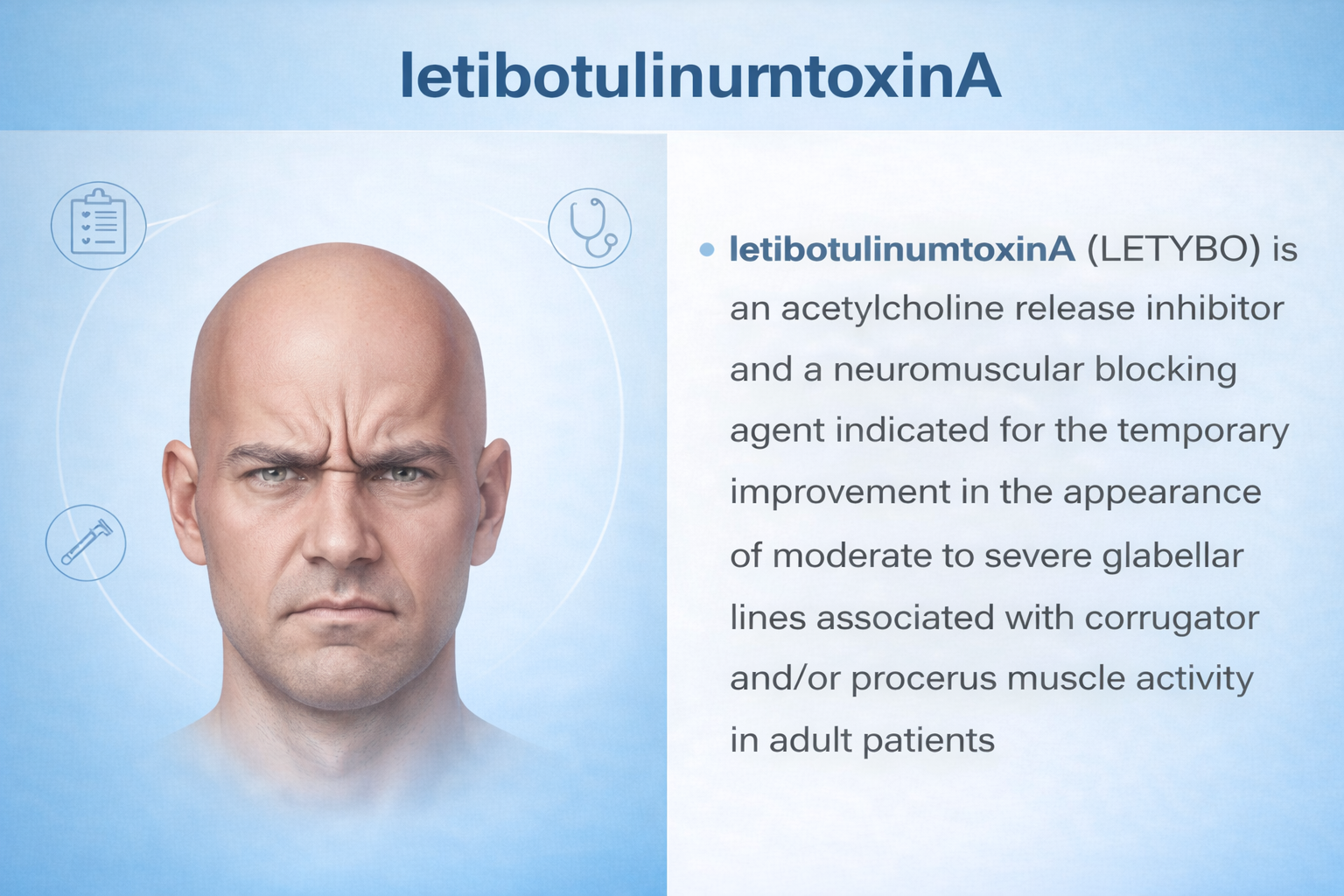
| Established / Proper Name | letibotulinumtoxinA-wlbg |
| Proposed Trade Name | LETYBO |
| Pharmacologic Class | Acetylcholine release inhibitor; neuromuscular blocking agent |
| Molecular Weight | ~900 kDa (noncovalent multimeric complex; 6 proteins) |
| Source Organism | Clostridium botulinum (fermentation) |
| Toxin Type | Botulinum toxin type A |
| Active Ingredient | letibotulinumtoxinA-wlbg |
| Inactive Ingredients | Albumin human; sodium chloride |
| Marketed Name Outside US | Botulax® (Korea; marketed since 2010) |
| US License Number | 2237 |
| Manufacturer | Hugel, Inc., 61-20 Sinbuk-ro, Sinbuk-eup, Chuncheon, 24206 Korea |
| Primary Target | SNAP25 (Synaptosomal-Associated Protein 25) |
| Action | Prevents ACh vesicle membrane fusion; blocks cholinergic NMJ transmission |
| Mechanism (cellular) | Internalization → translocation to neuronal cytosol → SNAP25 cleavage |
| Onset of Effect | Gradual; dose-dependent decrease in muscle function |
| Recovery Mechanism | Neurotoxin degradation + axonal sprouting → muscle reinnervation → slow reversal |
| Preclinical Comparator | Onset and duration of paralysis comparable to onabotulinumtoxinA at all timepoints (3, 7, 14, 21, 28 days) and doses (2, 4, 8 U/animal) in rat model (Study CP-001) |
| FDA-Approved Indication | Temporary improvement in the appearance of moderate to severe glabellar lines associated with corrugator and/or procerus muscle activity in adult patients |
| Population | Adults (18–75 years in trials) |
| Line Severity | Moderate to severe at maximum frown (GLS ≥2) |
| Not Approved For | Spasticity or any conditions other than glabellar lines |
| Pediatric Use | Safety and effectiveness not established in pediatric patients; full waiver granted (extremely low prevalence of glabellar lines in pediatric population) |
| Product (INN) | FDA Approval | Dosing | Pivotal Efficacy (responder rate) | Key Safety |
|---|---|---|---|---|
| BOTOX Cosmetic (onabotulinumtoxinA) | 2002 | 20 U IM; 5 sites × 4 U | Study 1: 61%; Study 2: 46% | Spread of toxin; dysphagia; breathing difficulties |
| Dysport (abobotulinumtoxinA) | 2009 | 50 U IM; 5 sites × 10 U | GL1: 55%; GL2: 52%; GL3: 60% | Spread of toxin; dysphagia; breathing difficulties |
| Xeomin (incobotulinumtoxinA) | 2011 | 20 U IM; 5 sites × 4 U | GL1: 60%; GL2: 48% | Spread of toxin; dysphagia; breathing difficulties |
| Jeuveau (prabotulinumtoxinA-xvfs) | 2019 | 20 U IM; 5 sites × 4 U | EV-001: 67%; EV-002: 70% | Spread of toxin; dysphagia; breathing difficulties |
| LETYBO (letibotulinumtoxinA-wlbg) | 2024 | 20 U IM; 5 sites × 4 U | BLESS I: 47%; II: 49%; III: 65% | Spread of toxin; standard BTX-A warnings |
Source: FDA Medical Review BLA 761225 (Ref ID 4960826), Table 1. Physician’s Inserts from Drugs@FDA.
| Parameter | BLESS I (Letybo / Placebo) | BLESS II (Letybo / Placebo) | BLESS III (Letybo / Placebo) |
|---|---|---|---|
| Randomized | 531 / 177 | 160 / 53 | 266 / 89 |
| Received Treatment | 529 (99.6%) / 175 (98.9%) | 160 (100%) / 53 (100%) | 266 (100%) / 89 (100%) |
| FAS (primary analysis) | 528 / 175 | 160 / 53 | 266 / 89 |
| Completed Double-Blind Phase | 500 (94.2%) / 160 (90.4%) | 147 (91.9%) / 48 (90.6%) | 249 (93.6%) / 84 (94.4%) |
| Completed Entire Study | 456 (85.9%) / 145 (81.9%) | 136 (85.0%) / 43 (81.1%) | 227 (85.3%) / 80 (89.9%) |
Source: FDA Medical Review BLA 761225 (Ref ID 4960826), Table 5. Non-responder imputation for FAS.
| Characteristic | BLESS I Letybo (N=528) / Placebo (N=175) | BLESS II Letybo (N=160) / Placebo (N=53) | BLESS III Letybo (N=266) / Placebo (N=89) |
|---|---|---|---|
| Mean Age (years) | 49.3 / 48.7 | 52.0 / 52.4 | 52.2 / 49.4 |
| Median Age (years) | 49 / 49 | 52.5 / 51 | 53 / 52 |
| Age Range (years) | 19–75 / 21–74 | 27–75 / 29–73 | 21–75 / 22–75 |
| 18–64 years | 462 (87.5%) / 157 (89.7%) | 141 (88.1%) / 45 (84.9%) | 233 (87.6%) / 81 (91.0%) |
| 65–75 years | 66 (12.5%) / 18 (10.3%) | 19 (11.9%) / 8 (15.1%) | 33 (12.4%) / 8 (9.0%) |
| Female | 483 (91.5%) / 155 (88.6%) | 150 (93.8%) / 45 (84.9%) | 248 (93.2%) / 80 (89.9%) |
| Male | 45 (8.5%) / 20 (11.4%) | 10 (6.3%) / 8 (15.1%) | 18 (6.8%) / 9 (10.1%) |
| White | 482 (91.3%) / 153 (87.4%) | 153 (95.6%) / 50 (94.3%) | 236 (88.7%) / 79 (88.8%) |
| Black or African American | 33 (6.3%) / 18 (10.3%) | 3 (1.9%) / 1 (1.9%) | 25 (9.4%) / 7 (7.9%) |
| Asian | 7 (1.3%) / 3 (1.7%) | 2 (1.3%) / 1 (1.9%) | 4 (1.5%) / 1 (1.1%) |
| Not Hispanic or Latino | 497 (94.1%) / 166 (94.9%) | 126 (78.8%) / 45 (84.9%) | 200 (75.2%) / 67 (75.3%) |
| Hispanic or Latino | 25 (4.7%) / 8 (4.6%) | 33 (20.6%) / 7 (13.2%) | 66 (24.8%) / 22 (24.7%) |
| Region: US | 268 (50.8%) / 95 (54.3%) | 160 (100%) / 53 (100%) | 225 (84.6%) / 79 (88.8%) |
| Region: EU | 260 (49.2%) / 80 (45.7%) | 0 / 0 | 41 (15.4%) / 10 (11.2%) |
Source: FDA Medical Review BLA 761225 (Ref ID 4960826), Table 7. EU: Germany and Poland in BLESS I; Austria in BLESS III.
| Characteristic | BLESS I Letybo / Placebo | BLESS II Letybo / Placebo | BLESS III Letybo / Placebo |
|---|---|---|---|
| GLS-I = 3 (Severe) at max frown | 384 (72.7%) / 133 (76.0%) | 112 (70.0%) / 37 (69.8%) | 202 (75.9%) / 67 (75.3%) |
| GLS-I = 2 (Moderate) at max frown | 144 (27.3%) / 42 (24.0%) | 48 (30.0%) / 16 (30.2%) | 64 (24.1%) / 22 (24.7%) |
| GLS-S = 3 (Severe) at max frown | 401 (75.9%) / 121 (69.1%) | 121 (75.6%) / 42 (79.2%) | 196 (73.7%) / 64 (71.9%) |
| GLS-S = 2 (Moderate) at max frown | 127 (24.1%) / 54 (30.9%) | 39 (24.4%) / 11 (20.8%) | 70 (26.3%) / 25 (28.1%) |
| Previous Use of Botulinum Toxin: No | 345 (65.3%) / 116 (66.3%) | 105 (65.6%) / 42 (79.2%) | 169 (63.5%) / 53 (59.6%) |
| Previous Use of Botulinum Toxin: Yes | 183 (34.7%) / 59 (33.7%) | 55 (34.4%) / 11 (20.8%) | 97 (36.5%) / 36 (40.4%) |
Source: FDA Medical Review BLA 761225 (Ref ID 4960826), Table 8. A higher proportion of subjects had severe (74%) vs moderate (26%) glabellar lines. Demographics were generally balanced across treatment groups.
| Design | Randomized, double-blind, placebo-controlled; two-part: double-blind phase + open-label extension |
| Randomization | 3:1 (LETYBO : placebo) at Day 0 (baseline) |
| Double-Blind Phase | Single injection session with evaluations at Weeks 1, 2, 4, 8, and re-evaluation visits (starting Week 12, every 4 weeks) |
| Open-Label Extension | Up to 3 additional retreatments with 20 U LETYBO over 48 weeks; minimum 3-month interval between treatments; up to 4 total treatment cycles |
| Total Study Duration | Up to 60 weeks |
| Treatment Duration | At least 12 weeks per cycle (until retreatment eligibility) |
| Injection Sites | 5 sites: 2 per corrugator supercilii muscle (inferomedial + superior middle), 1 in procerus muscle |
| Dose (active) | 4 Units per site × 5 sites = 20 Units total |
| Volume per Site | 0.1 mL |
| Primary Analysis Population | Full Analysis Set (FAS): all randomized subjects receiving ≥1 injection; ITT principle |
| Supportive Population | Per Protocol Set (PPS): FAS minus significant protocol deviations; ~84–90% Letybo, ~85–91% placebo |
| Statistical Method | Cochran-Mantel-Haenszel (CMH) test stratified by study center; Mantel-Haenszel common risk difference and 95% CI (reviewer-corrected) |
| Missing Data Handling | Primary: non-responder imputation (NRI); Sensitivity: observed values only, LOCF, worst-case imputation |
| GLS Score | Descriptor | Line Severity at Maximum Frown |
|---|---|---|
| 0 — None | Smooth area | No visible lines between the eyebrows |
| 1 — Mild | Shallow lines | One or more thin or shallow lines |
| 2 — Moderate | Medium depth | One or more lines of medium depth |
| 3 — Severe | Deep/pronounced | One or more deep and pronounced lines |
Source: FDA Medical Review BLA 761225 (Ref ID 4960826), Table 4. GLS-I = Investigator assessment; GLS-S = Subject (patient) assessment.
| Study | Design | Population / Country | N | Purpose |
|---|---|---|---|---|
| HG-11-01 | Double-blind, randomized, active-controlled (Botox comparator) | Mod-severe glabellar lines; 18–75 yrs; Korea | 272 | Safety/efficacy (Korea approval); supportive safety data for BLA |
| HG-13-02 (HG-12-02) | Post-marketing surveillance | Mod-severe glabellar lines; 18–65 yrs; Korea | 815 | Additional post-marketing safety data |
Source: FDA Medical Review BLA 761225 (Ref ID 4960826), Table 3. Phase 3 dose selection for BLESS studies was supported by HG-11-01 results demonstrating similar efficacy to onabotulinumtoxinA (Botox) at 20 Units.
| Study | LETYBO Multi-component Responder n/N (%) | Placebo n/N (%) | Treatment Difference (MH) | 95% CI | p-value |
|---|---|---|---|---|---|
| BLESS I | 246/528 (46.6%) | 0/175 (0%) | 47.0% | (42.7%, 51.4%) | <0.0001 |
| BLESS II | 78/160 (48.8%) | 1/53 (1.9%) | 45.1% | (36.0%, 54.3%) | <0.0001 |
| BLESS III | 172/266 (64.7%) | 0/89 (0%) | 65.2% | (59.3%, 71.2%) | <0.0001 |
Source: FDA Medical Review BLA 761225 (Ref ID 4960826), Table 9. Reviewer analysis using Mantel-Haenszel stratified by study center. NRI for missing data. All three studies met pre-specified primary endpoint; results statistically superior to placebo. PI (Ref ID 5337801) reports Newcombe CIs (unstratified); reviewer-corrected MH CIs shown here.
| Component | BLESS I LETYBO / Placebo | BLESS II LETYBO / Placebo | BLESS III LETYBO / Placebo |
|---|---|---|---|
| Investigator Assessment (GLS-I 0 or 1; ≥2-pt improvement) | 348/528 (65.9%) / 1/175 (0.6%) | 120/160 (75.0%) / 1/53 (1.9%) | 209/266 (78.6%) / 1/89 (1.1%) |
| Subject Assessment (GLS-S 0 or 1; ≥2-pt improvement) | 290/528 (54.9%) / 0/175 (0%) | 83/160 (51.9%) / 1/53 (1.9%) | 183/266 (68.8%) / 0/89 (0%) |
Source: FDA Medical Review BLA 761225 (Ref ID 4960826), Table 9. Investigator assessment responder rates were 10–23% higher than subject assessment rates in the LETYBO arm across studies.
| Analysis Method | BLESS I LETYBO / Placebo | BLESS II LETYBO / Placebo | BLESS III LETYBO / Placebo |
|---|---|---|---|
| Primary (NRI) | 46.6% / 0% | 48.8% / 1.9% | 64.7% / 0% |
| Observed Values Only | 47.2% / 0% | 50.6% / 2.0% | 65.2% / 0% |
| LOCF | 47.2% / 0% | 50.6% / 1.9% | 64.7% / 0% |
| Worst-Case Imputation | 46.6% / 4.0% | 48.8% / 9.4% | 64.7% / 3.4% |
Source: FDA Medical Review BLA 761225 (Ref ID 4960826), Tables 11–13. All sensitivity analyses showed consistent results; missing data had limited impact on efficacy conclusions due to large effect size and small proportion of subjects with missing data (0.8–3.8%).
| Secondary Endpoint | BLESS I LETYBO / Placebo | Treatment Diff. (95% CI) | BLESS II LETYBO / Placebo | Treatment Diff. (95% CI) | BLESS III LETYBO / Placebo (exploratory) |
|---|---|---|---|---|---|
| SE1: Multi-component Responder Rate at Week 12 (NRI) | 67/528 (12.7%) / 0/175 (0%) | 12.2% (9.3%, 15.0%); p<0.0001 | 7/160 (4.4%) / 0/53 (0%) | 3.6% (0.6%, 6.6%); p=0.173 (Stop) | 56/266 (21.1%) / 1/89 (1.1%); 19.4% (13.8%, 25.0%) |
| SE2: Multi-component Responder Rate at Week 16 (observed) | 22/501 (4.4%) / 0/159 (0%) | 4.5% (2.6%, 6.3%); p=0.006 | 5/149 (3.4%) / 0/48 (0%) | 2.9% (-0.0%, 5.7%) [exploratory after SE1 stop] | 27/254 (10.6%) / 1/84 (1.2%); 8.6% (4.1%, 13.2%) |
| SE3.1: ≥1-pt improvement at rest (GLS-I; Week 4) | 333/473 (70.4%) / 27/160 (16.9%) | 54.8% (47.7%, 61.9%); p<0.0001 | 95/141 (67.4%) / 3/47 (6.4%) | 58.5% (47.4%, 69.6%) | 163/215 (75.8%) / 8/66 (12.1%); 62.4% (52.8%, 72.0%) |
| SE3.2: ≥1-pt improvement at rest (GLS-S; Week 4) | 412/502 (82.1%) / 17/167 (10.2%) | 72.5% (66.7%, 78.2%); p<0.0001 | 113/148 (76.4%) / 9/52 (17.3%) | 57.7% (44.7%, 70.7%) | 214/255 (83.9%) / 11/82 (13.4%); 69.4% (60.6%, 78.1%) |
| SE4: Multi-component Responder Rate at Week 20 (observed) | 6/503 (1.2%) / 0/158 (0%) | 1.2% (0.2%, 2.2%); p=0.169 (Stop) | 2/148 (1.4%) / 0/48 (0%) | 1.3% (-0.7%, 3.2%) [exploratory] | NA |
Source: FDA Medical Review BLA 761225 (Ref ID 4960826), Table 15. SE3 applicable only for subjects with GLS at rest ≥1 at baseline. Mantel-Haenszel weights stratified by center.
| Subgroup | BLESS I LETYBO / Placebo | BLESS II LETYBO / Placebo | BLESS III LETYBO / Placebo |
|---|---|---|---|
| Age 18–64 years | 222/462 (48.1%) / 0/157 (0%) | 73/141 (51.8%) / 1/45 (2.2%) | 155/233 (66.5%) / 0/81 (0%) |
| Age 65–75 years | 24/66 (36.4%) / 0/18 (0%) | 5/19 (26.3%) / 0/8 (0%) | 17/33 (51.5%) / 0/8 (0%) |
| Female | 230/483 (47.6%) / 0/155 (0%) | 77/150 (51.3%) / 1/45 (2.2%) | 166/248 (66.9%) / 0/80 (0%) |
| Male | 16/45 (35.6%) / 0/20 (0%) | 1/10 (10.0%) / 0/8 (0%) | 6/18 (33.3%) / 0/9 (0%) |
| White | 216/482 (44.8%) / 0/153 (0%) | 75/153 (49.0%) / 1/50 (2.0%) | 157/236 (66.5%) / 0/79 (0%) |
| Black or African American | 22/33 (66.7%) / 0/18 (0%) | 2/3 (66.7%) / 0/1 (0%) | 12/25 (48.0%) / 0/7 (0%) |
| Not Hispanic/Latino | 233/497 (46.9%) / 0/166 (0%) | 60/126 (47.6%) / 0/45 (0%) | 121/200 (60.5%) / 0/67 (0%) |
| Hispanic/Latino | 10/25 (40.0%) / 0/8 (0%) | 18/33 (54.5%) / 1/7 (14.3%) | 51/66 (77.3%) / 0/22 (0%) |
| Botulinum Toxin Naïve | 160/345 (46.4%) / 0/116 (0%) | 49/105 (46.7%) / 1/42 (2.4%) | 106/169 (62.7%) / 0/53 (0%) |
| Previous Botulinum Toxin Use | 86/183 (47.0%) / 0/59 (0%) | 29/55 (52.7%) / 0/11 (0%) | 66/97 (68.0%) / 0/36 (0%) |
| US | 146/268 (54.5%) / 0/95 (0%) | 78/160 (48.8%) / 1/53 (1.9%) | 153/225 (68.0%) / 0/79 (0%) |
| EU | 100/260 (38.5%) / 0/80 (0%) | N/A | 19/41 (46.3%) / 0/10 (0%) |
Source: FDA Medical Review BLA 761225 (Ref ID 4960826), Table 16. Treatment effect for females was higher than males; effect for subjects <65 yrs was higher than ≥65 yrs in all three studies. Small sample sizes in male and ≥65-yr subgroups limit reliable estimation. Results consistent across most subgroups.
| Treatment Cycle | BLESS I (N=704) | BLESS II (N=213) | BLESS III (N=355) | Combined (N=1272) |
|---|---|---|---|---|
| 1st treatment (DB LETYBO + all OL) | 704 (100%) | 213 (100%) | 355 (100%) | 1272 (100%) |
| 3rd study treatment | 616 (93.5%) | 181 (92.8%) | 265 (82.0%) | 1062 (83.5%) |
| 4th study treatment | 464 (70.4%) | 149 (76.4%) | 139 (43.0%) | 752 (59.1%) |
Source: FDA Medical Review BLA 761225 (Ref ID 4960826), Table 17. ISS Population: 1,272 total; 955 DB LETYBO + 317 placebo; 1,177 OL LETYBO. Total BoNT/A-DP exposures at marketed 20U dose: 1,380 subjects (including 134 from HG-11-01). 546 subjects received all 4 treatment cycles.
| Adverse Reaction | LETYBO (N=911) n (%) | Placebo (N=310) n (%) |
|---|---|---|
| Headache* (any) | 17 (2%) | 2 (1%) |
| Brow ptosis** (any) | 3 (<1%) | 0 |
| Eyelid ptosis | 3 (<1%) | 0 |
| Blepharospasm | 2 (<1%) | 0 |
* Includes headache, head discomfort, migraine, and procedural headache. ** Includes brow ptosis and brow heaviness. Source: FDA PI BLA 761225 (Ref ID 5337801), Table 2. Adverse reactions reported in more than one subject in the LETYBO group vs placebo.
| Preferred Term | LETYBO (N=911) n (%) | Placebo (N=310) n (%) |
|---|---|---|
| Any TEAE | 215 (23.6%) | 60 (19.4%) |
| Upper respiratory tract infection* | 47 (5.2%) | 12 (3.9%) |
| Headache† | 31 (4.3%) | 5 (1.6%) |
| Injection site reaction‡ | 11 (1.2%) | 6 (1.9%) |
| Urinary tract infection | 9 (1.0%) | 0 |
* Includes nasopharyngitis, URTI, sinusitis, laryngitis, tonsillitis, pharyngitis, pharyngitis streptococcal. † Includes headache, head discomfort, migraine, procedural headache. ‡ Includes contusion, facial pain, folliculitis, haematoma, injection site pain/bruising/hematoma/pruritus, swelling. Source: FDA Medical Review BLA 761225 (Ref ID 4960826), Table 26.
| Preferred Term | DB: LETYBO (N=911) | DB: Placebo (N=310) | OL Cycle 2 (N=1129) | OL Cycle 3 (N=1020) | OL Cycle 4 (N=722) |
|---|---|---|---|---|---|
| Any Adverse Reaction | 33 (3.6%) | 8 (2.6%) | 28 (2.5%) | 23 (2.3%) | 7 (1.0%) |
| Headache* | 17 (1.9%) | 2 (0.6%) | 15 (1.3%) | 8 (0.8%) | 2 (0.3%) |
| Injection site reaction | 11 (1.2%) | 6 (1.9%) | 5 (0.4%) | 4 (0.4%) | 3 (0.4%) |
Source: FDA Medical Review BLA 761225 (Ref ID 4960826), Tables 28 and 30. Headache AR was more frequent in younger subjects (<65 yrs: 4.6% vs ≥65 yrs: 1.4%) and in treatment-naïve subjects (5.1% vs 2.5% pre-treated). AR incidence did not increase with multiple retreatments.
| Injection Site Reaction | LETYBO (N=911) n (%) | Placebo (N=310) n (%) |
|---|---|---|
| Any injection site reaction | 6 (0.7%) | 2 (0.6%) |
| Injection site pain | 3 (0.3%) | 1 (0.3%) |
| Contusion (bruising) | 2 (0.2%) | 1 (0.3%) |
| Haematoma | 1 (0.1%) | 1 (0.3%) |
| Swelling | 1 (0.1%) | 1 (0.3%) |
| Injection site bruising | 1 (0.1%) | 1 (0.3%) |
| Facial pain | 0 | 1 (0.3%) |
| Folliculitis | 1 (0.1%) | 0 |
| Injection site haematoma | 1 (0.1%) | 0 |
| Injection site pruritus | 1 (0.1%) | 0 |
Source: FDA Medical Review BLA 761225 (Ref ID 4960826), Table 29.
| SAEs in LETYBO group (DB) | 10/911 (1.1%) subjects; none treatment-related |
| SAEs in Placebo group (DB) | 1/310 (0.3%) subject; not treatment-related |
| SAE pattern | All by PT reported for 1 subject except cholecystitis, osteoarthritis, and coronary artery disease (2 subjects each) |
| SAEs in OL period | 21 subjects overall (1.9%); rate decreased with subsequent cycles: Cycle 1: 1.1%, Cycle 2: 1.1%, Cycle 3: 0.7%, Cycle 4: 0.4% |
| Treatment-Related SAEs | None |
| Deaths | None |
| AESI (Preferred Term) | DB: LETYBO (N=911) n (%) | DB: Placebo (N=310) n (%) | OL: LETYBO (N=1129) n (%) |
|---|---|---|---|
| LOCAL SPREAD | |||
| Eyelid ptosis | 3 (0.3%) | 0 | 6 (0.5%) |
| Brow ptosis and heaviness | 3 (0.3%) | 0 | 1 (0.1%) |
| Vision blurred | 1 (0.1%) | 0 | 1 (0.1%) |
| Photophobia | 0 | 0 | 1 (0.1%) |
| Diplopia | 0 | 0 | 1 (0.1%) |
| DISTANT SPREAD | |||
| Bradycardia | 1 (0.1%) | 0 | 0 |
| Dysarthria | 1 (0.1%) | 0 | 0 |
| Constipation | 1 (0.1%) | 0 | 1 (0.1%) |
| Dyspnoea | 0 | 0 | 1 (0.1%) |
| Muscular weakness | 0 | 1 (0.3%) | 0 |
| Dysphagia | 0 | 1 (0.3%) | 0 |
Source: FDA Medical Review BLA 761225 (Ref ID 4960826), Table 21. Total 24 AESIs across studies (excluding 1 subject from BLESS III Site 110). 12 in DB period (10 after LETYBO, 2 after placebo); 12 in OL period. None of the AESIs were considered serious or severe. DB clinical reviewer noted disagreement with investigator causality assessment for several eyelid/brow ptosis events, stating temporal relationship could not rule out treatment-relatedness.
| Preferred Term | DB: LETYBO (N=955) n (%) | DB: Placebo (N=317) n (%) | OL: LETYBO (N=1177) n (%) |
|---|---|---|---|
| Any cardiac disorder | 4 (0.4%) | 1 (0.3%) | 4 (0.3%) |
| Arrhythmia | 1 (0.1%) | 0 | 1 (0.1%) |
| AV block first degree | 1 (0.1%) | 1 (0.3%) | 0 |
| Bradycardia | 1 (0.1%) | 0 | 0 |
| Palpitations | 1 (0.1%) | 0 | 0 |
| Coronary artery disease | 0 | 0 | 2 (0.2%) |
| Acute myocardial infarction | 0 | 0 | 1 (0.1%) |
| Angina unstable | 0 | 0 | 1 (0.1%) |
| Hypertension | 2 (0.2%) | 0 | 10 (0.8%) |
Source: FDA Medical Review BLA 761225 (Ref ID 4960826), Table 23. None of the cardiac events was judged treatment-related; none was consistent with MACE. ECG assessment showed no clinically meaningful differences between groups or QT prolongation.
| Subjects evaluated (Phase 3 pivotal studies) | 1,129 subjects (DB + OL phases) |
| Pre-existing antibodies at Screening/Baseline | 3 subjects (<1%) |
| Antibody development post-treatment | 2 subjects (<1%) — end of study |
| Neutralizing antibodies detected | None (all titer values zero) |
| Impact on efficacy/safety | No apparent association between antibody development and reduced efficacy or adverse events |
| PI-reported ADA incidence (1,195 subjects) | 4 subjects (0.3%) developed antibodies; no neutralizing ADA detected in tested samples |
| Supportive study (HG-11-01; Korea) | No positive antibody samples among 271 subjects; samples collected at Baseline and Week 16 |
| Caveats | Small number of antibody-positive subjects limits definitive conclusions; ADA detection dependent on assay sensitivity/specificity |
Source: FDA Medical Review BLA 761225 (Ref ID 4960826), Section 6.2.1 and Table 2; FDA PI (Ref ID 5337801). PI and medical review differ slightly in the total N reported (1,195 vs 1,129) due to inclusion/exclusion of supportive studies.
| Drug Type | Botulinum toxin type A; 900 kDa noncovalent multimeric complex (6 proteins) |
| Mechanism | Blocks cholinergic transmission at the neuromuscular junction by inhibiting acetylcholine release; cleaves SNAP25 protein |
| Cellular pathway | IM injection → internalization into nerve terminal → translocation to neuronal cytosol → SNAP25 cleavage → prevents ACh vesicle membrane fusion → dose-dependent decrease in muscle function |
| Recovery | Gradual: neurotoxin degradation + axonal sprouting → muscle reinnervation → slow pharmacological reversal |
| Primary pharmacology comparator | Onset and duration of muscle paralysis comparable to onabotulinumtoxinA at all tested timepoints (3–28 days) and doses (2, 4, 8 U/animal) in rat model. No recovery within 4 weeks after injection of either toxin (Study CP-001). |
| Absorption / Bioavailability | Not characterized; systemic exposure undetectable after recommended IM dose |
| Distribution | Not characterized; systemic concentrations undetectable |
| Metabolism | Not characterized |
| Excretion | Not characterized |
| Nonclinical PK | No nonclinical PK evaluations performed; systemic concentrations not detectable at clinically relevant doses by any available bioanalytical methods |
| Formal PD Studies | No formal pharmacodynamic studies conducted in humans |
| Human PD characterization | The pharmacodynamic effects of letibotulinumtoxinA in humans have not been characterized by the Applicant |
| Dose-response | No dose-ranging study conducted; Phase 3 dose (20 U) selected based on supportive study HG-11-01 results (comparable efficacy to onabotulinumtoxinA 20 U) |
| Dose-exposure-response | No pharmacodynamic or pharmacokinetic dose-/exposure-response data available |
| Therapeutic individualization | Not necessary; dose adjustment based on intrinsic factors not required |
| Active Ingredient | letibotulinumtoxinA-wlbg |
| Molecular Weight | ~900 kDa (noncovalent multimeric complex; 6 proteins) |
| Toxin Type | Botulinum neurotoxin type A |
| Source | Clostridium botulinum fermentation |
| Formulation | Sterile, preservative-free, white freeze-dried powder; single-dose vial |
| 50 Units vial excipients | Albumin human (0.25 mg), Sodium chloride (0.45 mg) |
| 100 Units vial excipients | Albumin human (0.5 mg), Sodium chloride (0.9 mg) |
| Reconstituted appearance | Clear, colorless; free of particulate matter |
| Drug Class / Agent | Clinical Concern | Management |
|---|---|---|
| Aminoglycosides | Enhanced neuromuscular blockade | Caution; monitor for excessive neuromuscular weakness |
| Anticholinergic drugs | May heighten systemic anticholinergic effects | Caution; monitor closely |
| Other botulinum neurotoxin products | Cumulative toxin effects; potentiate blockade | Avoid concurrent use or within several months of LETYBO |
| Muscle relaxants | Enhanced neuromuscular weakness | Caution before or after LETYBO administration |
Source: FDA PI BLA 761225 (Ref ID 5337801) §7.
| Study | Species / Duration | Key Findings |
|---|---|---|
| Single dose IM toxicity (Study 05-RA-241-1) | Rat; 6, 30, 150 U/kg | Dose-dependent paralysis, decreased body weight; LD50 = 129.5 U/kg (both sexes). Mortality at 150 U/kg. |
| Single dose IM toxicity (Study 05-DA242) | Beagle dog; 2.5–200 U/kg (escalating) | Minimum lethal dose >200 U/kg in dogs (not appropriate species for botulinum toxin toxicity) |
| 4-week repeat dose IM toxicity (Study 05-RR-243) | Rat; 0, 1.5, 3, 6 U/kg weekly × 4 wks | Paralysis at injection site (hind leg) all dose groups; muscle atrophy; NOAEL <1.5 U/kg/dose (paralysis at all groups) |
| 6-month repeat dose IM toxicity (Study 167857) | Rat; 0, 0.67/3.75, 2.0/7.5, 6.0/15 U/kg monthly | Muscle fiber atrophy/degeneration all dose groups; inflammatory infiltrate; fibrosis; some reversal after 6-month recovery |
| Embryo-fetal development (Study 08-RP-375) | Rat; 0, 1, 4, 8 U/kg/dose; GD 5–16 | Decreased fetal body weight (all doses); ossification delays (mid/high dose). Effects secondary to maternal toxicity. No drug-related malformations. MRHD = 20 U/subject (0.34 U/kg for 60 kg subject); NOAEL not established at ≥1 U/kg (3× MRHD) |
| Carcinogenicity / Genotoxicity | — | Not conducted; not warranted per ICH S6(R1) for biotechnology-derived products |
| Common toxicities | — | Muscle paralysis and atrophy — typical for botulinum neurotoxin type A; no new or unique toxicities |
Source: FDA Medical Review BLA 761225 (Ref ID 4960826), Section 5. No nonclinical PMRs or PMCs recommended.
| Pregnancy (§8.1) | Insufficient data from case reports to identify drug-associated risk. Systemic exposure not assessed (undetectable). Animal data: decreased fetal body weight and skeletal ossification at maternally toxic doses ≥1 U/kg (3× MRHD) in rats — secondary to maternal toxicity, not fetal teratogenicity. Background risk (US general population): birth defects 2–4%; miscarriage 15–20%. |
| Lactation (§8.2) | No data on presence in human or animal milk, effects on breastfed infant, or milk production. Systemic exposure not assessed. Consider developmental and health benefits of breastfeeding. |
| Pediatric Use (§8.4) | Safety and effectiveness not established. Full waiver granted — extremely low prevalence of glabellar lines in pediatric population (age 0–17 years). |
| Geriatric Use (§8.5) | 148 subjects ≥65 years enrolled (12%). No clinically meaningful differences in safety or efficacy vs younger subjects. Insufficient numbers to determine whether older patients respond differently. Subgroup analysis: response rate lower in ≥65 yrs vs 18–64 yrs. |
| Vial Size | Diluent Added | Resulting Concentration |
|---|---|---|
| 50 Units | 1.25 mL | 4 Units / 0.1 mL |
| 100 Units | 2.5 mL | 4 Units / 0.1 mL |
Diluent: Preservative-free 0.9% Sodium Chloride Injection, USP. Source: FDA PI BLA 761225 (Ref ID 5337801), Table 1.
| Needle Size | 30–31 gauge |
| Volume per Injection Site | 0.1 mL (4 Units) |
| Number of Sites | 5 (see PI Figure 1) |
| Corrugator Injections | 2 per corrugator muscle (inferomedial + superior middle of each corrugator); lateral injections ≥1 cm above bony supraorbital ridge |
| Procerus Injection | 1 in mid-line of procerus muscle |
| Safety Distance | Avoid injecting toxin closer than 1 cm above the central eyebrow |
| Syringe Preparation | Draw ≥0.5 mL of reconstituted toxin into sterile syringe; expel air bubbles; remove reconstitution needle; attach 30–31G needle; confirm needle patency |
| Injection Volume Accuracy | Ensure injected volume/dose is accurate; administer in steady, controlled manner |
| Unopened vials — storage | Refrigerator 2°C to 8°C (36°F to 46°F); original carton; protect from light |
| Unopened vials — do not freeze | Do not freeze |
| Reconstituted — storage | Refrigerator 2°C to 8°C in original carton; protect from light; ≤24 hours |
| Reconstituted — do not | Do not freeze reconstituted product |
| NDC (50 Units) | NDC 81165-050-01 (carton of 1 vial) |
| NDC (100 Units) | NDC 81165-100-01 (carton of 1 vial) |
| Patients with neuromuscular disorders (ALS, myasthenia gravis, Lambert-Eaton) | Caution; increased risk of clinically significant effects; monitor for neuromuscular compromise after treatment |
| Patients with pre-existing cardiovascular disease | Caution; reports of arrhythmia and MI with botulinum toxins, some fatal |
| Patients with compromised respiratory function or dysphagia | Caution; more susceptible to dysphagia/dyspnea complications |
| Marked facial asymmetry, surgical facial alterations, ptosis, dermatochalasis, deep scarring, thick sebaceous skin | Use with particular caution; increased risk of suboptimal outcomes or adverse events |
| Cumulative dose with other botulinum toxin indications | Consider cumulative dose when treating glabellar lines if other botulinum toxin products are or have been used for other approved indications |
| Geriatric patients (≥65 years) | No dose adjustment required; 148 subjects ≥65 yrs in trials showed no clinically meaningful differences; limited data preclude definitive conclusions |
| Application Number | BLA 761225 |
| Application Type | BLA 351(a) — full Biologics License Application (original submission) |
| Applicant | Hugel, Inc. |
| IND Number | IND 123178 |
| Initial BLA Submission | 2021 (first review cycle) |
| Resubmission Date | August 31, 2023 |
| PDUFA Goal Date | February 29, 2024 |
| Actual Approval Date | February 29, 2024 |
| Review Division | Division of Dermatology and Dentistry (DDD) |
| Office | Office of Immunology and Inflammation (OII) |
| Office Director (acting) | Nikolay Nikolov, M.D. |
| Division Signatory (ADTR) | Gordana Diglisic, M.D. |
| Cross-Discipline Team Leader | Snezana Trajkovic, M.D. |
| Clinical Reviewer | Tong Li-Masters, M.D., Ph.D. |
| Review Type | Standard review |
| Advisory Committee | Not convened |
| Recommendation | Approval |
| Medical Review Ref ID | 4960826 (original); 5337218 (resubmission) |
| PI Ref ID | 5337801 |
| U.S. License Number | 2237 |
| Overall Benefit-Risk | Favorable for glabellar lines indication. Performance similar to other marketed botulinum toxin A products for the same indication. |
| Efficacy Evidence | Substantial evidence from three adequate and well-controlled Phase 3 trials; consistent primary endpoint results across all three studies (p<0.0001 each) |
| Safety Profile | Consistent with other approved BoNT-A products; generally well tolerated; no treatment-related deaths or SAEs; no new safety signals identified |
| Headache (most common AR) | 2% (LETYBO) vs 1% (placebo); headache rate higher in treatment-naïve and younger subjects |
| Immunogenicity | Low rate of ADA formation (0.3%); no neutralizing antibodies detected; no apparent impact on efficacy or safety |
| Labeling | Standard botulinum toxin warnings and precautions included; label includes relevant safety information for risk management |
| Global Marketing History | Marketed in Korea as Botulax® since 2010; ~16.7 million vials distributed globally (March 2009 – September 2020) across multiple indications; no new safety signals from global post-marketing experience |
| Statistical Issues | None affecting efficacy conclusions |
| Source Documents | Medical Review Ref ID 4960826 (original) / 5337218 (resubmission); PI Ref ID 5337801 |
