Physical Address
304 North Cardinal St.
Dorchester Center, MA 02124
Physical Address
304 North Cardinal St.
Dorchester Center, MA 02124
Clarity in Trials, Confidence in Decisions
Clarity in Trials, Confidence in Decisions
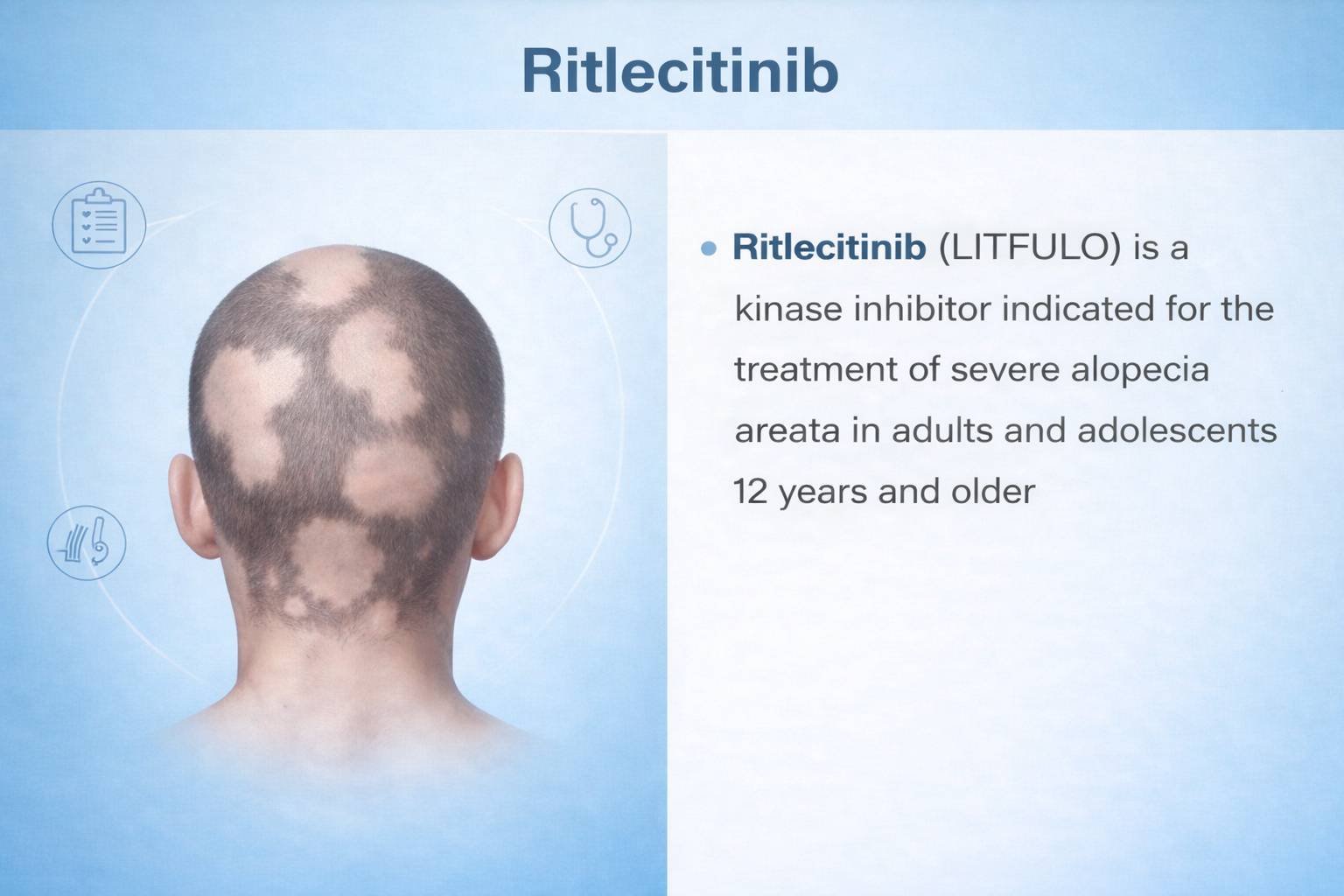
A first-in-class irreversible, covalent inhibitor of JAK3 and the TEC kinase family with a dual mechanism of action — the only approved kinase inhibitor for alopecia areata that targets both JAK3-dependent cytokine signaling and TEC family–dependent immune receptor pathways. Ritlecitinib is indicated for severe alopecia areata (≥50% scalp hair loss) in adults and adolescents ≥12 years, making it the first FDA-approved therapy for adolescents with this condition. Carries a Boxed Warning for serious infections, mortality, malignancy, MACE, and thrombosis consistent with the JAK inhibitor class.
Ritlecitinib is a covalent, irreversible kinase inhibitor that blocks the ATP binding site of JAK3 and the TEC kinase family (ITK, BMX, BTK, TEC, TXK). This dual mechanism distinguishes ritlecitinib from reversible JAK inhibitors (baricitinib, abrocitinib, upadacitinib). JAK3 inhibition blocks cytokine-induced STAT phosphorylation mediated by JAK3-dependent receptors (IL-2Rγ/γc chain cytokines: IL-2, IL-4, IL-7, IL-9, IL-15, IL-21). TEC kinase inhibition blocks signaling of immune receptors dependent on TEC family members, including T cell receptor (TCR) and B cell receptor (BCR) signaling via ITK and BTK, respectively. In alopecia areata, cytotoxic CD8+ T cells and NK cells attack anagen-phase hair follicles after loss of immune privilege; JAK3/TEC pathway inhibition suppresses this immune-mediated follicle destruction. The relevance of inhibition of specific JAK or TEC family enzymes to therapeutic effectiveness is not currently known per the prescribing information.
| Drug (Brand) | NDA / Sponsor | FDA Approval | Dose | Selectivity | SALT ≤20 — Primary Endpoint | Timepoint | Population |
|---|---|---|---|---|---|---|---|
| Ritlecitinib (LITFULO) | NDA 215830 / Pfizer | Jun 23, 2023 | 50 mg QD oral | JAK3 + TEC kinase family (irreversible covalent) | 23.0% vs 1.6% placebo; Δ +21.4% (95% CI 13.4–29.5%); p<0.00001 at α=0.00125 | Week 24 | Adults + adolescents ≥12 yrs; no CYP2C9 restriction; first approved for adolescents |
| Baricitinib (OLUMIANT) | NDA 213049 / Eli Lilly | Jun 13, 2022 | 4 mg QD oral (approved) | JAK1/2 (reversible; selective) | 38.8% (BRAVE-AA1) / 35.9% (BRAVE-AA2) vs 6.2% / 3.3% placebo; Δ +32.6 pp (both trials); p<0.001 | Week 36 | Adults ≥18 only; no CYP2C9 restriction |
| Deuruxolitinib (LEQSELVI) | NDA 217900 / Sun Pharma | Jul 25, 2024 | 8 mg BID oral | JAK1/2 ≥ TYK2 >> JAK3 (reversible; deuterium-substituted) | 29% (AA-1) / 32% (AA-2) vs 1% placebo; Δ +28%/+31% (95% CI 23–33%/25–37%) | Week 24 | Adults ≥18 only; CYP2C9 PGx required; contraindicated in CYP2C9 PMs and with CYP2C9 inhibitors |
Sources: NDA 215830 label, Ref ID 5196496 (Revised 6/2023); Medical Review Ref ID 5195916. Baricitinib: King B et al., N Engl J Med 2022;386:1687–1699, DOI: 10.1056/NEJMoa2110343. Deuruxolitinib: NDA 217900 label, Ref ID 5418989 (Revised 7/2024). Cross-trial comparisons are descriptive — different timepoints (Wk 24 vs Wk 36) and populations preclude direct efficacy ranking. Ritlecitinib is not recommended in combination with other JAK inhibitors, biologic immunomodulators, cyclosporine, or other potent immunosuppressants.
| Parameter | Detail |
|---|---|
| Study type | Randomized, double-blind, placebo-controlled Phase 2b/3 dose-ranging trial; 48-week total (24-week placebo-controlled + 24-week extension) |
| Inclusion criteria | Subjects ≥12 years; ≥50% scalp hair loss due to alopecia areata; no evidence of terminal scalp hair regrowth within prior 6 months; current episode duration ≤10 years |
| Treatment arms (7) | A: Ritlecitinib 200/50 mg QD; B: Ritlecitinib 200/30 mg QD; C: Ritlecitinib 50 mg QD; D: Ritlecitinib 30 mg QD; E: Ritlecitinib 10 mg QD; F: Placebo →200/50 mg QD (Wk 24); G: Placebo → 50 mg QD (Wk 24) |
| Randomization ratio | 2:2:2:2:1:1:1 (arms A:B:C:D:E:F:G); stratified by age (<18 vs ≥18 years) and AT/AU status |
| Primary endpoint (FDA) | SALT ≤20 (≤20% scalp hair loss) at Week 24; overall α = 0.00125 |
| Key secondary endpoint (FDA) | SALT ≤10 (≤10% scalp hair loss) at Week 24 |
| Additional secondary endpoints | SALT ≤20 and SALT ≤10 at Weeks 4, 8, 12, 18, 28, 34, 40, 48; SALT75 (75% improvement) at multiple visits; EBA (eyebrow) and ELA (eyelash) assessments — not included in labeling due to multiplicity control |
| Statistical method | Miettinen-Nurminen method for 95% CI; multiplicity control: graphical procedure (200/50 mg → 50 mg + 200/30 mg via Holm → 30 mg); 10 mg not included |
| Missing data (primary) | Analysis #1: COVID-19 missing excluded; other missing = NRI. Analysis #4 (FDA preferred): COVID-19 missing = MI/MAR; other missing = NRI |
| First subject enrolled | December 3, 2018 |
| Countries | 18 countries; 128 centers; US (31 centers), Europe, Asia, Latin America |
| Completion rate (Wk 48) | Ritlecitinib 50 mg: 86.9%; Placebo: 89.3%; most common reason for discontinuation: withdrawal by participant, physician decision |
| Marketed dose | 50 mg QD (Arm C, without loading dose) — selected by applicant as proposed marketing dose |
| Characteristic | Ritlecitinib 50 mg (N=130) | Placebo (N=131) |
|---|---|---|
| Mean age (range) | 32.4 years (13–70) | 32.0 years (12–71) |
| Age <18 years, n (%) | 18 (13.8%) | 19 (14.5%) |
| Age 18–64 years, n (%) | 109 (83.8%) | 107 (81.7%) |
| Age ≥65 years, n (%) | 3 (2.3%) | 5 (3.8%) |
| Female, n (%) | 71 (54.6%) | 86 (65.6%) |
| White, n (%) | 79 (60.8%) | 94 (71.8%) |
| Black / African American, n (%) | 5 (3.8%) | 4 (3.1%) |
| Asian, n (%) | 43 (33.1%) | 31 (23.7%) |
| Hispanic or Latino, n (%) | 11 (8.5%) | 11 (8.4%) |
| Characteristic | Ritlecitinib 50 mg (N=130) | Placebo (N=131) |
|---|---|---|
| AT/AU (SALT = 100), n (%) | 60 (46.2%) | 60 (45.8%) |
| Not AT/AU, n (%) | 70 (53.8%) | 71 (54.2%) |
| Mean episode duration (range), years | 3.2 (0.18–9.89) | 3.2 (0.04–9.97) |
| Median duration since AA diagnosis | 6.9 years (across all arms) | — |
| Eyebrow involvement — None (EBA=0), n (%) | 59 (45.4%) | 58 (44.3%) |
| Eyebrow involvement — Minimal (EBA=1), n (%) | 31 (23.8%) | 33 (25.2%) |
| Eyebrow involvement — Normal (EBA=3), n (%) | 24 (18.5%) | 24 (18.3%) |
| Eyelash involvement — None (ELA=0), n (%) | 56 (43.1%) | 52 (39.7%) |
| Eyelash involvement — Normal (ELA=3), n (%) | 35 (26.9%) | 34 (26.0%) |
| Mean SALT score (across all arms) | 88.3–93.0 (all groups); 78.3–87.0 (non-AT/AU subgroup) | — |
| Treatment compliance (80–120%) | ~97% | ~97% |
Source: NDA 215830 Medical Review, Ref ID 5195916. AT = alopecia totalis (100% scalp); AU = alopecia universalis (all body hair). Randomization stratified by age (<18 vs ≥18 years) and AT/AU status. Enrollment targets: ~40% AT/AU, ~15% adolescents. Higher proportion of Asian subjects in ritlecitinib 50 mg arm (33%) vs placebo (24%) — consistent efficacy across race subgroups confirmed. Note: some European countries only enrolled adults (18–74 years).
Proportion of subjects with ≤20% scalp hair loss (SALT ≤20) at Week 24. All four higher-dose arms statistically significant vs placebo at prespecified α=0.00125 under graphical multiplicity procedure. Marketed dose is ritlecitinib 50 mg QD (without loading dose).
| Endpoint | Ritlecitinib 50 mg QD (N=130) | Placebo (N=131) | Difference from Placebo (95% CI) | p-value |
|---|---|---|---|---|
| SALT ≤20 at Week 24 (Primary — ≤20% scalp hair loss) | 23.0% (30/130) | 1.6% (2/131) | +21.4% (13.4%, 29.5%) | <0.00001 |
| SALT ≤10 at Week 24 (Key Secondary — ≤10% scalp hair loss) | 13.4% (17/127) | 1.5% (2/131) | +11.9% (5.4%, 18.3%) | Significant |
| Sensitivity analyses (Analysis #1–#4) | 22.3%–23.7% | 1.5%–1.6% | All four prespecified analyses: p<0.000001 — consistent across all missing data methods | |
| Subgroup | Ritlecitinib 50 mg n/N (%) | Placebo n/N (%) | Treatment Difference (95% CI) |
|---|---|---|---|
| Age <18 years | 4/16 (25.0%) | 0/19 (0%) | +25.0% (5.5%, 49.9%) |
| Age 18–64 years | 24/105 (22.9%) | 1/106 (0.9%) | +22.0% (14.4%, 31.0%) |
| Female | 25/69 (36.2%) | 2/85 (2.4%) | +33.8% (22.7%, 46.0%) |
| Male | 4/55 (7.3%) | 0/45 (0%) | +7.3% (−0.9%, 17.3%) |
| White | 18/74 (24.3%) | 1/93 (1.1%) | +23.2% (14.3%, 34.3%) |
| Asian | 10/42 (23.8%) | 1/31 (3.2%) | +20.6% (4.8%, 36.1%) |
| AT/AU at baseline (SALT=100) | 4/55 (7.3%) | 0/60 (0%) | +7.3% (1.0%, 17.3%) |
| Non-AT/AU at baseline | 25/69 (36.2%) | 2/70 (2.9%) | +33.3% (22.4%, 46.6%) |
| Hispanic or Latino | 5/11 (45.5%) | 0/11 (0%) | +45.5% (13.1%, 72.5%) |
| Adverse Reaction | Ritlecitinib 50 mg N=130 | Placebo N=213 | Notes |
|---|---|---|---|
| Headache (incl. migraine) | 14 (10.8%) | 18 (8.5%) | Most common ADR; modest excess over placebo |
| Diarrhea (incl. frequent bowel movements) | 13 (10.0%) | 8 (3.8%) | GI adverse effect; consistent with JAK inhibitor class |
| Acne (incl. acne pustular) | 8 (6.2%) | 10 (4.7%) | Similar to placebo; skin-related |
| Rash (incl. allergic dermatitis) | 7 (5.4%) | 2 (0.9%) | Notable excess vs placebo; monitor; may require interruption |
| Urticaria | 6 (4.6%) | 3 (1.4%) | 8.23 vs 4.03/100 pt-yrs (50 mg vs placebo); median onset 8 wks; median duration 7 days; mostly mild-moderate |
| Folliculitis | 4 (3.1%) | 4 (1.9%) | Minor excess; skin-related |
| Pyrexia | 4 (3.1%) | 0 (0%) | Excess vs placebo; monitor for infection |
| Atopic dermatitis | 3 (2.3%) | 1 (0.5%) | May be comorbid condition in AA population |
| Dizziness | 3 (2.3%) | 3 (1.4%) | Minor excess |
| Blood CPK increased | 2 (1.5%) | 0 (0%) | Monitor CPK at baseline; elevated CPK associated with ritlecitinib vs placebo |
| Herpes zoster | 2 (1.5%) | 0 (0%) | 1.17/100 pt-yrs across all trials; multi-dermatomal HZ reported (opportunistic); recommend prophylactic HZ vaccination pre-treatment |
| Red blood cell count decreased | 2 (1.5%) | 0 (0%) | Monitor CBC; ALC and platelet monitoring required |
| Stomatitis | 2 (1.5%) | 0 (0%) | Oral mucosal adverse effect |
Source: NDA 215830 label, Ref ID 5196496 (Revised 6/2023); Medical Review, Ref ID 5195916. Boxed Warning class warnings derived from ORAL Surveillance study of tofacitinib (another JAK inhibitor) in RA patients; not from ritlecitinib studies. Ritlecitinib safety database: 2,085 subject-years, 1,628 subjects; 1,011 with ≥1 year of exposure. No deaths through Week 48 in ritlecitinib clinical trials.
| PK Parameter | Details |
|---|---|
| Absorption | Absolute oral bioavailability ~64%; Tmax <1 hour; dose-proportional AUC₀-tau and Cmax up to 200 mg; steady state by Day 4 |
| Effect of food | High-fat meal: Cmax reduced ~32%, AUCinf increased ~11% — not clinically significant; administer with or without food |
| Distribution | ~14% plasma protein bound (very low); volume of distribution not specified in label |
| Metabolism | Multiple pathways — no single route >25% of total. Glutathione S-transferase (GST): cytosolic GST A1/3, M1/3/5, P1, S1, T2, Z1 and microsomal GST 1/2/3; CYP enzymes (CYP3A, CYP2C8, CYP1A2, CYP2C9). Ritlecitinib is NOT an inhibitor of CYP2D6, UGTs, GSTs, SULTs, P-gp, or BSEP. |
| Excretion | ~66% in urine; ~20% in feces; ~4% unchanged in urine; >90% eliminated within 48 hours after a single oral dose up to 800 mg |
| Half-life | Mean terminal t½ 1.3–2.3 hours (short PK t½ — once-daily dosing supported by irreversible covalent MOA with pharmacodynamic half-life >> plasma t½) |
| Renal impairment | Severe RI (eGFR <30): AUC 55.2% higher — not clinically significant; no dose adjustment for any renal impairment severity. Not studied in ESRD or renal transplant recipients. |
| Hepatic impairment | Moderate HI (Child Pugh B): AUC +18.5%, Cmax +4.0% — no dose adjustment. Severe HI (Child Pugh C): not studied; not recommended. |
| Intrinsic factors | No clinically relevant PK differences by age (12–73 years), body weight, gender, GST genotype, or race per population PK analysis |
| Interaction | Direction | Magnitude | Recommendation |
|---|---|---|---|
| Strong CYP3A inhibitor (itraconazole) | ↑ ritlecitinib | AUCinf ×1.15 — not clinically significant | No dose adjustment required |
| Strong CYP3A inducer (rifampin) | ↓ ritlecitinib | AUCinf ×0.56 (44% decrease) | Not recommended — may reduce clinical response |
| CYP3A substrate (midazolam) | ↑ substrate | AUCinf ×2.69 (at 200 mg ritlecitinib — 4× approved dose) | Monitor and consider dose adjustment of sensitive CYP3A substrates |
| CYP1A2 substrate (caffeine) | ↑ substrate | AUCinf ×2.65 (at 200 mg — 4× approved dose) | Monitor and consider dose adjustment of sensitive CYP1A2 substrates |
| Oral contraceptives (EE/LNG) | Minor ↓ LNG | AUC LNG ×0.88 — not clinically significant | No clinically significant interaction |
| CYP2B6, CYP2C, OATP1B1/BCRP/OAT3, OCT1 substrates | Minimal | Not clinically significant | No dose adjustment required |
Source: NDA 215830 label, Ref ID 5196496 (Sections 12.1–12.3). Drug interaction studies at 200 mg ritlecitinib (4× approved dose) and 400–800 mg (8× approved dose) used for DDI characterization; CYP3A and CYP1A2 inhibition at the 50 mg approved dose expected to be substantially lower. Ritlecitinib molecular formula (tosylate salt): C₂₂H₂₇N₅O₄S; MW 457.55 g/mol. Chemical name: 1-{(2S,5R)-2-Methyl-5-[(7H-pyrrolo[2,3-d]pyrimidin-4-yl)amino]piperidin-1-yl}prop-2-en-1-one 4-methylbenzene-1-sulfonic acid.
| Population | Guidance |
|---|---|
| Pregnancy (8.1) | Insufficient data in pregnant women. Animal studies: fetotoxicity and malformations at 49× (rats) and 55× MRHD (rabbits) — only at supratherapeutic doses. Pregnancy registry: 1-877-390-2940. No developmental toxicity in rats at 16× MRHD, rabbits at 12× MRHD. |
| Lactation (8.2) | No human breast milk data. Ritlecitinib present in rat milk (milk:plasma AUC ratio 2.2). Do not breastfeed during treatment and for 14 hours after last dose (~6 elimination half-lives) due to serious infection and malignancy risks. |
| Pediatric Use (8.4) | Safety and efficacy established in patients 12–<18 years. 181 pediatric patients enrolled across AA trials; 105 in pivotal placebo-controlled trial. Efficacy consistent with adults. AE profile similar to adults. Not established <12 years. |
| Geriatric Use (8.5) | No dose adjustment for ≥65 years. Only 28 patients ≥65 years in AA trials (none ≥75 years). Caution due to higher general infection risk in elderly; age is risk factor for lower ALC. |
| Hepatic Impairment (8.6) | No dose adjustment for mild (Child Pugh A) or moderate (Child Pugh B) HI. NOT RECOMMENDED in severe HI (Child Pugh C) — not studied. |
| Renal Impairment | No dose adjustment for any renal impairment severity (mild, moderate, severe). Not studied in ESRD or renal transplant recipients. |
| Item | Detail |
|---|---|
| Storage | 20°C–25°C (68°F–77°F); excursions permitted 15°C–30°C (59°F–86°F); keep in original package |
| Capsule description | Size 3, opaque; yellow body printed “RCB 50”; blue cap printed “Pfizer” in black |
| NDC | 0069-0334-28 (28 count bottle in child-resistant HDPE bottle with desiccant canister) |
| Manufacturer | Pfizer Labs, Division of Pfizer Inc., New York, NY 10001 |
| Limitations of use | Not recommended in combination with other JAK inhibitors, biologic immunomodulators, cyclosporine, or other potent immunosuppressants |
Source: NDA 215830 label, Ref ID 5196496, Revised 6/2023. LAB-1469-0.8. Contact Pfizer for adverse reactions: 1-800-438-1985. FDA MedWatch: 1-800-FDA-1088. Pregnancy registry: 1-877-390-2940. Medical information: www.pfizermedinfo.com or 1-800-438-1985.
| Aspect | Detail |
|---|---|
| Application number | NDA 215830 (Orig1s000) |
| Code name | PF-06651600 |
| Applicant | Pfizer, Inc. / Pfizer Labs, Division of Pfizer Inc., New York, NY 10001 |
| Submission / receipt date | June 24, 2022 |
| PDUFA goal date | June 24, 2023 |
| Review completion date | June 22, 2023 |
| Approval date | June 23, 2023 |
| Pivotal trial | Study B7981015 (Phase 2b/3, N=718) — single adequate and well-controlled trial; significance threshold α=0.00125 |
| Primary endpoint met | SALT ≤20 at Week 24: 23.0% (ritlecitinib 50 mg) vs 1.6% (placebo); Δ +21.4%; p<0.00001 — significant at α=0.00125 |
| Statistical standard | Single trial with high internal and external validity; all four pre-specified supplementary analyses concordant; consistent across centers, demographic subgroups, and all missing data methods |
| PREA obligations | Triggered as new active ingredient; post-marketing requirements for pediatric studies in patients 6–<12 years (efficacy/safety studies); pediatric long-term extension study (B7981032) ongoing |
| Reference IDs | 5196496 (label, 6/2023) / 5195916 (multi-disciplinary review) |
| Label identifier | LAB-1469-0.8 (prescribing information); LAB-1525-0.6 (Medication Guide) |
Source: NDA 215830 label, Ref ID 5196496, Revised 6/2023; NDA 215830 Multi-disciplinary Review, Ref ID 5195916, completed June 22, 2023. Reviewed under Division of Dermatology and Dentistry (DDD), Office of Immunology and Inflammation (OII), CDER, FDA. Ritlecitinib is the second JAK inhibitor approved for alopecia areata in the US and the first approved for adolescents 12–<18 years with severe AA.
