Difamilast
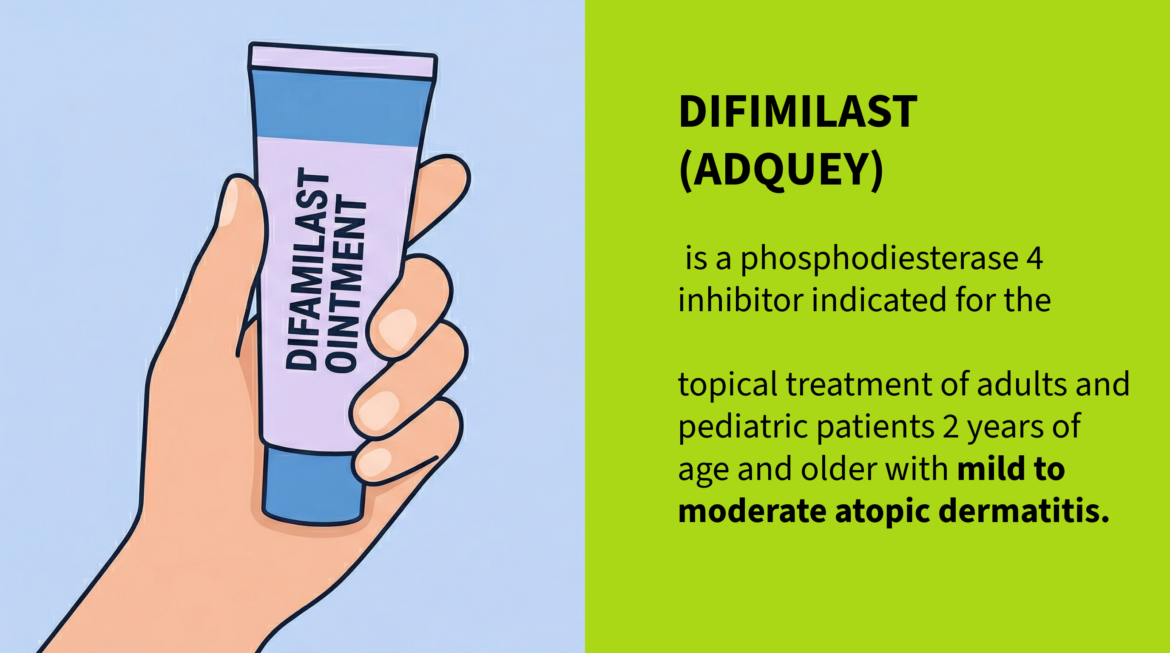
A selective topical phosphodiesterase-4 (PDE-4) inhibitor — the first new molecular entity in its class approved for topical use in mild to moderate atopic dermatitis in adults and pediatric patients ≥2 years of age. Originally developed in Japan by Otsuka Pharmaceutical, ADQUEY was approved in the United States in February 2026 under NDA 219474 based on two pivotal Phase 3 trials conducted in Japan.
Drug Overview
Mechanism of Action
Difamilast is an inhibitor of phosphodiesterase-4 (PDE-4), a major cyclic adenosine monophosphate (cyclic AMP)-metabolizing enzyme. Inhibition of PDE-4 leads to intracellular accumulation of cyclic AMP, which in turn decreases production of various cytokines and chemokines involved in the inflammatory cascade underlying atopic dermatitis. The specific mechanism(s) by which difamilast exerts its therapeutic action in AD is not fully defined.
In atopic dermatitis, disrupted skin barrier function leads to allergen sensitization and dysregulated Th2-predominant immune responses. PDE-4 inhibition attenuates these responses by reducing cAMP degradation in immune cells, downregulating pro-inflammatory mediator production. Difamilast demonstrated efficacy in a mouse model of chronic contact dermatitis.
Competitive Landscape
| Drug | Target | Formulation | Approval | Population |
|---|---|---|---|---|
| Crisaborole (EUCRISA) | PDE-4 Inhibitor | 2% ointment | Dec 2016 | ≥2 years, mild-moderate AD |
| Roflumilast (ZORYVE) | PDE-4 Inhibitor | 0.05%/0.15% cream; 0.3% foam | Jul 2022 / 2023 | ≥2 years (cream), ≥6 years (foam) |
| Tacrolimus (PROTOPIC) | Calcineurin Inhibitor | 0.03%/0.1% ointment | Dec 2000 | ≥2 years; moderate-severe AD |
| Pimecrolimus (ELIDEL) | Calcineurin Inhibitor | 1% cream | Dec 2001 | ≥2 years, mild-moderate AD |
| Difamilast (ADQUEY) ▶ | PDE-4 Inhibitor | 1% ointment | Feb 2026 | ≥2 years, mild-moderate AD |
Key Drug Information
| Parameter | Detail |
|---|---|
| Proprietary Name | ADQUEY™ |
| INN / Generic Name | Difamilast |
| Code Names | OPA-15406 · OPC-271 · MM36 · Moizerto® (Japan) |
| Manufacturer | Acrotech Biopharma Inc., East Windsor, NJ 08520 USA (Made in Canada) |
| Pharmacologic Class | Phosphodiesterase 4 (PDE-4) Inhibitor |
| Dosage Forms | Ointment 1% (white to off-white) · 27 g tube · 85 g tube |
| NDC | 72893-017-08 (27 g) · 72893-017-09 (85 g) |
| Storage | 20°C–25°C; excursions to 15°C–30°C; store away from direct sunlight and moisture |
| Inactive Ingredients | Mineral oil, paraffin, propylene carbonate, white petrolatum, white wax |
| Molecular Formula | C₂₃H₂₄F₂N₂O₅ · MW 446.44 g/mol |
| PI Revision Date | February 2026 |
Clinical Efficacy
at Week 4
Phase 3 Primary Endpoint Results — IGA Success at Week 4
IGA Success Rate Over Time — Phase 3 Pivotal Trials
Phase 2 Dose-Response (Supporting Efficacy)
| Trial | Difamilast 1% (IGA Success) | Difamilast 0.3% | Vehicle | p-value (1% vs vehicle) |
|---|---|---|---|---|
| 271-12-205 (Multinational, ≥10 yr, 8 wk) | 9/43 (20.9%) | 6/41 (14.6%) | 1/37 (2.7%) | 0.017 |
| 271-15-001 (Japan, ≥15 yr, 8 wk) | 15/67 (22.4%) | 10/67 (14.9%) | 6/66 (9.1%) | 0.033 |
| 271-102-00002 (Japan, ≥2 yr, 4 wk) | 10/25 (40.0%) | 9/24 (37.5%) | 2/24 (8.3%) | 0.011 |
Long-Term Open-Label Extension
In open-label trials of both Japanese and US subjects, 857 adult and pediatric subjects continued twice-daily treatment with ADQUEY for up to 52 weeks. Application site adverse reactions that led to drug discontinuation included pain, pruritus, vesicles, blistering, erythema, burning, and contact dermatitis. The safety profile was consistent with the controlled trials.
Safety & Adverse Drug Reactions
Adverse Reactions ≥1% (4-Week Controlled Trials 2 & 3)
| Adverse Reaction | ADQUEY 1% (N=267) | Vehicle (N=265) |
|---|---|---|
| Nasopharyngitis | 16 (6%) | 10 (4%) |
Less Common Adverse Reactions (<1%)
In Trials 2 and 3, less common adverse reactions observed with ADQUEY included: application site folliculitis, contact dermatitis, application site rash, and molluscum contagiosum.
Postmarketing Adverse Reactions
Long-Term Safety (Open-Label, up to 52 Weeks)
The following application site adverse reactions occurred that led to drug discontinuation during the open-label extension studies:
Nonclinical Safety Summary
Use in Special Populations
| Population | Summary |
|---|---|
| Pregnancy | Insufficient human data. Animal data showed embryo-fetal toxicity at subcutaneous doses 263× MRHD (rat) and skeletal variations at 14× MRHD (rabbit). Background risk of major birth defects in US: 2–4%. |
| Lactation | No data on presence in human milk. Difamilast/metabolites excreted in lactating rat milk (milk:blood AUC ratio 5.4). Advise breastfeeding women not to apply directly to nipple/areola. |
| Pediatric (≥2 years) | Safety and effectiveness established. 236 subjects aged 2 to <17 years in controlled trials (119 ADQUEY, 117 vehicle). Not established in children <2 years. |
| Geriatric (≥65 years) | Only 2 subjects ≥65 years in trials. Insufficient data to determine if they respond differently from younger adults. |
| Renal Impairment | No substantial PK differences observed with mild or moderate renal impairment. Effect of severe renal impairment (eGFR <30 mL/min) unknown. |
| Hepatic Impairment | No substantial PK differences with mild or moderate hepatic impairment. Effect of severe (Child-Pugh C) hepatic impairment unknown. |
Pharmacology & Pharmacokinetics
Pharmacokinetics
Absorption — Adult (Mild-Moderate AD)
Absorption — Pediatric (Moderate-Severe AD, Higher BSA)
Metabolism & Major Metabolites
| Metabolite | Pathway | Enzyme |
|---|---|---|
| Metabolite 1 | O-deethylation | CYP3A4 |
| Metabolite 2 | Hydroxylation | CYP1A2 |
| Metabolite 3 | Hydrolysis | Enzymatic |
Drug Interaction Studies
| System | Finding | Clinical Implication |
|---|---|---|
| CYP1A2, CYP2B6, CYP2C8/9/19, CYP2D6, CYP2E1, CYP3A4 Inhibition | Not expected to inhibit at clinically relevant concentrations | No dose adjustments anticipated for co-administered CYP substrates |
| CYP1A2, CYP2B6, CYP2C9, CYP3A4 Induction | Low induction expected | No clinically significant induction anticipated |
| Transporter — BCRP | Difamilast is a BCRP substrate | Potential for interaction with strong BCRP inhibitors |
| Transporter — P-gp, OATP1B1/B3 | Not a substrate | No interaction expected |
| Transporter inhibition (P-gp, BCRP, OAT1/3, OCT1/2, OATP1B1/B3, MATE1/2-K) | Not expected to inhibit at clinical concentrations | No dose adjustments anticipated |
Special Populations
Based on cross-study analyses, no substantial differences in PK were observed based on age (2–70 years), sex, race, or mild/moderate renal or hepatic impairment. The effect of severe renal impairment or severe hepatic impairment on difamilast PK remains unknown.
Dosing & Administration
Administration Instructions
| Parameter | Recommendation |
|---|---|
| Application | Apply a thin layer to affected areas twice daily; rub in completely until no longer visible on skin |
| After application | Wash hands after applying; instruct caregiver to wash hands if applying on behalf of patient |
| Infected skin | Avoid areas of skin that are infected (red, warm, swollen, or painful) |
| Eyes / mouth / vagina | Not for use in or near eyes, mouth, or vagina |
| Breastfeeding | Do not apply directly to nipple or areola; avoid inadvertent infant skin contact with treated areas |
| Renal impairment (mild-moderate) | No dose adjustment required |
| Hepatic impairment (mild-moderate) | No dose adjustment required |
| Severe renal or hepatic impairment | Effect unknown; use with caution |
| Pediatric (<2 years) | Not established — safety and efficacy not studied |
| Geriatric (≥65 years) | Insufficient data — only 2 subjects ≥65 years in trials |
Contraindications
Regulatory History
NDA 219474 — Key Facts
| Parameter | Detail |
|---|---|
| Application Number | NDA 219474 |
| Application Type | 505(b)(1) · Standard review |
| Sponsor / Applicant | Acrotech Biopharma Inc. (East Windsor, NJ) |
| Original Developer | Otsuka Pharmaceutical Co., Ltd. (Japan) |
| Submission Date | February 13, 2025 |
| PDUFA Goal Date | February 13, 2026 |
| Review Completion Date | February 10, 2026 |
| Review Division | Division of Dermatology and Dentistry / Office of Inflammation and Immunology (DDD/OII) |
| Japan Approval | September 27, 2021 (Moizerto® Ointment) · Marketed June 1, 2022 |
| Medical Review Ref ID | 5743278 |
| PI Ref ID | 5745225 |
Regulatory Timeline
FDA Review Assessment
Limitations of Use
The safety and effectiveness of ADQUEY have not been established in pediatric patients younger than 2 years of age.
Avoid applying ADQUEY to areas of skin that are infected. Breastfeeding women should not apply ADQUEY directly to the nipple or areola to minimize potential infant exposure.