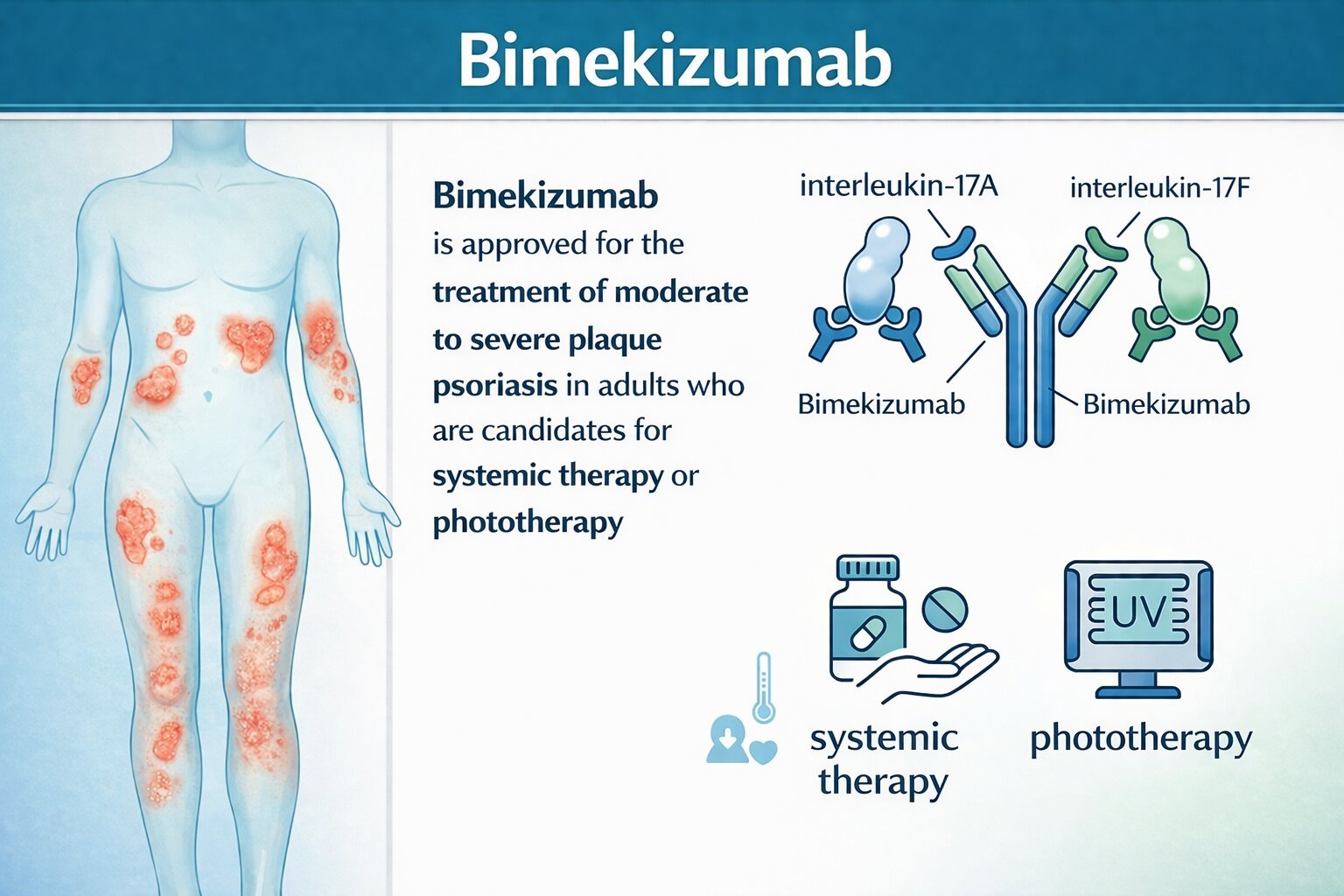
Indication
Moderate to Severe Plaque Psoriasis
Adults eligible for systemic therapy or phototherapy
Mechanism
Dual IL-17A & IL-17F Inhibitor
First-in-class dual cytokine inhibitor; IgG1 mAb
Dose & Schedule
320 mg SC
Q4W ×5 (Wks 0,4,8,12,16) then Q8W; ≥120 kg consider Q4W after Wk 16
Phase 3 Programme
3 Pivotal Trials
PS0008 (vs ADA), PS0009 (vs UST + PBO), PS0013 (vs PBO) — N=1,480 combined
Mechanism of Action: Bimekizumab-bkzx is a humanized IgG1/κ monoclonal antibody with two identical antigen-binding regions that selectively bind IL-17A, IL-17F, and the IL-17AF heterodimer, inhibiting their interaction with the IL-17 receptor complex. IL-17A and IL-17F are naturally occurring cytokines involved in psoriasis-related inflammatory responses; elevated levels are found in lesional psoriatic skin. Inhibition of both cytokines by bimekizumab-bkzx suppresses proinflammatory cytokine and chemokine release.
| Trial (NCT) | Design | N Randomised | Duration | Comparator(s) | Primary Endpoint |
|---|
| PS0008 (NCT03412747) | R, DB, AC, parallel-group (Ps-3) | 478 | 56 weeks | Adalimumab 80 mg then 40 mg Q2W → BKZ at Wk 24 | IGA 0/1 & PASI 90 at Week 16 |
| PS0009 (NCT03370133) | R, DB, PC, AC, parallel-group (Ps-1) | 567 | 52 weeks | Ustekinumab (45 or 90 mg); Placebo → BKZ at Wk 16 | IGA 0/1 & PASI 90 at Week 16 |
| PS0013 (NCT03410992) | R, DB, PC, parallel-group (Ps-2) | 435 | 56 weeks + RW period | Placebo → BKZ at Wk 16 (non-responders) | IGA 0/1 & PASI 90 at Week 16 |
| PS0014 (OLE) | Open-label extension of PS0008/0009/0013 | 1,343 | Up to 144 weeks | None (all receive BKZ) | Safety, long-term efficacy |
| PS0015 (NCT03985943) | R, DB, AC, parallel-group (Ps-4) | 743 | 48 weeks | Secukinumab 300 mg Q4W then Q4W or Q8W | PASI 90 at Week 16 |
| Drug (INN + Brand) | Target | Formulation | US Approval | Approved Population |
|---|
| Secukinumab (COSENTYX) | IL-17A | SC injection | 2015 | Adults, moderate-severe plaque psoriasis |
| Ixekizumab (TALTZ) | IL-17A | SC injection | 2016 | Adults, moderate-severe plaque psoriasis |
| Brodalumab (SILIQ) | IL-17RA | SC injection | 2017 | Adults, moderate-severe plaque psoriasis (REMS) |
| Guselkumab (TREMFYA) | IL-23 (p19) | SC injection | 2017 | Adults, moderate-severe plaque psoriasis |
| Risankizumab (SKYRIZI) | IL-23 (p19) | SC injection | 2019 | Adults, moderate-severe plaque psoriasis |
| Bimekizumab (BIMZELX) ► | IL-17A + IL-17F | SC injection | October 2023 | Adults, moderate-severe plaque psoriasis |
| Parameter | Detail |
|---|
| Proprietary Name | BIMZELX® |
| INN / Generic Name | Bimekizumab-bkzx |
| Code Name | UCB4940 (CDP4940) |
| Manufacturer | UCB, Inc. · 1950 Lake Park Drive, Smyrna, GA 30080 · US License No. 1736 |
| Pharmacologic Class | Humanized interleukin-17A and F antagonist (IgG1/κ monoclonal antibody) |
| Molecular Weight | ~150 kDa |
| Production Method | Recombinant DNA technology in Chinese Hamster Ovary (CHO) cells |
| Dosage Forms & Strengths | 160 mg/mL solution in single-dose prefilled syringe or single-dose prefilled autoinjector (1 mL) |
| NDC | 50474-781-85 (autoinjector, carton of 2) · 50474-780-79 (prefilled syringe, carton of 2) |
| Storage | Refrigerate 2°C–8°C; may store at room temperature ≤25°C for up to 30 days in original carton; do not freeze or shake |
| Inactive Ingredients | Glacial acetic acid (1.23 mg), glycine (16.5 mg), polysorbate 80 (0.4 mg), sodium acetate (2.83 mg), Water for Injection USP (pH 5.1) |
| Boxed Warning | None |
| PI Revision Date | October 2023 |
Trial Summary: Three pivotal trials (PS0008, PS0009, PS0013) enrolled a total of 1,480 subjects. Demographics and baseline disease characteristics were generally balanced across treatment arms within each trial and comparable across trials. Trial PS0009 had a higher proportion of Asian subjects (22%) and lower proportion of White subjects (74%) compared to PS0008 (88% White) and PS0013 (93% White), reflecting differences in study site distribution.
| Parameter | BKZ Q4W (N=321) | Ustekinumab (N=163) | Placebo (N=83) |
|---|
| Age, Mean (SD), years | 45.2 (14.0) | 46.0 (13.6) | 49.7 (13.6) |
| Age, Median | 43.0 | 47.0 | 50.0 |
| Age ≥65 years, n (%) | 34 (11%) | 18 (11%) | 10 (12%) |
| Male, n (%) | 229 (71%) | 117 (72%) | 60 (72%) |
| White, n (%) | 237 (74%) | 120 (74%) | 63 (76%) |
| Asian, n (%) | 71 (22%) | 36 (22%) | 20 (24%) |
| Black or African American, n (%) | 9 (3%) | 3 (2%) | 0 (0%) |
| Weight, Mean (SD), kg | 88.7 (23.1) | 87.2 (21.1) | 89.1 (26.4) |
| Weight ≥100 kg, n (%) | 96 (30%) | 43 (26%) | 23 (28%) |
| Prior Systemic Therapy, Yes, n (%) | 267 (83%) | 132 (81%) | 64 (77%) |
| Baseline IGA 4 — Severe, n (%) | 119 (37%) | 66 (40%) | 28 (34%) |
| Baseline PASI, Mean (SD) | 22.0 (8.6) | 21.3 (8.3) | 20.0 (6.8) |
| Baseline PASI, Median | 19.4 | 18.5 | 17.6 |
| BSA Affected, Mean (SD), % | 27.3 (16.7) | 29.0 (17.1) | 27.0 (16.3) |
| Parameter | BKZ Q4W (N=349) | Placebo (N=86) |
|---|
| Age, Mean (SD), years | 44.5 (12.9) | 43.5 (13.1) |
| Age, Median | 45.0 | 42.0 |
| Age ≥65 years, n (%) | 21 (6%) | 4 (5%) |
| Male, n (%) | 255 (73%) | 58 (67%) |
| White, n (%) | 324 (93%) | 79 (92%) |
| Asian, n (%) | 13 (4%) | 5 (6%) |
| Weight, Mean (SD), kg | 88.7 (20.6) | 91.7 (22.2) |
| Weight ≥100 kg, n (%) | 94 (27%) | 29 (34%) |
| Prior Systemic Therapy, Yes, n (%) | 276 (79%) | 71 (83%) |
| Baseline IGA 4 — Severe, n (%) | 107 (31%) | 24 (28%) |
| Baseline PASI, Mean (SD) | 20.4 (7.6) | 20.1 (7.5) |
| Baseline PASI, Median | 18.0 | 17.8 |
| BSA Affected, Mean (SD), % | 24.6 (15.2) | 24.4 (16.0) |
| Parameter | BKZ Total (N=319) | Adalimumab (N=159) |
|---|
| Age, Mean (SD), years | 44.6 (13.3) | 45.5 (14.3) |
| Male, n (%) | 214 (67%) | 114 (72%) |
| White, n (%) | 280 (88%) | 141 (89%) |
| Asian, n (%) | 23 (7%) | 11 (7%) |
| Weight, Mean (SD), kg | 91.4 (23.0) | 30.5 (22.1)* |
| Prior Systemic Therapy, Yes, n (%) | 228 (71%) | 110 (69%) |
| Baseline IGA 4 — Severe, n (%) | 106 (33%) | 45 (28%) |
| Baseline PASI, Mean (SD) | 20.2 (6.5) | 19.0 (5.9) |
| Baseline PASI, Median | 18.5 | 17.4 |
| BSA Affected, Mean (SD), % | 25.9 (14.2) | 25.0 (14.4) |
Co-Primary Endpoints: The proportion of subjects achieving (i) IGA 0 or 1 (“clear” or “almost clear”) with at least a 2-grade improvement from baseline, and (ii) PASI 90 (≥90% reduction from baseline PASI score), both assessed at Week 16. Statistical framework: NRI for missing data imputation; CMH test stratified by region and prior biologic use; FWER controlled by hierarchical testing.
IGA 0/1 at Week 16
Bimekizumab 320 mg Q4W (N=321)
Treatment difference 79% (95% CI: 73%, 85%) · p <0.001PASI 90 at Week 16
Bimekizumab 320 mg Q4W (N=321)
Treatment difference 80% (95% CI: 74%, 86%) · p <0.001IGA 0/1 at Week 16
Bimekizumab 320 mg Q4W (N=349)
Treatment difference 91% (95% CI: 88%, 95%) · p <0.001PASI 90 at Week 16
Bimekizumab 320 mg Q4W (N=349)
Treatment difference 90% (95% CI: 86%, 93%) · p <0.001| Endpoint | PS0009 BKZ (N=321) | PS0009 PBO (N=83) | PS0013 BKZ (N=349) | PS0013 PBO (N=86) |
|---|
| IGA 0 (“Clear”) at Week 16 | 188 (59%) | 0 (0%) | 243 (70%) | 1 (1%) |
| PASI 100 (Complete Clearance) at Week 16 | 188 (59%) | 0 (0%) | 238 (68%) | 1 (1%) |
| PASI 75 at Week 4 | 77% | 2% | 76% | 1% |
| Scalp IGA 0/1 at Week 16* | 240/285 (84%) | 11/72 (15%) | 286/310 (92%) | 5/74 (7%) |
IGA 0/1 and PASI 90 Response Rates at Week 16 — Trials PS0009 and PS0013
Source: FDA Medical Review BLA 761151 (Ref ID 4982337), Table 18 (RS, NRI). Data extracted verbatim; no estimation.
Design: PASI 90 responders at Week 16 were re-randomised 1:1:1 to bimekizumab 320 mg Q4W, bimekizumab 320 mg Q8W, or placebo (withdrawal). Relapse defined as not achieving PASI 75 response at Week 20 or later during the withdrawal period.
PASI 90 Maintenance at Week 56
BKZ Q4W / Placebo (N=105) IGA 0/1 Maintenance at Week 56
BKZ Q4W / Placebo (N=104) Median time to loss of PASI 90 or IGA 0/1 response after withdrawal: approximately 24 weeks.
PASI 90 Response Rates During Randomised-Withdrawal Period — Trial PS0013 (Weeks 16–56)
Source: FDA Medical Review BLA 761151 (Ref ID 4982337), Figure 18 and Table 28. Week 56 values from Table 28 (87%, 91%, 16%). Intermediate values digitized from Figure 18; reported values at Weeks 16, 56 are exact; intermediate values are approximate from figure.
| PRO Instrument | Finding | Timepoint |
|---|
| Patient Symptom Diary (PSD) — Itch (NRS) | Greater improvement with bimekizumab vs placebo in both PS0009 and PS0013; statistically superior (p <0.001) | Week 16 |
| PSD — Pain (NRS) | Greater improvement with bimekizumab vs placebo in both trials; statistically superior (p <0.001) | Week 16 |
| PSD — Scaling (NRS) | Greater improvement with bimekizumab vs placebo in both trials; statistically superior (p <0.001) | Week 16 |
No Boxed Warning. BIMZELX does not carry a boxed warning. Warnings and precautions apply (see §4.2 below).
Safety Population (Controlled)
839
Subjects in 16-week controlled period, Trials PS0009 + PS0013 (Pool S1)
Long-Term Exposure
1,789
Total subjects treated with bimekizumab across all trials
≥1 Year Exposure
1,073
Subjects exposed to bimekizumab ≥52 weeks
Most Common ADR (≥1%)
Oral Candidiasis
61/670 (9%) vs 0/169 (0%) placebo — key distinguishing signal
- Suicidal Ideation and Behavior (SI/B): Pooled analysis of 16-week placebo-controlled data showed 12/670 (1.8%) bimekizumab-treated vs 1/169 (0.6%) placebo-treated subjects reported passive suicidal ideation on C-SSRS (estimated RR 3.0; 95% CI: 0.39, 22.74). One completed suicide occurred in the OLE after 718 days (no prior psychiatric history). Three suicide attempts also reported. Causal association not established. Advise patients/caregivers to monitor. Call National Suicide and Crisis Lifeline at 988 if changes occur.
- Infections: Infections reported in 36% of bimekizumab vs 23% of placebo subjects through 16 weeks (141.7 vs 84.6 per 100 PY). Serious infections: 0.3% vs 0% placebo. Do not initiate in patients with clinically important active infection until resolved.
- Tuberculosis: Evaluate for TB prior to initiating. Avoid in active TB. Initiate treatment of latent TB before starting bimekizumab. Consider anti-TB therapy if adequate prior treatment cannot be confirmed.
- Liver Biochemical Abnormalities: Transaminase elevations >3× ULN in 1.0% vs 0.6% placebo. Time to onset: 28–198 days. Resolved after discontinuation. Test liver enzymes, ALP, and bilirubin at baseline and periodically. Permanently discontinue if causally associated combined transaminase + bilirubin elevations occur. Avoid in acute liver disease or cirrhosis.
- Inflammatory Bowel Disease: 7 adjudicated new IBD cases (0.12 per 100 PY) in 2,480 subjects (5,830 PY). Avoid in active IBD. Monitor and discontinue if new onset or worsening IBD symptoms occur.
- Immunizations: Complete all age-appropriate vaccinations before initiating therapy. Avoid live vaccines during treatment.
| Adverse Reaction | Bimekizumab 320 mg (N=670) n (%) | Placebo (N=169) n (%) |
|---|
| Upper Respiratory Tract Infections | 102 (15%) | 24 (14%) |
| Oral Candidiasis | 61 (9%) | 0 (0%) |
| Headache | 22 (3%) | 0 (0%) |
| Injection Site Reactions | 19 (3%) | 2 (1%) |
| Tinea Infections | 18 (3%) | 1 (1%) |
| Gastroenteritis | 12 (2%) | 0 (0%) |
| Herpes Simplex Infections | 9 (1%) | 0 (0%) |
| Acne | 8 (1%) | 0 (0%) |
| Folliculitis | 8 (1%) | 0 (0%) |
| Other Candida Infections | 7 (1%) | 1 (1%) |
| Fatigue | 7 (1%) | 0 (0%) |
Suicidal Ideation & Behavior12/670 (1.8%) passive SI on C-SSRS vs 1/169 (0.6%) placebo (RR 3.0; 95% CI: 0.39, 22.74). 1 completed suicide (OLE day 718); 3 suicide attempts. Causal relationship not established. Subjects with active SI/B excluded from trials.
Oral Candidiasis9% (61/670) vs 0% placebo — the most numerically distinct adverse reaction. Includes oral, oropharyngeal, fungal pharyngitis. Generally mild-moderate; mostly manageable without discontinuation.
Liver Biochemical AbnormalitiesTransaminases >3× ULN: 1.0% vs 0.6% placebo. 5 possible/probable DILI cases identified. Time to onset 28–198 days. All resolved after discontinuation. Monitor LFTs at baseline and periodically.
Infections (All)36% (141.7/100 PY) vs 23% (84.6/100 PY) placebo through 16 weeks. Serious infections: 0.3% vs 0%. Long-term (combined periods): 63% (120.4/100 PY); serious 1.5% (1.6/100 PY).
Inflammatory Bowel Disease7 adjudicated new IBD cases (UC, CD, IBD-undetermined) in 2,480 subjects over 5,830 PY (0.12/100 PY). Majority serious; most led to treatment discontinuation.
Immunogenicity (ADA)116/257 (45%) developed anti-bimekizumab antibodies over 52–56 weeks; ~16% neutralising. No identified clinically significant effect on safety or efficacy over 56 weeks.
| Laboratory Finding | Bimekizumab (N=670) | Placebo (N=169) | Notes |
|---|
| Serum transaminases >3× ULN | 1.0% | 0.6% | Time to onset 28–198 days; resolved on discontinuation |
| Population | Summary |
|---|
| Pregnancy | Insufficient human data. Animal study (cynomolgus monkeys, SC doses 20 or 50 mg/kg/week, gestation day 20 to parturition): no maternal toxicity, no treatment-related effects on growth, development, malformations, or neurobehavioural development. NOAEL (maternal and developmental): 50 mg/kg/week (38× MRHD based on mg/kg). IgG crosses placenta — consider delaying live vaccines in exposed infants (minimum 4 months after birth). Pregnancy registry: 1-877-311-8972. |
| Lactation | No data on bimekizumab-bkzx in human or animal milk. Endogenous IgG and monoclonal antibodies are transferred in human milk. Effects on breastfed infant unknown. |
| Pediatric | Safety and effectiveness not established in pediatric patients. |
| Geriatric (≥65 years) | 153/1,789 total subjects were ≥65 years; 18 were ≥75 years. No differences in safety or effectiveness observed vs younger adults; insufficient numbers for definitive conclusions. |
| Body Weight (≥120 kg) | Average plasma concentrations ~30% lower in subjects ≥120 kg vs <120 kg (median 87 kg). Consider 320 mg Q4W after Week 16 for patients ≥120 kg. |
CarcinogenicityNot conducted with bimekizumab-bkzx. No long-term animal carcinogenicity studies available.
GenotoxicityNot conducted with bimekizumab-bkzx.
Reproductive ToxicityNo effects on fertility parameters (reproductive organs, menstrual cycle, sperm analysis) in cynomolgus monkeys subcutaneously administered 200 mg/kg/week for 26 weeks (150× MRHD based on mg/kg). Monkeys were not mated to evaluate fertility.
Developmental ToxicityPre- and postnatal study in cynomolgus monkeys: NOAEL 50 mg/kg/week SC (38× MRHD). No adverse effects on growth, development, malformations, immunotoxicology, or neurobehavioural development in mothers or infants.
Peak Concentration (Cmax)
25 μg/mL
Median (range 12–50 μg/mL) in adults with moderate-severe plaque psoriasis; reached in 3–4 days
Bioavailability (%F)
70%
Absolute bioavailability following SC administration in healthy subjects
Volume of Distribution (Vss)
11.2 L
Median Vss at steady state
Terminal Half-Life (t½)
23 days
Mean terminal elimination half-life
Clearance (CL/F)
0.337 L/day
Median; 32.7% CV; dose-independent clearance
PK Linearity
Dose-proportional
Over 64–480 mg range (0.2–1.5× approved dose) following SC administration
§5.1 Absorption
Absolute bioavailability of bimekizumab-bkzx was 70% in healthy subjects following subcutaneous administration. Median Cmax of 25 μg/mL (range 12–50 μg/mL) reached in 3–4 days. Dose-proportional PK demonstrated over 64–480 mg range. No food effect data available (SC administration; food effect not applicable).
§5.2 Distribution
Median volume of distribution at steady state was 11.2 L, consistent with predominantly extravascular distribution expected for a large IgG1 monoclonal antibody. Protein binding data not reported in the PI or Medical Review for this molecule.
§5.3 Metabolism & Elimination
| Parameter | Detail |
|---|
| Metabolic Pathway | Expected to be degraded into small peptides by catabolic pathways, consistent with other IgG1 monoclonal antibodies |
| CYP450 Involvement | Bimekizumab is not metabolized by CYP450 enzymes; however, treatment may modulate cytokine levels which can alter CYP450 enzyme formation (see Drug Interactions) |
| Primary Excretion Route | Not applicable (protein catabolism); no data on renal or fecal excretion of intact molecule |
| Terminal Half-Life | Mean 23 days; clearance independent of dose |
§5.5 Special Population PK
| Population | Effect on Bimekizumab PK | Recommendation |
|---|
| Age (≥18 years) | No significant differences in PK observed based on age | No dose adjustment |
| Body Weight ≥120 kg | Average plasma concentrations ~30% lower vs <120 kg (median 87 kg) | Consider 320 mg Q4W after Week 16 |
| Renal Impairment | No dedicated studies; not expected to affect PK of a mAb (not renally cleared as intact protein) | Not reported |
| Hepatic Impairment | No dedicated studies | Not reported |
§5.6 Drug–Drug Interactions
CYP450 Substrate Interaction: The formation of CYP450 enzymes can be altered by elevated cytokine levels (e.g., IL-1, IL-6, IL-10, TNFα, IFN) during chronic inflammation. Initiation or discontinuation of bimekizumab may modulate serum cytokine levels. For patients receiving narrow therapeutic index CYP450 substrates (e.g., warfarin, cyclosporine), monitor for effect or drug concentration upon initiation or discontinuation and consider dosage modification of the CYP450 substrate. No formal clinical drug interaction studies have been conducted with bimekizumab-bkzx.
§5.7 Mechanism of Action
Bimekizumab-bkzx is a humanized IgG1/κ monoclonal antibody with two identical antigen-binding regions that selectively bind to human IL-17A, IL-17F, and the IL-17AF heterodimer, inhibiting their interaction with the IL-17 receptor complex. IL-17A and IL-17F are naturally occurring pro-inflammatory cytokines involved in inflammatory and immune responses; both are elevated in lesional psoriatic skin. Bimekizumab-bkzx inhibits the release of downstream proinflammatory cytokines and chemokines from keratinocytes and other cells. The dual neutralisation of IL-17A and IL-17F distinguishes bimekizumab from IL-17A-only inhibitors (secukinumab, ixekizumab).
§5.8 Pharmacodynamics
Elevated levels of IL-17A and IL-17F are found in lesional psoriatic skin. Bimekizumab-bkzx exposure-response relationships to serum biomarkers, including IL-17A and IL-17F, and the time course of pharmacodynamic responses are not fully characterised per the PI. Regarding immune response to non-live vaccines: healthy subjects who received a single 320 mg dose of bimekizumab two weeks prior to inactivated seasonal influenza vaccination had similar antibody responses compared to individuals who did not receive bimekizumab. Avoid live vaccines during treatment.
Approved Dose
320 mg SC
Two 160 mg injections per dose at different anatomical sites
Route
Subcutaneous
Thigh, abdomen, or back of upper arm (HCP/caregiver only for upper arm)
Initial Frequency
Q4W ×5
Weeks 0, 4, 8, 12, and 16
Maintenance Frequency
Q8W
After Week 16; Q4W if weight ≥120 kg
Standard Dosing
- Loading / induction: 320 mg SC at Weeks 0, 4, 8, 12, and 16
- Maintenance: 320 mg SC every 8 weeks (Q8W) after Week 16
- Each 320 mg dose = two separate 160 mg SC injections at different anatomical sites
- No loading dose escalation required
Dose Modifications
- Body weight ≥120 kg: Consider 320 mg Q4W after Week 16 (plasma concentrations ~30% lower in this group)
- Renal impairment: No dose adjustment recommended (not renally excreted; no dedicated studies)
- Hepatic impairment: No dose adjustment recommended (no dedicated studies)
- Age: No dose adjustment based on age (≥18 years)
- Paediatric: Not established (<18 years)
Preparation & Administration
- Remove from refrigerator 30–45 minutes before injection to reach room temperature (keep in carton, protect from light)
- Visually inspect: solution should be clear to slightly opalescent, colourless to pale brownish-yellow; discard if cloudy, discoloured, or contains particles
- Rotate injection sites between abdomen, thigh, or back of upper arm (HCP/caregiver for upper arm)
- Do not inject within 2 inches of navel or into tender, bruised, red, hard, thick, scaly, or psoriasis-affected skin
- Each autoinjector/syringe is single-dose; discard after use
Missed Dose
- Administer missed dose as soon as possible
- Resume dosing at regular scheduled time thereafter
- Do not double dose
None. There are no contraindications listed in the approved prescribing information for BIMZELX (bimekizumab-bkzx). Source: FDA Prescribing Information BLA 761151 (Ref ID 5262329), Section 4.
Pre-treatment evaluations required before initiating bimekizumab: (1) Evaluate for tuberculosis infection; (2) Test liver enzymes, alkaline phosphatase, and bilirubin; (3) Complete all age-appropriate vaccinations per current immunisation guidelines; (4) Assess history of severe depression or suicidal ideation/behaviour — weigh risks and benefits; (5) Do not initiate in patients with active clinically important infection.
| Interacting Drug/Class | Mechanism | Clinical Recommendation |
|---|
| Narrow therapeutic index CYP450 substrates (e.g., warfarin, cyclosporine) | Bimekizumab may modulate serum cytokine levels → alters CYP450 enzyme formation → potential change in substrate exposure | Monitor for therapeutic effect or drug concentration upon initiation or discontinuation; consider dosage modification of CYP450 substrate |
| Live vaccines | Immunosuppression may reduce vaccine efficacy and increase risk of infection from live attenuated strains | Avoid live vaccines during bimekizumab treatment; complete before initiating |
| Parameter | Recommendation |
|---|
| Self-injection training | First injection must be performed under guidance of a qualified HCP; patients may self-inject after proper training |
| Autoinjector technique | Hold at 90° to skin, press firmly, wait for 1st click (injection begins), then 2nd click (~15 seconds); yellow indicator confirms full dose; do not lift during injection |
| Prefilled syringe technique | Insert at 45° angle, push plunger fully; lift thumb to retract needle automatically |
| Site rotation | Use different anatomical sites for each of the two injections per dose; do not reuse same site in consecutive doses |
| Sharps disposal | Place used autoinjector/syringe immediately in FDA-cleared sharps container; do not recap; do not dispose in household trash |
| Parameter | Detail |
|---|
| Application Number | BLA 761151 |
| Application Type | BLA 351(a) — Original + Resubmission after Complete Response |
| Applicant | UCB, Inc. |
| Code Name | UCB4940 (CDP4940) |
| Original BLA Submission | July 15, 2020 |
| Complete Response Letter (CRL) | May 12, 2022 — GMP deficiencies at UCB Braine Drug Product Manufacturing Facility (FEI: 3003909356) |
| BLA Resubmission Date | November 21, 2022 |
| PDUFA Goal Date | May 21, 2023 |
| Review Completion Date | October 16, 2023 |
| FDA Approval Date | October 2023 |
| Review Type | Standard |
| Breakthrough Therapy Designation | Not reported in Medical Review |
| Review Division | Division of Dermatology and Dentistry / Office of Immunology and Inflammation |
| Advisory Committee | Not reported in Medical Review |
| Medical Review Ref IDs | 5261174 (Resubmission) · 4982337 (Original BLA) |
| PI Ref ID | 5262329 |
~2014–2018
Phase 1 & Phase 2 Development
Phase 1 first-in-human (single and multiple dose), dose-ranging, and Phase 2 trials (PS0010, PS0011, PS0016, PS0018) establish dose-response relationship and support 320 mg Q4W for Phase 3.
2018–2020
Phase 3 Pivotal Trials Conducted
Trial PS0008 (vs adalimumab), PS0009 (vs ustekinumab + placebo), and PS0013 (vs placebo with randomised withdrawal) all enrolled and completed. All trials met co-primary endpoints (IGA 0/1 and PASI 90 at Week 16, p <0.001).
July 15, 2020
Original BLA 761151 Submitted
UCB, Inc. submits original BLA for bimekizumab (BIMZELX) for moderate to severe plaque psoriasis in adults.
May 12, 2022
Complete Response Letter (CRL) Issued
FDA issued CRL due to Good Manufacturing Practice (GMP) deficiencies identified during inspection of the UCB Braine Drug Product Manufacturing Facility (FEI: 3003909356) by OPMA/DBM. Product not approvable until GMP issues resolved. Product not marketed in the US at this time.
August 17, 2022
Type A End of Review Meeting
FDA agreed applicant’s proposed data package for GMP remediation appeared adequate. UCB also proposed to include new safety data from OLE trial PS0014 and new Phase 3b active comparator trial PS0015 (vs secukinumab, 743 subjects). Resubmission classified as Class 2 resubmission due to substantial new safety data.
November 21, 2022
BLA Resubmission Filed (Class 2)
Resubmission addresses GMP deficiencies and includes new safety data from PS0014 (OLE, N=1,343) and PS0015 (vs secukinumab, N=743). New data triggered identification of SI/B safety signal.
June 2 & 13, 2023
REMS Oversight Committee (ROC) Meetings
Convened to evaluate potential SI/B risk (new completed suicide + 3 suicide attempts in OLE data; nearly 3-fold higher passive SI on C-SSRS vs placebo). ROC advised on communicating SI/B risk via Warnings & Precautions and Medication Guide. REMS not required.
July 19, 2023
Medical Policy & Programme Review Council (MPPRC) Meeting
Provided advice regarding SI/B risk communication strategy in labelling for healthcare providers and patients.
October 2023
FDA Approval — BIMZELX® (bimekizumab-bkzx)
Approved for the treatment of moderate to severe plaque psoriasis in adults who are candidates for systemic therapy or phototherapy. SI/B risk described in Warnings & Precautions (§5.1), ADRs (§6.1), and Medication Guide (§17). No Boxed Warning. No contraindications.
Suicidal Ideation & Behavior (SI/B) — New Safety SignalNew OLE data (completed suicide + 3 attempts + neuropsychiatric AEs) prompted re-evaluation. Re-analysis of C-SSRS data across 3 Phase 3 trials found ~3-fold higher passive SI with bimekizumab vs placebo/active comparator (1.7% vs 0.6%). Resolution: SI/B risk conveyed in Warnings & Precautions and Medication Guide. REMS not required. Study population excluded highest-risk subjects (active SI/B, recent suicide attempt, severe depression).
GMP Deficiencies — Manufacturing (CRL Reason)Initial BLA issued CRL due to GMP deficiencies at UCB Braine Drug Product Manufacturing Facility (Belgium) identified during FDA inspection. Resolution: Applicant submitted complete response addressing manufacturing deficiencies; facility compliance confirmed during resubmission review cycle, enabling approval.
Drug-Induced Liver Injury (DILI)5 subjects identified as possible/probable DILI by DILI team (Division of Hepatology and Nutrition) and Applicant’s Hepatology Assessment Committee. No fatalities or liver transplants. Transaminases >3× ULN in 1.0% vs 0.6% placebo. Resolution: Liver Biochemical Abnormalities included in Warnings & Precautions (§5.4); mandatory baseline and periodic LFT monitoring required.
Candidiasis SignalOral candidiasis in 9% of bimekizumab vs 0% placebo — far more frequent than comparators. Generally mild-to-moderate; did not typically require treatment discontinuation. Resolution: Included in ADR table and patient counselling; no dose modification required. Biologically expected from dual IL-17A/F inhibition (IL-17 important for mucosal defence).
PMR Summary: Postmarketing requirements have been established as conditions of approval, including paediatric studies under PREA and ongoing pharmacovigilance for SI/B.
| Domain | Requirement |
|---|
| Paediatric Studies (PREA) | Safety and efficacy data required in paediatric patients; not established at time of approval |
| Suicidal Ideation & Behavior | Ongoing pharmacovigilance monitoring; updated labelling and Medication Guide communicate SI/B risk to HCPs and patients |
| Pregnancy Registry | OTIS AutoImmune Diseases Study — 1-877-311-8972 or mothertobaby.org/pregnancy-studies/; monitors outcomes in women exposed to bimekizumab during pregnancy |
| Long-term Liver Safety | Continued monitoring and reporting of liver biochemical abnormalities per routine pharmacovigilance |
| Domain | Note |
|---|
| Benefit-Risk Conclusion | FDA review team concluded: “The benefit-risk of bimekizumab is favorable in the proposed population with appropriate labeling.” (FDA Medical Review BLA 761151, Ref ID 5261174) |
| Indication Approved vs Proposed | Indication approved as proposed: “treatment of moderate to severe plaque psoriasis in adults who are candidates for systemic therapy or phototherapy.” No narrowing of indication by FDA. |
| Labelling Negotiation — SI/B | SI/B warning in Warnings & Precautions (§5.1), ADRs (§6.1), and Medication Guide. No Boxed Warning assigned despite signal. Causal association explicitly noted as “not established” in labelling. |
| Immunogenicity Labelling | 45% ADA incidence at 52–56 weeks; ~16% neutralising; no identified clinically significant impact on safety or efficacy. Stated in PI §12.6. |
| Source Documents | FDA Medical Review BLA 761151 Ref IDs: 5261174 (Resubmission, October 2023), 4982337 (Original BLA, May 2022). FDA PI Ref ID: 5262329 (October 2023). |