Tralokinumab-ldrm
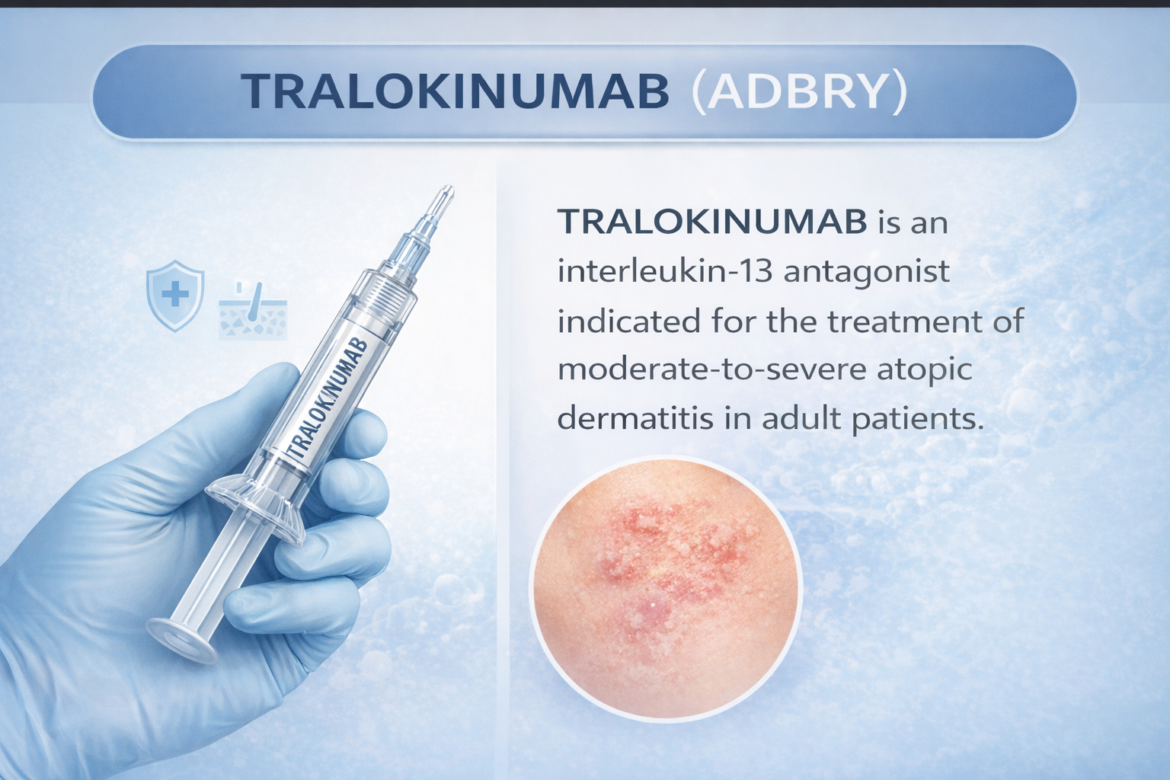
A fully human IgG4 monoclonal antibody that selectively neutralizes interleukin-13 (IL-13), a key Th2 cytokine driving atopic dermatitis. The first selective IL-13 antagonist approved in the US — and the second systemic biologic for moderate-to-severe AD — based on three pivotal Phase 3 trials (ECZTRA 1, ECZTRA 2, and ECZTRA 3).
Drug Overview
BLA 761180Mechanism of Action
Tralokinumab-ldrm is a human IgG4 monoclonal antibody that specifically binds human interleukin-13 (IL-13) and inhibits its interaction with the IL-13 receptor α1 and α2 subunits (IL-13Rα1 and IL-13Rα2). IL-13 is a key cytokine of the Type 2 (Th2) immune response. By blocking the IL-13Rα1/IL-4Rα receptor complex, tralokinumab inhibits IL-13–induced downstream signaling, proinflammatory cytokine and chemokine release, and IgE production — all central to the pathophysiology of atopic dermatitis.
Pharmacodynamic Biomarkers
Drug Identity
| Generic Name | Tralokinumab-ldrm |
| Brand Name | ADBRY™ |
| Drug Class | Interleukin-13 (IL-13) antagonist; fully human IgG4 monoclonal antibody |
| Antibody Isotype | Human IgG4; 1,326 amino acids; molecular weight ~147 kDa |
| Production | Mouse myeloma (NS0) cells by recombinant DNA technology |
| Sponsor / Manufacturer | LEO Pharma A/S (Ballerup, Denmark) · Distributed by LEO Pharma Inc. (Madison, NJ, USA) |
| Formulation | 150 mg/mL sterile, preservative-free solution · Single-dose prefilled syringe with needle guard (27G × ½ inch, siliconized Type-1 glass) · pH ~5.5 |
| Inactive Ingredients | Acetic acid (0.3 mg), polysorbate 80 (0.1 mg), sodium acetate trihydrate (6 mg), sodium chloride (5 mg), water for injection |
| NDC Numbers | 50222-346-02 (2-syringe carton) · 50222-346-04 (4-syringe multipack) |
| BLA / Approval | BLA 761180 · Initial US Approval December 2021 · 351(a) NME |
Competitive Landscape
| Drug | Target | Approval Date | Dose | Population |
|---|---|---|---|---|
| Dupilumab (DUPIXENT) | IL-4Rα (IL-4/IL-13 dual) | March 28, 2017 | 300 mg Q2W SC | Adults & pediatric ≥6 months |
| Tralokinumab (ADBRY) | IL-13 selective | December 2021 | 300 mg Q2W SC | Adults only |
| Lebrikizumab (EBGLYSS) | IL-13 selective | September 13, 2023 | 250 mg Q2W SC | Adults & adolescents ≥12 years |
Sources: FDA prescribing information (BLA 761180) and FDA Medical Review (Ref ID 4909926).
Clinical Efficacy
ECZTRA 1 · ECZTRA 2 · ECZTRA 3ECZTRA 1 — Primary Endpoint Results
NCT03131648 · MONOTHERAPY · 52 WEEKSECZTRA 2 — Primary Endpoint Results
NCT03160885 · MONOTHERAPY · 52 WEEKSECZTRA 3 — Primary Endpoint Results
NCT03363854 · COMBINATION WITH TCS · 32 WEEKSKey Secondary & Maintenance Endpoints
| Endpoint | ECZTRA 1 (ADBRY) | ECZTRA 2 (ADBRY) | ECZTRA 3 (ADBRY+TCS) |
|---|---|---|---|
| Pruritus NRS ≥4-point ↓ at Week 16 | 20% vs. 10% pbo | 25% vs. 9% pbo | 46% vs. 35% pbo+TCS |
| IGA 0/1 maintained at Week 52 (Q2W arm) | 51% | 60% | 89% at Week 32 |
| IGA 0/1 maintained at Week 52 (Q4W arm) | 39% | 50% | 76% at Week 32 |
| EASI-75 maintained at Week 52 (Q2W arm) | 60% | 57% | 92% at Week 32 |
| EASI-75 maintained at Week 52 (Q4W arm) | 49% | 55% | 90% at Week 32 |
| EASI-75 maintained at Week 52 (Placebo arm) | 33% | 20% | — |
Maintenance analyses restricted to Week 16 responders re-randomized at Week 16. ECZTRA 3 continuation period 16–32 weeks. All analyses: CMH test stratified by region and baseline IGA. Non-responders/rescue medication recipients counted as non-responders. TCS = mometasone furoate 0.1% cream as needed.
Baseline Demographics
TABLE 12 · ECZTRA-1, ECZTRA-2, ECZTRA-3 (FAS)| Parameter | ECZTRA 1 | ECZTRA 2 | ECZTRA 3 (+TCS) | |||
|---|---|---|---|---|---|---|
| ADBRY Q2W (N=601) | Placebo (N=197) | ADBRY Q2W (N=577) | Placebo (N=193) | ADBRY+TCS (N=243) | Placebo+TCS (N=123) | |
| Sex | ||||||
| Male, n (%) | 350 (58%) | 122 (62%) | 347 (60%) | 108 (56%) | 120 (49%) | 83 (67%) |
| Female, n (%) | 251 (42%) | 75 (38%) | 230 (40%) | 85 (44%) | 123 (51%) | 40 (33%) |
| Age (years) | ||||||
| Mean (SD) | 38.6 (13.7) | 39.3 (15.3) | 36.9 (14.7) | 34.8 (14.0) | 39.1 (14.7) | 37.5 (14.8) |
| Median | 37 | 36 | 34 | 29 | 37 | 34 |
| Range | 18–92 | 18–82 | 18–86 | 18–80 | 18–79 | 18–78 |
| 18–64 years, n (%) | 572 (95%) | 183 (93%) | 548 (95%) | 186 (96%) | 231 (95%) | 115 (94%) |
| 65–84 years, n (%) | 28 (5%) | 14 (7%) | 28 (5%) | 7 (4%) | 12 (5%) | 8 (6%) |
| ≥85 years, n (%) | 1 (<1%) | 0 | 1 (<1%) | 0 | 0 | 0 |
| Race | ||||||
| White, n (%) | 424 (71%) | 137 (70%) | 370 (64%) | 123 (64%) | 194 (80%) | 81 (66%) |
| Asian, n (%) | 120 (20%) | 40 (20%) | 154 (26%) | 52 (26%) | 17 (7%) | 24 (19%) |
| Black / African American, n (%) | 41 (7%) | 17 (9%) | 31 (5%) | 9 (5%) | 22 (9%) | 12 (10%) |
| Other / Not reported | 16 (3%) | 3 (2%) | 22 (4%) | 9 (5%) | 10 (4%) | 6 (5%) |
Missing race data for 5 subjects in ECZTRA-1 (2 ADBRY, 2 placebo). Abbreviations: FAS, full analysis set; Q2W, every 2 weeks; TCS, topical corticosteroids. Source: FDA Statistical Reviewer analysis, Table 12, BLA 761180 (Ref ID: 4784656).
Baseline Disease Characteristics
TABLE 13 · ECZTRA-1, ECZTRA-2, ECZTRA-3 (FAS)| Characteristic | ECZTRA 1 | ECZTRA 2 | ECZTRA 3 (+TCS) | |||
|---|---|---|---|---|---|---|
| ADBRY Q2W (N=601) | Placebo (N=197) | ADBRY Q2W (N=577) | Placebo (N=193) | ADBRY+TCS (N=243) | Placebo+TCS (N=123) | |
| IGA Score at Baseline | ||||||
| IGA 3 — Moderate, n (%) | 296 (49%) | 95 (48%) | 296 (51%) | 93 (48%) | 127 (52%) | 64 (52%) |
| IGA 4 — Severe, n (%) | 305 (51%) | 102 (52%) | 281 (49%) | 100 (51%) | 116 (48%) | 59 (48%) |
| EASI Score at Baseline | ||||||
| Mean (SD) | 32.2 (13.7) | 32.9 (13.9) | 32.4 (14.3) | 33.1 (13.8) | 29.1 (12.0) | 30.4 (12.9) |
| Median | 28.2 | 30.3 | 28.6 | 30.8 | 25.4 | 26.2 |
| Range | 16–72 | 16–70.8 | 15.4–72 | 16–72 | 15.8–68.4 | 16.1–72 |
| Worst Daily Pruritus NRS (Weekly Average) at Baseline | ||||||
| Mean (SD) | 7.7 (1.4) | 7.7 (1.4) | 7.9 (1.5) | 8.0 (1.3) | 7.7 (1.5) | 7.9 (1.5) |
| Median | 7.9 | 7.9 | 8.0 | 8.1 | 8.0 | 8.0 |
| NRS ≥4, n (%) | 594 (99%) | 194 (98%) | 563 (98%) | 192 (99%) | 240 (99%) | 123 (100%) |
| Body Surface Area (BSA) at Baseline (%) | ||||||
| Mean (SD) | 52.7 (24.1) | 54.4 (25.5) | 53.2 (25.4) | 54.3 (24.6) | 47.9 (23.6) | 49.1 (26.1) |
| Median | 50 | 53 | 50 | 50 | 42 | 40 |
| Range | 10–100 | 10–100 | 10–100 | 11–100 | 11–100 | 12–100 |
Abbreviations: BSA, body surface area; EASI, Eczema Area and Severity Index; IGA, Investigator’s Global Assessment; NRS, numeric rating scale; Q2W, every 2 weeks; SD, standard deviation; TCS, topical corticosteroids. Source: Table 13, FDA Medical Review BLA 761180 (Ref ID: 4784656).
Pooled Baseline Summary
ECZTRA 1 + ECZTRA 2 + ECZTRA 3Pooled comorbidity data from the safety population (n=1,964 treated with ADBRY across 5 trials including dose-finding and vaccine-response trials). Source: Section 6.1, ADBRY Prescribing Information (BLA 761180, Ref ID: 4911283).
Contraindications
- Known hypersensitivity to tralokinumab-ldrm or any excipients in ADBRY
Warnings & Precautions
Common Adverse Reactions — Weeks 0–16
TABLE 1 · ECZTRA 1+2 MONOTHERAPY POOLConjunctivitis & Keratitis — Detailed Data
| Event | ADBRY | Placebo | Notes |
|---|---|---|---|
| Conjunctivitis (incl. allergic) — initial 16 wks (pool of 5 trials) | 7.5% | 3.1% | 29 vs. 12 events/100 PY; 126 subjects, 145 events; 114 resolved; 2 discontinuations |
| Conjunctivitis — maintenance Wk 16–52 (Q2W) | 8.9% | — | 20 events/100 PY; 1 severe event; 1 discontinuation |
| Conjunctivitis — maintenance Wk 16–52 (Q4W) | 6.3% | — | 14 events/100 PY |
| Keratitis (incl. keratoconjunctivitis) — initial 16 wks | 0.5% | 0% | Incl. 1 ulcerative keratitis; 9 subjects, 10 events; 5 resolved; none serious or led to discontinuation |
| Keratitis — maintenance Wk 16–52 (Q2W) | 0.6% | — | 1 subject (ulcerative, severe; resolved after discontinuation); 1.2/100 PY |
| Keratoconjunctivitis — maintenance (Q2W) | 1.9% | — | 3 subjects; not serious/severe; resolved; no discontinuations; 3.6/100 PY |
Eosinophilia & Immunogenicity
| Parameter | ADBRY | Placebo | Notes |
|---|---|---|---|
| Eosinophilia >5,000 cells/mcL — initial 16 wks | 1.2% | 0.3% | Mean/median increase from baseline to Week 4: +190 / +100 cells/mcL; declined to baseline with continued treatment |
| ADA — initial 16 weeks | 1.4% | 1.3% | Similar ADA incidence between arms |
| Neutralizing antibodies — initial 16 wks | 0.1% | 0.2% | |
| ADA — across all periods | 4.6% | — | Persistent ADA 0.9%; neutralizing antibodies 1.0% |
| ADA clinical impact | — | No clinically meaningful differences in PK, safety, or efficacy in ADA-positive patients | |
Discontinuation Rates
| Trial / Period | ADBRY | Placebo | Leading Reasons |
|---|---|---|---|
| ECZTRA 1+2 monotherapy — Wk 0–16 | 0.7% | 0% | Injection site reaction (0.3%), eosinophilia (0.3%) |
| ECZTRA 3 (+TCS) — Wk 0–16 | 0.8% | 0% | Injection site reaction (0.4%), conjunctivitis (0.4%) |
Mechanism of Action
| Target | Interleukin-13 (IL-13) — Th2 immune response cytokine |
| Specificity | Selective IL-13 neutralization; does NOT block IL-4 (cf. dupilumab = dual IL-4/IL-13 via IL-4Rα) |
| Receptor Blockade | Inhibits IL-13Rα1 and IL-13Rα2 interactions; specifically blocks the IL-13Rα1/IL-4Rα signaling complex |
| Downstream Effects | ↓ proinflammatory cytokines, ↓ chemokines (CCL17, CCL18, CCL26), ↓ IgE; suppression of Th2, Th17, and Th22 pathway gene expression in lesional AD skin |
| Antibody Class | Fully human IgG4 monoclonal antibody · 1,326 amino acids · ~147 kDa · NS0 mouse myeloma cells |
Pharmacokinetics
PK Special Populations
| Body Weight (>100 kg) | Exposure decreases with increasing weight. At 300 mg Q4W, median AUC in patients >100 kg is ~1.46-fold lower vs. <100 kg — basis for Q4W restriction to patients <100 kg only |
| Age (18–92 yrs) | No clinically significant PK differences |
| Sex | No clinically significant PK differences |
| Renal Impairment | No significant PK changes in mild–moderate impairment; severe renal impairment not studied |
| Hepatic Impairment | No significant PK changes in mild impairment; moderate–severe not studied |
| Drug Interactions | Not formally assessed; no CYP-based interactions expected |
Pharmacodynamics
| Systemic biomarkers ↓ | TARC/CCL17, periostin, IL-22, lactate dehydrogenase (LDH), serum IgE |
| Skin tissue biomarkers | ↓ Keratin 16 (epidermal proliferation), ↓ Ki-67; ↑ Loricrin (barrier protein) |
| Gene expression (skin) | Suppression of Th2 pathway genes: CCL17, CCL18, CCL26; suppression of Th17/Th22-regulated markers in lesional skin |
| Eosinophil kinetics | Transient increase peaking ~Week 4 (mean +190 cells/mcL, median +100 cells/mcL); declines to baseline levels with continued treatment |
Dosing Regimen
| Administration Route | Subcutaneous injection — thigh, abdomen (avoid 5 cm periumbilical zone), or upper arm (caregiver only) |
| Injection Sites | Multiple sites within the same body area per dose; rotate body area with each subsequent dose set; avoid tender, damaged, bruised, or scarred skin; individual injections ≥1 inch (3 cm) apart |
| Injection Angle | ~45° to skin surface; pinch fold of skin before inserting |
| Room Temp Warm-up | 30 minutes before injection; allow to reach 20–25°C (68–77°F); do not microwave, heat, or shake |
| Missed Dose | Administer as soon as possible; resume original schedule thereafter |
| Self-Injection | Permitted after training; first injection under HCP supervision |
| Concomitant TCS | May be used with or without TCS; topical calcineurin inhibitors reserved for problem areas (face, neck, intertriginous, genital) |
| Live Vaccines | Avoid; complete age-appropriate vaccinations prior to initiating therapy |
Storage & Formulation
| Formulation | 150 mg/mL — clear to opalescent, colorless to pale yellow solution; sterile, preservative-free; pH ~5.5; siliconized Type-1 glass syringe, no latex |
| Refrigerated Storage | 2–8°C (36–46°F); original carton; protect from light; do not freeze or shake |
| Room Temp Stability | Up to 25°C (77°F) for ≤14 days after removal from refrigerator; discard if not used within 14 days |
| Pack Sizes | 2-syringe carton (NDC 50222-346-02) · 4-syringe multipack (NDC 50222-346-04) |
| Single-Dose Only | No preservatives — discard any unused product remaining in prefilled syringe |
Special Populations
| Pediatric Use | Safety and effectiveness not established in pediatric patients; PREA pediatric trials deferred (ages 6 months–18 years) |
| Geriatric Use | No dose adjustment needed; limited data in patients ≥65 years (n=77 in initial treatment period); no significant PK differences by age |
| Pregnancy | Limited human data; IgG antibodies cross the placental barrier. Animal studies at up to 10× MRHD (IV in cynomolgus monkeys) showed no adverse developmental effects through 6 months of infant age |
| Lactation | No human milk data available; consider clinical benefit vs. potential risk |
| Renal Impairment | No dose adjustment for mild–moderate; severe renal impairment not studied |
| Hepatic Impairment | No dose adjustment for mild impairment; moderate–severe not studied |
| Weight ≥100 kg | Q4W interval not recommended — median AUC ~1.46-fold lower vs. <100 kg; maintain Q2W dosing |
Regulatory History
BLA 761180FDA Review Assessment
Initial CRL context: The Complete Response in Cycle 1 was issued solely on device/combination product grounds (needle safety). Clinical efficacy and safety were not objections to approval.
Pediatric Plan
Key Drug Information
| Parameter | Detail |
|---|---|
| Proprietary Name | ADBRY™ |
| INN / Generic Name | Tralokinumab-ldrm |
| Sponsor / Manufacturer | LEO Pharma A/S (Industriparken 55, DK-2750 Ballerup, Denmark) · US License No. 2169 |
| US Distributor | LEO Pharma Inc., Madison, NJ 07940, USA |
| BLA Type | 351(a) Biologics License Application — Standard Review — New Molecular Entity |
| NDC Numbers | 50222-346-02 (2-syringe carton) · 50222-346-04 (4-syringe multipack) |
| Formulation | 150 mg/mL solution · prefilled syringe · 27G × ½ inch needle · siliconized Type-1 glass · no latex |
| BCS Class | N/A (biological / monoclonal antibody) |
| Storage | 2–8°C; original carton; ≤25°C ≤14 days after removal; do not freeze or shake |
| PI Revision Date | December 2021 |
| Reference IDs | 4911283 (Prescribing Information) · 4909926 (Integrated Medical Review) |
Data sourced from: FDA Prescribing Information for ADBRY (tralokinumab-ldrm) — BLA 761180 (Ref ID: 4911283, revised 12/2021) and FDA Integrated Medical Review — BLA 761180, SDN 41 (Ref ID: 4909926, memorandum date December 22, 2021). Clinical Reviewer: Hamid Tabatabai, MD. For investigational and educational purposes only. Not for clinical decision-making.