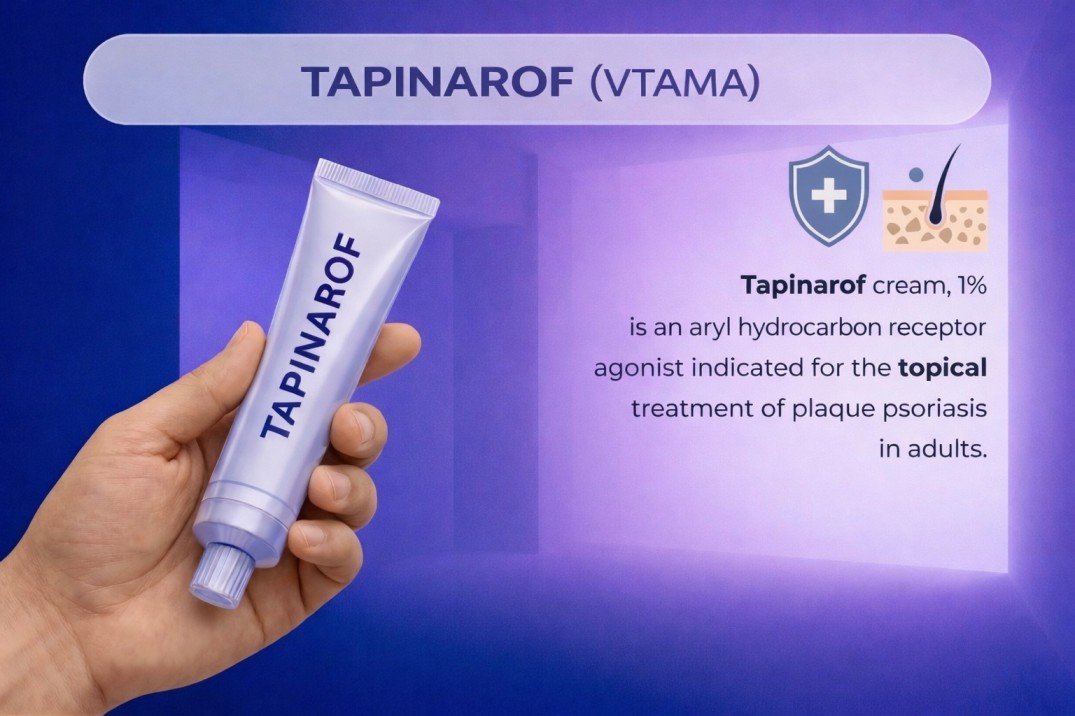
No Boxed Warning — First-in-class AhR agonist: Tapinarof carries no Boxed Warning and no contraindications. It is a non-steroidal small molecule that agonizes the aryl hydrocarbon receptor (AhR), a novel mechanism distinct from corticosteroids, vitamin D derivatives, calcineurin inhibitors, and PDE-4 inhibitors. The specific mechanisms by which VTAMA cream exerts its therapeutic action in psoriasis are unknown (PI §12.1).
Indication
Plaque Psoriasis — Adults
Topical treatment of plaque psoriasis in patients ≥18 years. First-in-class AhR agonist approved for any indication.
Mechanism of Action
AhR Agonist
Aryl hydrocarbon receptor (AhR) agonist. Specific therapeutic mechanism in psoriasis unknown (PI §12.1).
Primary Efficacy — PSOARING 1
36% / 6%
PGA Treatment Success at Wk 12: 36% tapinarof vs 6% vehicle; difference 29% (95% CI: 22%, 36%)
Primary Efficacy — PSOARING 2
40% / 6%
PGA Treatment Success at Wk 12: 40% tapinarof vs 6% vehicle; difference 34% (95% CI: 27%, 41%)
| Property | Detail |
|---|
| Pharmacologic class | Aryl hydrocarbon receptor (AhR) agonist |
| Chemical name | 3,5-dihydroxy-4-isopropyl-trans-stilbene; also (E)-2-isopropyl-5-styrylbenzene-1,3-diol |
| Empirical formula | C₁₇H₁₈O₂; molecular weight 254.32 |
| Physical description | White to pale brown powder |
| Formulation | Cream, 1%; each gram contains 10 mg tapinarof in a white to off-white cream base |
| Sponsor | Dermavant Sciences GMBH / Dermavant Sciences Inc., 3780 Kilroy Airport Way, Long Beach, CA 90806 |
| Initial U.S. Approval | 2022 |
| NDA Number | 215272 (Orig1s000) |
Mechanism of Action (PI §12.1): Tapinarof is an aryl hydrocarbon receptor (AhR) agonist. The specific mechanisms by which VTAMA cream exerts its therapeutic action in psoriasis patients are unknown. Preclinical data indicate AhR activation downregulates pro-inflammatory cytokines (IL-4, IL-5, IL-6, IL-13, IL-17A, IL-17F, eotaxin) and upregulates skin barrier proteins (filaggrin, hornerin, involucrin), providing a dual anti-inflammatory and barrier-restoration effect.
Trial Design: Two identically designed Phase 3, randomized, multicenter, double-blind, vehicle-controlled, parallel-group trials (DMVT-505-3001 [PSOARING 1; NCT03956355] and DMVT-505-3002 [PSOARING 2; NCT03983980]). Total 1,025 subjects with mild-to-severe plaque psoriasis randomized 2:1 to tapinarof cream 1% or vehicle QD for 12 weeks. BSA involvement 3%–20%; baseline PGA ≥2.
Total Subjects (Both Trials)
1,025
683 tapinarof, 342 vehicle; 2:1 randomization across 50–60 centers in the U.S. and Canada
Treatment Duration
12 Weeks
84 days; once-daily application to all affected areas regardless of anatomic location
Median Age / Disease Severity
51 yrs
Median age 51 (range 18–75); 82% moderate disease (PGA 3); 10% mild; 8% severe; mean BSA 8% (range 3–20%)
Remission Duration (PGA 0 Subjects)
114 days
Median time to first worsening (PGA ≥2) in 73 subjects who achieved PGA 0 at Wk 12 and had tapinarof withdrawn; 95% CI: 85, 142
| Characteristic | PSOARING 1 Tapinarof N=340 | PSOARING 1 Vehicle N=170 | PSOARING 2 Tapinarof N=343 | PSOARING 2 Vehicle N=172 |
|---|
| Mean Age, yrs (SD) | 50 (14) | 49 (13) | 50 (13) | 50 (14) |
| Male, n (%) | 213 (63%) | 86 (51%) | 188 (55%) | 102 (59%) |
| White, n (%) | 286 (84%) | 146 (86%) | 300 (87%) | 138 (80%) |
| Non-Hispanic/Latino, n (%) | 85% overall (both trials combined) | 85% overall (both trials combined) |
| Moderate PGA (3), n (%) | 271 (80%) | 133 (78%) | 288 (84%) | 144 (84%) |
| Mean PASI (SD) | 8.7 (4.0) | 9.2 (4.4) | 9.1 (3.7) | 9.3 (4.0) |
| Mean BSA % (SD) | 7.8 (4.6) | 8.2 (5.1) | 7.8 (4.4) | 7.3 (4.1) |
Primary Endpoint: Proportion of subjects achieving PGA Treatment Success at Week 12 — defined as a PGA score of “Clear” (0) or “Almost Clear” (1) and at least a 2-grade improvement from baseline. Intent-to-treat (ITT) population; multiple imputation for missing data.
Primary Endpoint: PGA Treatment Success at Week 12 (PGA 0 or 1 with ≥2-grade improvement from baseline). ITT population, multiple imputation. Both trials met their primary endpoint with p<0.001.
Difference: 29% (95% CI: 22%, 36%); p<0.001
Difference: 34% (95% CI: 27%, 41%); p<0.001
PGA TREATMENT SUCCESS — WEEK 12 COMPARISON (BOTH TRIALS)
Source: FDA PI NDA 215272, Ref ID 4986645, Table 2 (Section 14). Values as reported: PSOARING 1 tapinarof 36%, vehicle 6%; PSOARING 2 tapinarof 40%, vehicle 6%.
PSOARING 1 — Tapinarof (N=340)
PSOARING 1 — Vehicle (N=170)
PSOARING 2 — Tapinarof (N=343)
PSOARING 2 — Vehicle (N=172)
PSOARING 1: Difference 26% (95% CI: 19%, 33%), p<0.001 · PSOARING 2: Difference 41% (95% CI: 34%, 47%), p<0.001
PSOARING 1 — Tapinarof (N=340)
PSOARING 1 — Vehicle (N=170)
PSOARING 2 — Tapinarof (N=343)
PSOARING 2 — Vehicle (N=172)
PSOARING 1: Difference 17% (95% CI: 13%, 22%), p<0.001 · PSOARING 2: Difference 18% (95% CI: 13%, 23%), p<0.001
| Endpoint | PSOARING 1 Tapinarof N=340 | PSOARING 1 Vehicle N=170 | PSOARING 2 Tapinarof N=343 | PSOARING 2 Vehicle N=172 |
|---|
| PGA Treatment Success (primary) | 36% | 6% | 40% | 6% |
| PASI-75 | 36% | 10% | 48% | 7% |
| PGA 0 or 1 (unrestricted) | 38% | 10% | 44% | 8% |
| PASI-90 | 19% | 2% | 21% | 2% |
| Mean change in %BSA (LS Mean) | −3.5% | −0.2% | −4.2% | +0.1% |
All secondary endpoints statistically superior to vehicle in both trials (p<0.001). ITT population; multiple imputation.
Remission after treatment withdrawal: Following 12 weeks of treatment, 73 subjects randomized to tapinarof achieved complete disease clearance (PGA 0) and had tapinarof withdrawn. These subjects were followed for up to 40 additional weeks, with a median time to first worsening (PGA ≥2 [“Mild”]) of 114 days (95% CI: 85, 142).
No Boxed Warning. Tapinarof carries no Boxed Warning and no contraindications (PI §4).
Safety Population (Controlled)
683
Tapinarof-treated subjects in 12-week PSOARING 1 + 2 vehicle-controlled trials
Long-term Exposure (LTE)
763
PSOARING 3 (DMVT-505-3003) open-label safety trial; up to 40 additional weeks after completing PSOARING 1 or 2
Controlled Trial Duration
12 Weeks
Both PSOARING 1 and PSOARING 2 controlled phase; ages 18–75 years; median age 51 years
Most Common ADR (≥1%)
Folliculitis
20% tapinarof vs 1% vehicle; leading cause of treatment discontinuation (2.8%)
No Boxed Warning: VTAMA (tapinarof) cream carries no Boxed Warning.
- Folliculitis — most common adverse reaction (20% tapinarof vs 1% vehicle in controlled trials); leading cause of treatment discontinuation (2.8%). Application site folliculitis included. Monitor for signs of folliculitis during treatment.
- Contact dermatitis — 7% tapinarof vs 1% vehicle in controlled trials; leading cause of treatment discontinuation (2.9%). Includes dermatitis, contact dermatitis, hand dermatitis, and rash. Discontinue if severe.
- Urticaria — 0.3% in controlled trials; 1.0% in PSOARING 3 LTE study. Two subjects developed urticaria in the controlled phase.
| Adverse Reaction | Tapinarof N=683
n (%) | Vehicle N=342
n (%) |
|---|
| Folliculitisa | 140 (20%) | 3 (1%) |
| Nasopharyngitisb | 73 (11%) | 31 (9%) |
| Contact dermatitisc | 45 (7%) | 2 (1%) |
| Headached | 26 (4%) | 5 (1%) |
| Prurituse | 20 (3%) | 2 (1%) |
| Influenzaf | 14 (2%) | 2 (1%) |
aFolliculitis includes application site folliculitis and folliculitis.
bNasopharyngitis includes nasopharyngitis, nasal congestion, pharyngitis, RTI viral, rhinorrhea, sinus congestion, upper RTI, and viral upper RTI.
cContact dermatitis includes dermatitis, contact dermatitis, hand dermatitis, and rash.
dHeadache includes headache, migraine, and tension headache.
ePruritus includes application site pruritus, pruritus, generalized pruritus, and genital pruritus.
fInfluenza includes influenza and influenza-like illness.
Treatment Discontinuations (>1%): Contact dermatitis led to discontinuation in 2.9% of tapinarof-treated subjects; folliculitis led to discontinuation in 2.8% of tapinarof-treated subjects. These were the only adverse reactions with a discontinuation rate >1%.
Discontinuations (>1%)
Contact dermatitis: 2.9% of tapinarof subjects. Folliculitis: 2.8%. Only adverse reactions leading to discontinuation in >1% of subjects in the 12-week controlled trials.
Urticaria
Two (0.3%) subjects developed urticaria in 12-week controlled trials. In PSOARING 3 LTE (763 subjects, up to 40 additional weeks): urticaria 1.0%.
Drug Eruption — LTE Only
Drug eruption reported in 0.7% of subjects in PSOARING 3 (open-label extension). Not reported in 12-week controlled trials.
Folliculitis — Notable Signal
Folliculitis rate 20% (tapinarof) vs 1% (vehicle) in controlled trials. Leading cause of discontinuation. Application site folliculitis included in grouped term.
Pregnancy (PI §8.1)
Available human data insufficient to evaluate drug-associated risk of major birth defects, miscarriage, or other adverse maternal/fetal outcomes. Animal data: no significant effects at 268× MRHD (rats) and 16× MRHD (rabbits) based on AUC. Fetal skeletal variations (incomplete ossification of nasal bones) in rats at 34 mg/kg/day (268× MRHD). Fetal survival/viability decreased at ≥6 mg/kg/day (45× MRHD); no effects at 1 mg/kg/day (6× MRHD).
Lactation (PI §8.2)
No human data on presence in breast milk, effects on breastfed infant, or on milk production. Tapinarof detected in rat offspring following maternal subcutaneous dosing, suggesting transfer to milk. Developmental and health benefits of breastfeeding should be weighed against the mother’s clinical need.
Pediatric Use (PI §8.4)
Safety and efficacy not established in subjects <18 years. Juvenile animal toxicity: renal pelvic dilatation at ≥15 mg/kg/day (165× MRHD based on AUC). No adverse effects at 1.5 mg/kg/day (11× MRHD). Not approved for pediatric use.
Geriatric Use (PI §8.5)
Of 683 tapinarof-treated subjects in PSOARING 1/2, 99 (14.5%) were ≥65 years; 8 (1.2%) were ≥75 years. No overall differences in efficacy, safety, or tolerability between elderly and younger adult subjects.
Carcinogenicity — Mice
No drug-related neoplasms after 98 (females) to 102 (males) weeks of daily topical administration at doses up to 3% tapinarof cream (44× MRHD based on AUC).
Carcinogenicity — Rats
No drug-related neoplasms in female rats after 83 weeks of subcutaneous administration at doses up to 1 mg/kg/day (9× MRHD based on AUC).
Genotoxicity
No evidence of mutagenicity or clastogenicity: negative in Ames assay, in vitro mammalian chromosomal aberration assay, in vitro mouse lymphoma assay, and two in vivo micronucleus assays in mice and rats.
Fertility / Cardiac Safety
Female fertility unimpaired at subcutaneous doses up to 30 mg/kg/day (268× MRHD based on AUC). Cardiac: VTAMA does not prolong QTc interval to any clinically relevant extent at the approved recommended dosage (PI §12.2).
Cmax (Day 1)
0.90 ± 1.4 ng/mL
Mean ± SD; following mean daily dose of 5.23 g applied to mean BSA of 27.2% (range 21–46%) in 21 subjects with moderate-to-severe plaque psoriasis
AUC₀₋ₗₐₛₜ (Day 1)
4.1 ± 6.3 ng·h/mL
Mean ± SD; Day 1 values in 21-subject maximal use PK study
Cmax (Day 29)
0.12 ± 0.15 ng/mL
Mean ± SD; no accumulation with repeat topical application; substantial decline from Day 1
AUC₀₋ₗₐₛₜ (Day 29)
0.61 ± 0.65 ng·h/mL
Mean ± SD; substantial reduction from Day 1 AUC confirms no systemic accumulation
BQL Samples
68%
Plasma concentration below quantifiable limits (LLOQ = 50 pg/mL) in 68% of PK samples across the study
Plasma Protein Binding
~99%
Human plasma protein binding approximately 99% in vitro (PI §12.3)
Low systemic absorption: No accumulation was observed with repeat topical application. Plasma concentration of tapinarof was below the quantifiable limits (LLOQ = 50 pg/mL) in 68% of pharmacokinetic samples. Cmax and AUC declined substantially from Day 1 to Day 29, consistent with resolution of psoriatic lesions reducing percutaneous absorption over time.
| Parameter | Detail |
|---|
| Absorption | No accumulation with repeat topical application. 68% of samples BQL at LLOQ 50 pg/mL. Cmax and AUC declined substantially from Day 1 to Day 29. |
| Distribution | Human plasma protein binding approximately 99% in vitro. Terminal half-life could not be reliably estimated in most subjects due to low plasma concentrations (estimable in only 2 of 21 subjects in the maximal use study). |
| Metabolism | Metabolized in the liver via multiple pathways including oxidation, glucuronidation, and sulfation in vitro (PI §12.3). |
| Excretion / Half-life | Terminal half-life not reliably estimable in humans due to BQL concentrations in the elimination phase. Not reported in PI. |
| Cardiac Electrophysiology | VTAMA does not prolong the QTc interval to any clinically relevant extent at the approved recommended dosage (PI §12.2). |
Low DDI potential: Given minimal systemic exposure from topical application, clinically relevant drug interactions are unlikely. All in vitro studies confirmed no inhibitory or inductive activity on major metabolic enzymes and transporters. No formal clinical DDI studies conducted.
| Category | Finding (PI §12.3) |
|---|
| CYP Inhibition | Not an inhibitor of CYP2B6, CYP2C8, CYP2C9, CYP2C19, CYP2D6, or CYP3A4/5 |
| CYP Induction | Not an inducer of CYP1A2, CYP2B6, or CYP3A4 |
| Transporter Inhibition | Not an inhibitor of BCRP, MATE1, MATE-2K, OAT1, OAT3, OATP1B1, OATP1B3, OCT1, OCT2, or P-gp |
| Transporter Substrate | Not a substrate for BCRP, OATP1B1, OATP1B3, or P-gp |
| Overall DDI Risk | Low; topical route with minimal systemic absorption further reduces DDI risk |
Mechanism of Action (PI §12.1): Tapinarof is an aryl hydrocarbon receptor (AhR) agonist. The specific mechanisms by which VTAMA cream exerts its therapeutic action in psoriasis patients are unknown. Preclinical data indicate AhR activation downregulates pro-inflammatory cytokines (IL-4, IL-5, IL-6, IL-13, IL-17A, IL-17F, eotaxin) and upregulates skin barrier proteins (filaggrin, hornerin, involucrin), providing a dual anti-inflammatory and skin-barrier repair mechanism.
| Parameter | Detail |
|---|
| Pharmacodynamics | Pharmacodynamics of VTAMA cream are unknown (PI §12.2). No established PK/PD relationship for efficacy; systemic plasma concentrations do not predict efficacy as drug acts directly on target tissue. |
| Exposure–Response | No trend observed between PASI/PGA scores and systemic Cmax or Cmin across Phase 2 and Phase 3 studies. No trend between safety endpoints (headache, contact dermatitis, folliculitis) and systemic exposure. |
| QTc Assessment | At the approved recommended dosage, VTAMA does not prolong the QTc interval to any clinically relevant extent (PI §12.2). |
Approved Dose
1% Cream
Each gram contains 10 mg tapinarof; applied as a thin layer to affected areas
Route
Topical
External (cutaneous) use only. NOT for oral, ophthalmic, or intravaginal use.
Frequency
Once Daily
Apply once daily (QD) to psoriasis skin lesions; avoid unaffected areas of skin
Duration of Therapy
Not defined
No defined maximum treatment duration; pivotal trials ran 12 weeks; LTE up to 40 additional weeks
Standard Dosing (PI §2)
- Apply a thin layer of VTAMA cream to affected areas once daily
- Apply only to psoriasis skin lesions; avoid unaffected areas of skin
- Wash hands after application unless treating the hands
- No dose adjustment specified for body weight or BSA
- Formulation: Cream 1%; each gram contains 10 mg tapinarof
- Supplied in 60 g laminated tubes (NDC 81672-5051-1)
Dose Modifications / Special Populations
- Renal impairment: Not reported in PI; minimal systemic exposure; formal studies not conducted
- Hepatic impairment: Not reported in PI; minimal systemic absorption; formal studies not conducted
- Pediatric (<18 years): Not approved; safety and efficacy not established (PI §8.4)
- Geriatric (≥65 years): No dose adjustment necessary; no differences in efficacy or safety vs. younger adults (PI §8.5)
- Pregnancy: Insufficient human data; use only if potential benefit justifies potential risk (PI §8.1)
Preparation & Administration (PI §17)
- Apply VTAMA cream once daily to psoriasis skin lesions only
- Avoid applying to unaffected skin areas
- Wash hands after applying unless treating the hands
- If someone else applies VTAMA cream, they should also wash their hands after application
- For external use only — do not use in eyes, mouth, or vagina
Storage & Handling (PI §16)
- Store at 20°C to 25°C (68°F to 77°F)
- Excursions permitted between 15°C and 30°C (59°F and 86°F)
- Do not freeze
- Protect from exposure to excessive heat
- Keep out of reach of children
None. VTAMA (tapinarof) cream has no contraindications (PI §4).
None identified: No dose adjustments required based on drug interactions. In vitro data show no relevant CYP inhibition/induction or transporter interactions. Minimal systemic exposure further reduces DDI risk.
Benzoic acid, butylated hydroxytoluene, citric acid monohydrate, diethylene glycol monoethyl ether, edetate disodium, emulsifying wax, medium-chain triglycerides, polyoxyl 2 stearyl ether, polyoxyl 20 stearyl ether, polysorbate 80, propylene glycol, purified water, and sodium citrate dihydrate.
Application Type
Original NDA
Standard Review. New Molecular Entity. First-in-class AhR agonist for dermatology. Application Number: 215272Orig1s000.
Reviewing Division
DDD / OII
Division of Dermatology and Dentistry / Office of Immunology and Inflammation, CDER.
PDUFA Goal Date
May 26, 2022
NDA submitted and received May 26, 2021; PDUFA goal date May 26, 2022.
Approval Date
May 2022
Initial U.S. approval 2022. First-in-class AhR agonist; first new topical non-steroidal mechanism in psoriasis since crisaborole (2016).
| Aspect | Detail |
|---|
| Application number | NDA 215272 (Orig1s000) |
| Application type | NDA 505(b)(1) · New Molecular Entity · Original NDA |
| Applicant | Dermavant Sciences GMBH |
| Submission / receipt date | May 26, 2021 |
| PDUFA goal date | May 26, 2022 |
| Actual approval date | May 2022 (Revised label: 5/2022) |
| Review division | Division of Dermatology and Dentistry (DDD), Office of Immunology and Inflammation (OII), CDER |
| Review type | Standard Review |
| Breakthrough Therapy Designation | Not reported in label or review |
| Fast Track Designation | Not reported in label or review |
| Orphan Drug Designation | Not applicable |
| Advisory Committee | Not reported in label |
| Medical Review Ref ID | 4984343 |
| PI Ref ID | 4986645 |
| Pivotal trials | DMVT-505-3001 (NCT03956355) and DMVT-505-3002 (NCT03983980) |
| Primary endpoint met | PSOARING 1: 36% vs 6% (difference 29%, 95% CI: 22%, 36%); PSOARING 2: 40% vs 6% (difference 34%, 95% CI: 27%, 41%); both p<0.001 |
| Boxed Warning | None |
| Contraindications | None |
| REMS | Not required |
| Post-marketing requirements (PMR) | Not reported in label |
| Safety database at approval | 683 subjects in 12-week vehicle-controlled studies; 763 subjects in open-label LTE (PSOARING 3) for up to 40 additional weeks |
PHASE 3 CONDUCT
PSOARING 1 (NCT03956355) and PSOARING 2 (NCT03983980)
Two identically designed Phase 3 randomized, multicenter, double-blind, vehicle-controlled trials in 1,025 subjects with mild-to-severe plaque psoriasis (BSA 3–20%). 2:1 randomization to tapinarof 1% cream or vehicle QD for 12 weeks. Primary endpoint: PGA Treatment Success at Week 12.
MAY 26, 2021
NDA 215272 Submitted and Received
Dermavant Sciences GMBH submitted NDA 215272 for VTAMA (tapinarof) cream, 1% for topical treatment of plaque psoriasis in patients ≥18 years. Standard Review designation. PDUFA goal date: May 26, 2022.
SEPTEMBER 28, 2021
Proprietary Name Review Completed
Proprietary name “VTAMA” accepted as acceptable from both a promotional and safety perspective under NDA 215272.
MAY 2022
FDA Approval — NDA 215272 (VTAMA)
Tapinarof cream 1% QD approved for topical treatment of plaque psoriasis in adults (≥18 years). First-in-class AhR agonist. No Boxed Warning. No contraindications. Label Revised 5/2022; Ref ID 4986645. Multi-disciplinary Review Ref ID 4984343.
Primary Endpoint Consistency
Both PSOARING 1 and PSOARING 2 met the primary endpoint of PGA Treatment Success at Week 12 with highly statistically significant and clinically meaningful differences from vehicle (29% and 34%, respectively). Consistent results across both trials supported the benefit-risk determination.
Folliculitis Signal
Folliculitis was identified as a notable safety signal at 20% vs 1% vehicle. The review concluded this was a manageable adverse reaction that did not preclude approval; it was reflected in labeling with appropriate patient counseling information.
Novel Mechanism — No Precedent
Tapinarof is the first AhR agonist approved for any indication. The pharmacodynamics (PI §12.2) and specific therapeutic mechanism (PI §12.1) were classified as unknown at time of approval, consistent with first-in-class review challenges.
Pediatric Exclusion
Safety and efficacy in subjects <18 years was not established. Juvenile animal toxicity (renal pelvic dilatation at 165× MRHD) was noted. Pediatric studies deferred post-approval.
PMR/PMC: No post-marketing requirements or commitments are reported in the prescribing information label (Ref ID 4986645, Revised 5/2022). For current status, consult FDA Drugs@FDA.
| Domain | Note |
|---|
| Benefit-risk conclusion | Favorable benefit-risk assessment based on consistent PGA Treatment Success across two adequate and well-controlled trials, acceptable safety profile, and no systemic toxicity signals with topical use. |
| Labeling negotiation | Mechanism of action and pharmacodynamics designated as “unknown” in the approved PI (§§12.1–12.2), reflecting first-in-class status and absence of established biomarker data. |
| Immunogenicity | Not applicable — small molecule topical drug. |
| Statistical approach | Multiple imputation used for primary ITT analysis in both pivotal trials. Results consistent across sensitivity analyses. |
| Source documents | PI Ref ID 4986645 (Revised 5/2022); Multi-disciplinary Review Ref ID 4984343. NDA 215272Orig1s000. |