Deuruxolitinib (LEQSELVI) — TrialistMD Drug Profile
TRIALISTMD · Drug Intelligence PlatformFDA APPROVED 2024
JAK Inhibitor · Dermatology · Alopecia Areata
Deuruxolitinib
LEQSELVI™ · Sun Pharmaceutical Industries, Inc.
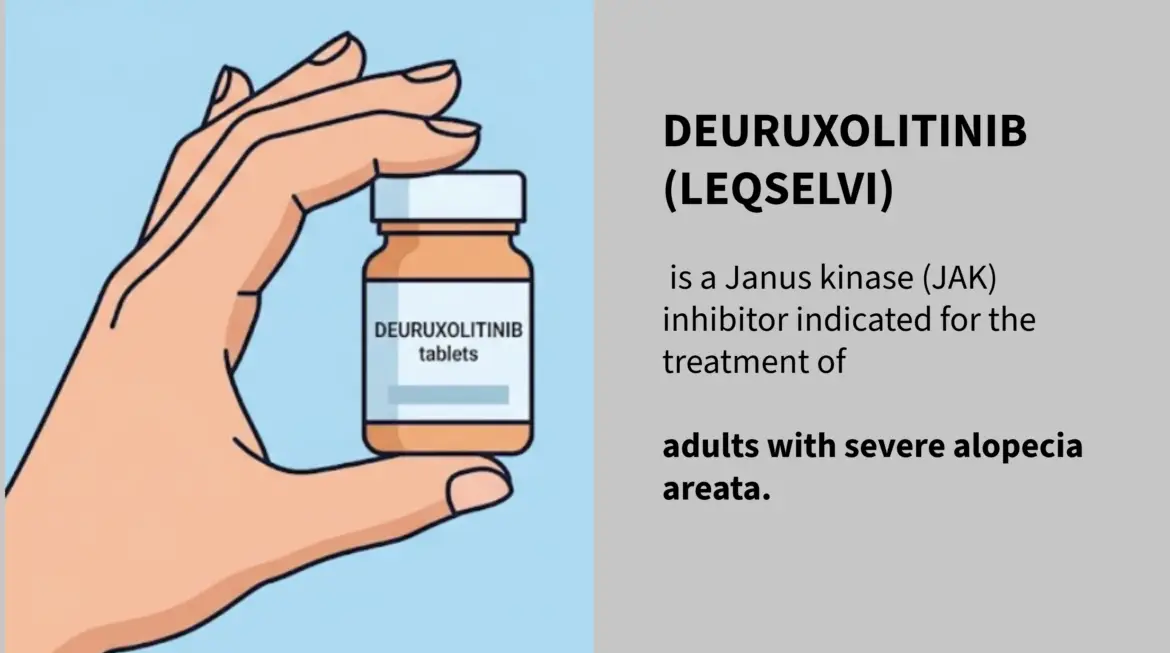
A selective, orally bioavailable Janus kinase (JAK1/2) inhibitor — and the first deuterated JAK inhibitor approved by the FDA. Developed as a deuterated analog of ruxolitinib, deuruxolitinib is indicated for the treatment of adult patients with severe alopecia areata based on two pivotal Phase 3 trials (THRIVE-AA1 and THRIVE-AA2).
Serious infections including tuberculosis — interrupt treatment if a serious infection occurs
Increased all-cause mortality including sudden cardiovascular death (based on class data vs. TNF blockers in RA patients)
Malignancy and lymphoproliferative disorders — higher rates of lymphomas and lung cancers observed with JAK inhibitor class
Major Adverse Cardiovascular Events (MACE) — cardiovascular death, MI, and stroke
Thrombosis — DVT, PE, and cerebral venous sinus thrombosis (CVST) reported in clinical trials
Drug Overview
NDA 217900
Indication
Severe Alopecia Areata
Adults with ≥50% scalp hair loss (SALT ≥50)
Mechanism
JAK1 / JAK2 / TYK2 Inhibitor
Deuterated analog of ruxolitinib (CTP-543)
Approved Dose
8 mg BID
Oral, with or without food
Higher Dose Status
12 mg — Not Approved
Partial clinical hold (thrombosis signal)
Mechanism of Action
Deuruxolitinib is a JAK inhibitor. JAK enzymes mediate intracellular signaling from cytokine and growth factor receptor interactions, recruiting STATs to cytokine receptors and activating downstream gene expression involved in immune function and hematopoiesis. In alopecia areata, autoimmune destruction of anagen hair follicles is thought to be mediated by cytotoxic T cells after loss of immune privilege, a process regulated by upstream JAK signaling.
Selectivity profile: In cell-free in vitro kinase assays, deuruxolitinib demonstrated greater inhibitory potency for JAK1, JAK2, and TYK2 relative to JAK3. The clinical relevance of this differential selectivity is not fully characterized.
Deuterium rationale: Deuruxolitinib is a C–D (carbon-deuterium) substituted analog of ruxolitinib. Deuterium substitution at the cyclopentyl ring was designed to slow CYP2C9-mediated metabolism. However, this characteristic — combined with its primary CYP2C9 metabolism (76%) — makes it particularly sensitive to CYP2C9 genetic variants and drug interactions.
Competitive Landscape
Drug
Target
Approval Date
Dose
Population
Baricitinib (OLUMIANT)
JAK1/2
June 13, 2022
2 mg or 4 mg QD
Adults with severe AA
Ritlecitinib (LITFULO)
JAK3 / TEC family
June 23, 2023
50 mg QD
Adults & adolescents ≥12 years
Deuruxolitinib (LEQSELVI)
JAK1/2/TYK2
July 2024
8 mg BID
Adults with severe AA
Sources: FDA prescribing information (NDA 217900) and FDA Medical Review (Ref ID 5418639). Baricitinib and ritlecitinib approval dates from FDA records as cited in medical review.
Clinical Efficacy
THRIVE-AA1 · THRIVE-AA2
Primary Endpoint
SALT ≤ 20 at Week 24
≥80% scalp hair coverage
Trial Design
RCT, DB, Placebo-Ctrl
24-week treatment + open-label extension
Population (N)
1,223
AA-1: n=706 · AA-2: n=517
Eligibility (SALT)
≥ 50
≥50% scalp hair loss for >6 months
Primary Endpoint Results
THRIVE-AA1 (CP543.3001 · NCT04518995) — SALT ≤20 at Week 24
Values digitized from Figure 9 (THRIVE-AA1 and THRIVE-AA2, all arms) and Figure 10 (pooled 8 mg BID vs placebo) in the FDA Multi-Disciplinary Medical Review, NDA 217900 (Ref ID: 5418639, p.113–114). Source: Reviewer analysis using dataset adsalt.xpt. * 12 mg not approved — shown for reference only. Figure 10 presents 8 mg BID vs placebo only (pooled).
Key Secondary & Exploratory Endpoints
Endpoint
8 mg BID
Placebo
Significance
SALT ≤20 at Week 20
~22–27%
~1%
Significant
SALT ≤20 at Week 16
~17–20%
~0–1%
Significant
SALT ≤20 at Week 12
~9–12%
~0–1%
Significant
SALT ≤20 at Week 8
~4–6%
~0%
AA-1 only
SALT ≤10 at Week 24 (≥90% hair coverage)
20–24%
0%
Exploratory (in label)
SPRO “Satisfied/Very Satisfied” at Week 24
42–46%
2–5%
Significant
BETA (eyebrow) & BELA (eyelash) scores
Nominally significant
—
Exploratory; not in label
Efficacy by Baseline Severity (Pooled AA-1 + AA-2)
Baseline SALT Category
N (8 mg)
SALT ≤20 at Wk 24
N (Placebo)
SALT ≤20 at Wk 24
SALT 50–94 (moderate-severe)
248
46%
110
2%
SALT 95–100 (near-total/total)
352
20%
157
0%
* Deuruxolitinib 12 mg BID is not approved. FDA placed this dose on partial clinical hold (May 17, 2023) due to dose-dependent thrombosis signal observed in Phase 3 open-label extension. All 12 mg data shown for reference only.
Anemia (<8 g/dL)
24-week: 6.9 per 100 PY (8 mg) vs 2.3 placebo
Neutropenia (<1000/mm³)
24-week: 3.6 per 100 PY (8 mg) vs 2.3 placebo
CPK Elevations
24-week: 12.9 per 100 PY (8 mg) vs 5.4 placebo
Lipid Elevations
24-week: 11.0 per 100 PY (8 mg) vs 7.7 placebo · Manage per guidelines
12 mg dose — Thrombotic events (Week 52–98 extension): Four subjects on deuruxolitinib 12 mg BID developed venous thromboembolic events between Week 52 and Week 98, totaling 7 thrombotic events (0.2 per 100 PY), including DVT, bilateral PE, and cerebral venous sinus thrombosis (CVST). This dose-dependent thrombosis signal drove the FDA partial clinical hold and ultimately the applicant’s withdrawal of the 12 mg dose from the NDA submission.
Pharmacokinetics
Section 12.3 — Prescribing Information
Oral Bioavailability
90%
High; not significantly affected by food
Tmax
~1.5 hr
Peak plasma concentration
Half-Life (t½)
~4 hr
Mean elimination half-life
Volume of Distribution
~50 L
Steady-state Vd
Protein Binding
91.5%
Plasma protein bound
Steady State
1–2 days
Minimal accumulation with BID dosing
Metabolism & Excretion
Parameter
Detail
Primary Metabolism
CYP2C9 (76%)
Secondary Metabolism
CYP3A4 (21%)
Minor Metabolism
CYP1A2 (3%)
Major Metabolites
C-21714 and C-21717 — each ~5% of total AUC; ~10-fold less pharmacologically active than parent
Excretion
No unchanged deuruxolitinib recovered in urine or feces after single radiolabeled dose
Linearity
Dose-proportional PK over 8–48 mg range (6× approved dose)
Transporter Substrates
BCRP, MDR1 (efflux); not a substrate of OATP1B1 or OATP1B3
Transporter Inhibition
Inhibits BCRP, BSEP, OAT3, MATE2-K; does not inhibit OATP1B1, OATP1B3, OCT1
CYP2C9 Poor Metabolizers (PMs): Based on PBPK modeling, CYP2C9 PMs (e.g., *2/*3, *3/*3 genotypes) may have up to 2-fold higher deuruxolitinib exposure compared to normal metabolizers. This is estimated to increase the risk of serious adverse reactions including thrombosis. No direct PK data in CYP2C9 PMs was generated in the clinical program. LEQSELVI is contraindicated in CYP2C9 poor metabolizers.
Population
PM Prevalence
White / European
~2–3%
Asian
~0.5–4%
Black / African American
<1% (but *5, *6, *8, *11 alleles more prevalent)
Note: No FDA-cleared or FDA-approved companion diagnostic for CYP2C9 genotyping was available at time of approval. Commercially available assays are acceptable for pre-treatment genotyping. A post-marketing requirement has been issued for development of an in-vitro diagnostic assay.
Dosing
Parameter
Recommendation
Approved Dose
8 mg orally twice daily (with or without food)
Missed Dose
Skip the missed dose; resume at next scheduled time
Mild–Moderate Renal Impairment
No dose adjustment (eGFR 30–89 mL/min)
Severe Renal Impairment / ESRD
Not recommended (eGFR <30 mL/min)
Mild–Moderate Hepatic Impairment
No dose adjustment (Child-Pugh A or B)
Severe Hepatic Impairment
Not recommended (Child-Pugh C)
Pediatric Use
Not established — safety and efficacy not studied
Geriatric Use
Only 0.3% of Phase 3 subjects were ≥65 years; insufficient data for subgroup conclusions
Pregnancy
May cause fetal harm based on animal data; advise effective contraception
Lactation
Not recommended — avoid breastfeeding during treatment and for 1 day after last dose
Pre-Treatment Evaluations Required
CYP2C9 genotyping — required before initiating treatment (no approved companion diagnostic; use commercially available assay)
Review of concomitant CYP2C9 inhibitors (moderate and strong are contraindicated)
Latent TB testing and treatment of latent TB prior to initiation
Viral hepatitis screening (HBV, HCV) per clinical guidelines
CBC — do not initiate if ALC <500/mm³, ANC <1,000/mm³, or Hgb <8 g/dL
Lipid panel at baseline
Complete immunizations including varicella zoster / herpes zoster vaccine prior to treatment; avoid live vaccines during therapy
FDA placed 12 mg deuruxolitinib BID on partial clinical hold for unfavorable benefit-risk due to dose-dependent thrombosis signal in open-label extension
JULY 28, 2023
NDA 217900 Submitted
Applicant filed 505(b)(1) NDA for 8 mg BID only; proposed indication: moderate to severe AA
JULY 28, 2024
PDUFA Goal Date
JULY 2024
FDA Approval — LEQSELVI™ (deuruxolitinib) 8 mg
Approved indication narrowed to “severe” (not moderate-to-severe) alopecia areata, per FDA review conclusion that SALT ≥50 corresponds to clinically “severe” disease
FDA Review Assessment
Review Division conclusion: “The review team concludes that the benefit-risk of deuruxolitinib 8 mg twice daily is favorable in the population of adult patients with severe alopecia areata with appropriate labeling and recommend approval of this application.”
The indication was narrowed from “moderate to severe” (applicant’s proposed language) to “severe alopecia areata” alone, as literature and clinical review determined that SALT ≥50 corresponds to the “severe” threshold, not “moderate to severe.”
Post-Marketing Requirements
Requirement
Detail
CYP2C9 PM PK Study
Required — assess systemic deuruxolitinib exposure in CYP2C9 poor metabolizers to further inform labeling
In-Vitro Diagnostic Assay
Applicant required to develop FDA-clearable CYP2C9 genotyping companion diagnostic
Pediatric Population
Safety and efficacy data required
Pregnancy Safety
Data required; pregnancy registry enrollment
Pharmacovigilance
OSE / Division of Epidemiology-I — Sentinel Initiative monitoring for thrombosis and other events of interest
Key Drug Information
Parameter
Detail
Proprietary Name
LEQSELVI™ — conditionally acceptable (DMEPA review, October 24, 2023)
Class I (high solubility at low pH; not hygroscopic)
Storage
20°C–25°C; excursions 15°C–30°C; store in original bottle (moisture protection)
US Patents
10,561,659 · 10,265,258 · 11,298,570 · 11,919,907
PI Revision Date
July 2024
Data sourced from: FDA Prescribing Information for LEQSELVI (deuruxolitinib) — NDA 217900 (Ref ID: 5418989, revised 7/2024) and FDA NDA/BLA Multi-Disciplinary Review and Evaluation — NDA 217900 (Ref ID: 5418639, review completed July 24, 2024). For investigational and educational purposes only. Not for clinical decision-making.