Physical Address
304 North Cardinal St.
Dorchester Center, MA 02124
Physical Address
304 North Cardinal St.
Dorchester Center, MA 02124
Clarity in Trials, Confidence in Decisions
Clarity in Trials, Confidence in Decisions
Pharmacodynamic Biomarkers
| Trial | NCT Number | Design | N Randomised | Duration | Comparator | Primary Endpoint |
|---|---|---|---|---|---|---|
| ECZTRA 1 | NCT03131648 | R, DB, PC — Monotherapy | 802 | 52 weeks | Placebo | IGA 0/1 + EASI-75 at Week 16 |
| ECZTRA 2 | NCT03160885 | R, DB, PC — Monotherapy | 794 | 52 weeks | Placebo | IGA 0/1 + EASI-75 at Week 16 |
| ECZTRA 3 | NCT03363854 | R, DB, PC — Combination with TCS | 380 | 32 weeks | Placebo + TCS | IGA 0/1 + EASI-75 at Week 16 |
| Dose-Finding Trial | Not reported | R, DB — Safety pool | Included in safety pool | Not reported | Multiple doses vs. Placebo | Safety/Dose selection |
| Vaccine Response Trial | Not reported | R, DB | Included in safety pool | Not reported | Placebo | Immune response to non-live vaccines |
| Drug (INN) | Brand | Target | US Approval Date | Formulation | Approved Population |
|---|---|---|---|---|---|
| Dupilumab | DUPIXENT | IL-4Rα (IL-4/IL-13 dual) | March 28, 2017 | 300 mg SC | Adults & pediatric ≥6 months |
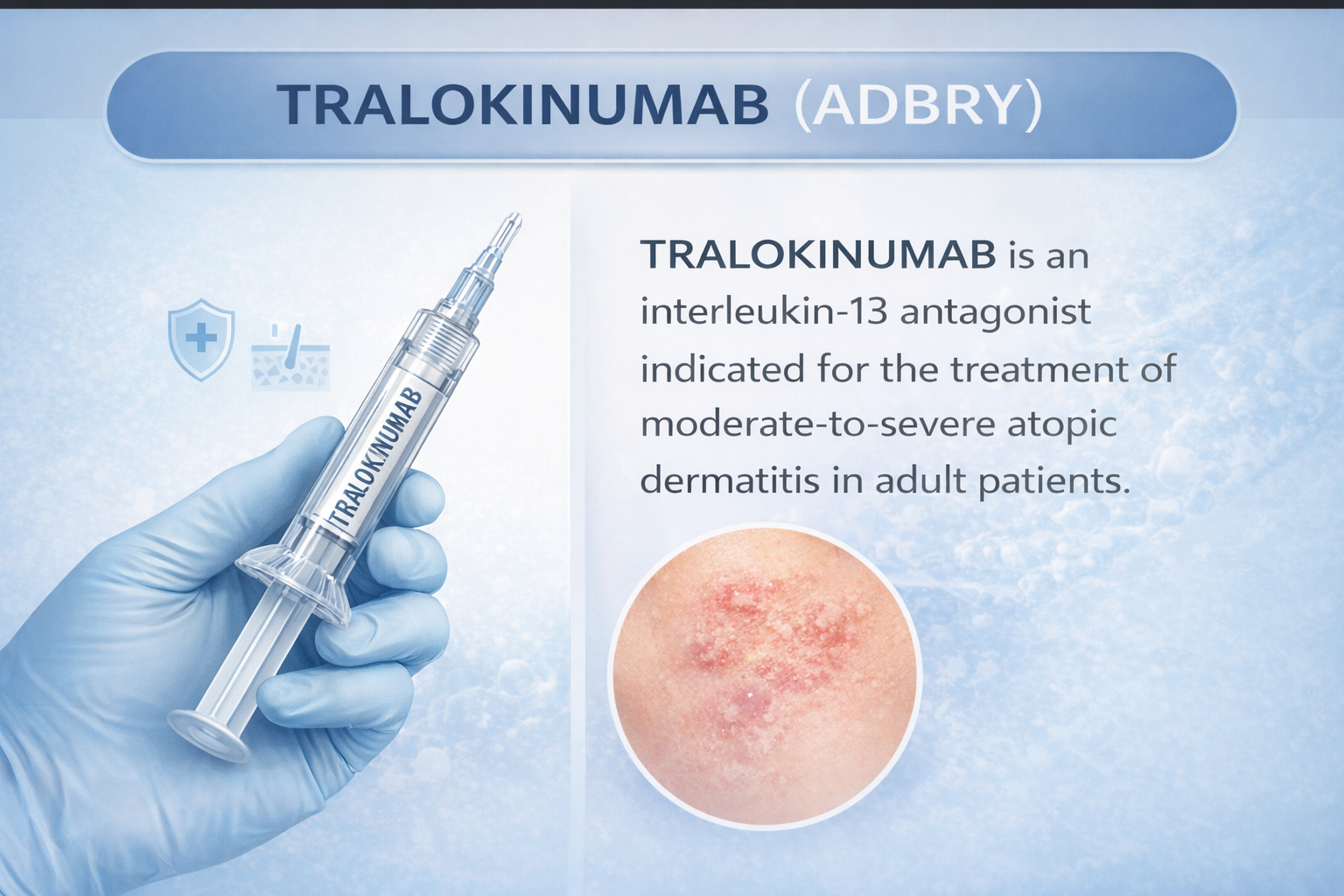
| Tralokinumab-ldrm | ADBRY | IL-13 selective | December 2021 | 300 mg Q2W SC | Adults only |
| Lebrikizumab | EBGLYSS | IL-13 selective | September 13, 2023 | 250 mg Q2W SC | Adults & adolescents ≥12 years |
| Parameter | Detail |
|---|---|
| Proprietary Name | ADBRY™ |
| INN / Generic Name | Tralokinumab-ldrm |
| Code Names | CAT-354 (development code) |
| Manufacturer | LEO Pharma A/S, Industriparken 55, DK-2750 Ballerup, Denmark · US License No. 2169 |
| US Distributor | LEO Pharma Inc., Madison, NJ 07940, USA |
| Pharmacologic Class | Interleukin-13 (IL-13) antagonist; fully human IgG4 monoclonal antibody |
| Antibody Details | Human IgG4 · 1,326 amino acids · ~147 kDa · Produced in mouse myeloma cells by recombinant DNA technology |
| Dosage Form & Strength | 150 mg/mL solution in single-dose prefilled syringe with needle guard (27G × ½ inch, siliconized Type-1 glass, no latex) |
| NDC Numbers | 50222-346-02 (2-syringe carton) · 50222-346-04 (4-syringe multipack) |
| Inactive Ingredients | Acetic acid (0.3 mg), polysorbate 80 (0.1 mg), sodium acetate trihydrate (6 mg), sodium chloride (5 mg), water for injection; pH ~5.5 |
| Storage | 2–8°C (36–46°F) refrigerated; original carton, protect from light; ≤25°C ≤14 days after removal; do not freeze or shake |
| Boxed Warning | None |
| PI Revision Date | December 2021 |
| Parameter | ECZTRA 1 (Monotherapy) | ECZTRA 2 (Monotherapy) | ECZTRA 3 (+TCS) | |||
|---|---|---|---|---|---|---|
| Tralokinumab Q2W (N=601) | Placebo (N=197) | Tralokinumab Q2W (N=577) | Placebo (N=193) | Tralokinumab+TCS (N=243) | Placebo+TCS (N=123) | |
| Sex | ||||||
| Male, n (%) | 350 (58%) | 122 (62%) | 347 (60%) | 108 (56%) | 120 (49%) | 83 (67%) |
| Female, n (%) | 251 (42%) | 75 (38%) | 230 (40%) | 85 (44%) | 123 (51%) | 40 (33%) |
| Age (years) | ||||||
| Mean (SD) | 38.6 (13.7) | 39.3 (15.3) | 36.9 (14.7) | 34.8 (14.0) | 39.1 (14.7) | 37.5 (14.8) |
| Median | 37 | 36 | 34 | 29 | 37 | 34 |
| Range | 18–92 | 18–82 | 18–86 | 18–80 | 18–79 | 18–78 |
| 18–64 years, n (%) | 572 (95%) | 183 (93%) | 548 (95%) | 186 (96%) | 231 (95%) | 115 (94%) |
| 65–84 years, n (%) | 28 (5%) | 14 (7%) | 28 (5%) | 7 (4%) | 12 (5%) | 8 (6%) |
| ≥85 years, n (%) | 1 (<1%) | 0 | 1 (<1%) | 0 | 0 | 0 |
| Race | ||||||
| White, n (%) | 424 (71%) | 137 (70%) | 370 (64%) | 123 (64%) | 194 (80%) | 81 (66%) |
| Asian, n (%) | 120 (20%) | 40 (20%) | 154 (26%) | 52 (26%) | 17 (7%) | 24 (19%) |
| Black / African American, n (%) | 41 (7%) | 17 (9%) | 31 (5%) | 9 (5%) | 22 (9%) | 12 (10%) |
| Other / Not reported | 16 (3%) | 3 (2%) | 22 (4%) | 9 (5%) | 10 (4%) | 6 (5%) |
| Characteristic | ECZTRA 1 (Monotherapy) | ECZTRA 2 (Monotherapy) | ECZTRA 3 (+TCS) | |||
|---|---|---|---|---|---|---|
| Tralokinumab Q2W (N=601) | Placebo (N=197) | Tralokinumab Q2W (N=577) | Placebo (N=193) | Tralokinumab+TCS (N=243) | Placebo+TCS (N=123) | |
| IGA Score at Baseline | ||||||
| IGA 3 — Moderate, n (%) | 296 (49%) | 95 (48%) | 296 (51%) | 93 (48%) | 127 (52%) | 64 (52%) |
| IGA 4 — Severe, n (%) | 305 (51%) | 102 (52%) | 281 (49%) | 100 (51%) | 116 (48%) | 59 (48%) |
| EASI Score at Baseline (scale 0–72) | ||||||
| Mean (SD) | 32.2 (13.7) | 32.9 (13.9) | 32.4 (14.3) | 33.1 (13.8) | 29.1 (12.0) | 30.4 (12.9) |
| Median | 28.2 | 30.3 | 28.6 | 30.8 | 25.4 | 26.2 |
| Range | 16–72 | 16–70.8 | 15.4–72 | 16–72 | 15.8–68.4 | 16.1–72 |
| Worst Daily Pruritus NRS (Weekly Avg) at Baseline (scale 0–10) | ||||||
| Mean (SD) | 7.7 (1.4) | 7.7 (1.4) | 7.9 (1.5) | 8.0 (1.3) | 7.7 (1.5) | 7.9 (1.5) |
| Median | 7.9 | 7.9 | 8.0 | 8.1 | 8.0 | 8.0 |
| NRS ≥4 (eligible for secondary endpoint), n (%) | 594 (99%) | 194 (98%) | 563 (98%) | 192 (99%) | 240 (99%) | 123 (100%) |
| Body Surface Area (BSA) Affected at Baseline (%) | ||||||
| Mean (SD) | 52.7 (24.1) | 54.4 (25.5) | 53.2 (25.4) | 54.3 (24.6) | 47.9 (23.6) | 49.1 (26.1) |
| Median | 50 | 53 | 50 | 50 | 42 | 40 |
| Range | 10–100 | 10–100 | 10–100 | 11–100 | 11–100 | 12–100 |
| Endpoint | ECZTRA 1 | ECZTRA 2 | ECZTRA 3 (to Wk 32) |
|---|---|---|---|
| IGA 0/1 maintained — Q2W arm | 51% (20/39) | 60% (32/53) | 89% (40/45) |
| IGA 0/1 maintained — Q4W arm | 39% (14/36) | 50% (22/44) | 76% (35/46) |
| IGA 0/1 maintained — Placebo arm | 47% (9/19) | 23% (6/26) | N/A (no placebo rerandom.) |
| EASI-75 maintained — Q2W arm | 60% (28/47) | 57% (43/76) | 92% (60/65) |
| EASI-75 maintained — Q4W arm | 49% (28/57) | 55% (38/69) | 90% (56/62) |
| EASI-75 maintained — Placebo arm | 33% (10/30) | 20% (8/40) | N/A |
| PRO Instrument | Finding | Timepoint |
|---|---|---|
| Worst Daily Pruritus NRS (11-point scale) | ≥4-point reduction: 20–25% (mono) vs 9–10% (placebo); 46% (combo+TCS) vs 35% (placebo+TCS) | Week 16 |
| EASI-90 (≥90% improvement) | Higher proportion in tralokinumab 300 mg Q2W arm vs. placebo in all three pivotal trials | Week 16 |
| Adverse Reaction | Tralokinumab Mono (N=1,180) n (%) | Placebo Mono (N=388) n (%) | Tralokinumab+TCS (N=243) n (%) | Placebo+TCS (N=123) n (%) |
|---|---|---|---|---|
| Upper respiratory tract infectionsa | 281 (23.8%) | 79 (20.4%) | 73 (30.0%) | 19 (15.4%) |
| Conjunctivitisb | 88 (7.5%) | 12 (3.1%) | 33 (13.6%) | 6 (4.9%) |
| Injection site reactionsc | 87 (7.4%) | 16 (4.1%) | 27 (11.1%) | 1 (0.8%) |
| Eosinophiliad | 17 (1.4%) | 2 (0.5%) | 3 (1.2%) | 0 |
| Event | Tralokinumab | Placebo | Notes |
|---|---|---|---|
| Conjunctivitis (incl. allergic) — initial 16 wks (5-trial pool) | 7.5% | 3.1% | 29 vs. 12 events/100 PY; 126 subjects, 145 events; 114 resolved; 2 discontinuations |
| Conjunctivitis — maintenance Wk 16–52 (Q2W) | 8.9% | — | 20 events/100 PY; 1 severe event; 1 discontinuation |
| Conjunctivitis — maintenance Wk 16–52 (Q4W) | 6.3% | — | 14 events/100 PY |
| Keratitis (incl. keratoconjunctivitis) — initial 16 wks | 0.5% | 0% | Including 1 ulcerative keratitis; 9 subjects, 10 events; 5 resolved; none serious or led to discontinuation |
| Keratitis — maintenance Wk 16–52 (Q2W) | 0.6% | — | 1 subject (ulcerative, severe; resolved after discontinuation); 1.2 events/100 PY |
| Keratoconjunctivitis — maintenance (Q2W) | 1.9% | — | 3 subjects; not serious/severe; resolved; no discontinuations; 3.6 events/100 PY |
| Parameter | Tralokinumab | Placebo | Notes |
|---|---|---|---|
| Eosinophilia >5,000 cells/mcL — initial 16 wks | 1.2% | 0.3% | Mean/median increase from baseline to Week 4: +190 / +100 cells/mcL; declined to baseline with continued treatment |
| Parameter | Tralokinumab | Placebo | Notes |
|---|---|---|---|
| Anti-drug antibodies (ADA) — initial 16 wks | 1.4% | 1.3% | Similar incidence between arms in ECZTRA 1, 2, 3 and vaccine-response trial |
| Neutralizing antibodies — initial 16 wks | 0.1% | 0.2% | Low incidence in both arms |
| ADA — across all trial periods | 4.6% | — | Persistent ADA 0.9%; neutralizing antibodies 1.0% |
| Clinical impact of ADA positivity | No clinically meaningful differences in pharmacokinetics, safety, or efficacy in ADA-positive patients including those with neutralizing antibodies. | ||
| Trial / Period | Tralokinumab | Placebo | Leading Reasons |
|---|---|---|---|
| ECZTRA 1+2 monotherapy — Wks 0–16 | 0.7% | 0% | Injection site reaction (0.3%), eosinophilia (0.3%) |
| ECZTRA 3 (+TCS) — Wks 0–16 | 0.8% | 0% | Injection site reaction (0.4%), conjunctivitis (0.4%) |
| Population | Summary |
|---|---|
| Pregnancy (§8.1) | Limited human data. Human IgG antibodies cross the placental barrier; tralokinumab may be transmitted to fetus. Animal data: no adverse developmental effects in cynomolgus monkeys at IV doses up to 100 mg/kg/week (10× MRHD) through organogenesis to parturition, and in infants followed to 6 months of age. |
| Lactation (§8.2) | No human milk data. Maternal IgG is present in breast milk. Effects of local GI exposure and limited systemic exposure on breastfed infant are unknown. Consider clinical benefit vs. potential risk. |
| Pediatric Use (§8.4) | Safety and effectiveness not established in pediatric patients. |
| Geriatric Use (§8.5) | 77 subjects aged ≥65 years in initial 16-week period (of 1,605 tralokinumab-exposed). Insufficient numbers to determine differential response vs. younger subjects. No significant PK differences by age. |
The volume of distribution was estimated to be approximately 4.2 L, consistent with the limited extravascular distribution expected of a large IgG4 monoclonal antibody. Tralokinumab is primarily confined to the vascular and interstitial compartments.
| Parameter | Detail |
|---|---|
| Primary Metabolic Pathway | Catabolic proteolysis to small peptides and amino acids; expected for all IgG monoclonal antibodies |
| Enzymes Involved | Nonspecific proteases; no CYP isoform involvement |
| Elimination Route | Typical IgG catabolism; no specific renal or hepatic excretion pathway |
| Terminal Half-Life | 3 weeks |
| Systemic Clearance | 0.149 L/day |
| Population | PK Effect | Dose Adjustment |
|---|---|---|
| Age (18–92 years) | No clinically significant differences in PK | None required |
| Sex | No clinically significant differences | None required |
| Body Weight >100 kg | Exposure decreases with increasing weight. At 300 mg Q4W, median AUC in patients >100 kg is ~1.46-fold lower vs. <100 kg | Q4W interval not applicable for patients ≥100 kg — maintain Q2W |
| Renal Impairment (mild–moderate) | No clinically significant PK differences | None required |
| Renal Impairment (severe) | Not studied | Unknown |
| Hepatic Impairment (mild) | No clinically significant PK differences | None required |
| Hepatic Impairment (moderate–severe) | Not studied | Unknown |
| Race / Ethnicity | Not specifically studied | None identified |
Tralokinumab-ldrm is a human IgG4 monoclonal antibody that specifically binds human interleukin-13 (IL-13) and inhibits its interaction with the IL-13 receptor α1 and α2 subunits (IL-13Rα1 and IL-13Rα2). IL-13 is a naturally occurring cytokine of the Type 2 immune response. Tralokinumab inhibits the bioactivity of IL-13 by blocking IL-13 interaction with the IL-13Rα1/IL-4Rα receptor complex. This results in inhibition of IL-13-induced responses including the release of proinflammatory cytokines, chemokines, and IgE.
| PD Parameter | Effect with Tralokinumab |
|---|---|
| Systemic Th2/Th22 biomarkers | Decreased TARC/CCL17, periostin, IL-22, lactate dehydrogenase (LDH), serum IgE |
| Skin tissue biomarkers | ↓ Keratin 16 (epidermal proliferation marker); ↓ Ki-67; ↑ Loricrin (barrier protein) |
| Gene expression (lesional skin) | Suppressed Th2 pathway genes: CCL17, CCL18, CCL26; suppressed Th17- and Th22-regulated markers |
| Eosinophil kinetics | Transient increase peaking ~Week 4 (mean +190 cells/mcL, median +100 cells/mcL); declines to baseline levels with continued treatment |
| Clinical relevance of biomarkers | Not fully understood per PI §12.2 |
| Parameter | Recommendation |
|---|---|
| Injection technique | Insert needle at approximately 45° angle; gently pinch fold of skin; push plunger fully; release thumb — needle automatically retracts into needle guard |
| Injection sites | Thigh or abdomen (avoid 2 inches / 5 cm around navel); upper arm by caregiver only. Rotate body area with each set. Avoid tender, damaged, bruised, or scarred skin. |
| Needle guard | Do not touch needle guard clips during handling; needle guard activates automatically on injection completion |
| Storage conditions | Refrigerated 2–8°C (36–46°F), original carton, protect from light. Room temp ≤25°C (77°F) for up to 14 days after removal. Do not freeze, shake, or heat. |
| Disposal | FDA-cleared sharps disposal container; do not throw in household trash; do not recap used syringes |
| Caregiver use | Upper arm injections require caregiver administration; patients may self-inject into thigh or abdomen after training |
| Parameter | Detail |
|---|---|
| Application Number | BLA 761180 |
| Application Type | 351(a) Biologics License Application — New Molecular Entity (NME) |
| Applicant | LEO Pharma A/S (Ballerup, Denmark) |
| US Distributor | LEO Pharma Inc., Madison, NJ 07940, USA |
| Submission Date | April 27, 2020 (initial); July 2, 2021 (resubmission / SDN 41) |
| PDUFA Goal Date | Not reported in available documents |
| Actual Approval Date | December 2021 |
| Review Division | Division of Dermatology and Dentistry, Office of Immunology and Inflammation, CDER |
| Review Type | Standard Review |
| Breakthrough Therapy Designation | Not reported in available documents |
| Fast Track Designation | Not reported in available documents |
| Orphan Drug Designation | None (atopic dermatitis is not an orphan condition) |
| Advisory Committee | Not reported in available documents |
| Medical Review Ref ID | 4909926 |
| PI Ref ID | 4911283 |
| Clinical Reviewer | Hamid Tabatabai, MD |
| Team Leader | David Kettl, MD |
| Identifier | Study Type | Objective | Key Design Elements |
|---|---|---|---|
| PREA Deferred PMR | Pediatric Phase 3 trial | Establish safety and effectiveness in patients 6 months to <18 years with moderate-to-severe atopic dermatitis | Deferred per iPSP (June 2018); full details not reported in Cycle 2 review documents |
| Domain | Note |
|---|---|
| Benefit-Risk Conclusion | Favorable benefit-risk for moderate-to-severe AD in adults inadequately controlled by topicals. Both co-primary endpoints met across all 3 pivotal trials. Safety manageable with labeling precautions (conjunctivitis, helminth infections, live vaccines). |
| Labeling Negotiation | Weight-based Q4W interval restriction (<100 kg only) incorporated based on PK modeling showing 1.46-fold lower AUC in heavier patients at Q4W. |
| CRL Context | Cycle 1 CRL was combination product/device only (CDRH); not related to clinical data. This is atypical and reflects the regulatory pathway for combination product biologics. |
| Immunogenicity Labeling | Standard ADA section incorporated; no clinical impact of ADA positivity; neutralizing antibody rate 0.1% at 16 weeks. |
| Comparator Note | No head-to-head comparator trials were conducted against dupilumab or any active comparator. Labeling is based on placebo-controlled evidence only. |
| Source Documents | FDA PI BLA 761180 (Ref ID: 4911283, revised 12/2021); FDA Integrated Medical Review BLA 761180 SDN 41 (Ref ID: 4909926, signed December 22, 2021) |
