Physical Address
304 North Cardinal St.
Dorchester Center, MA 02124
Physical Address
304 North Cardinal St.
Dorchester Center, MA 02124
Clarity in Trials, Confidence in Decisions
Clarity in Trials, Confidence in Decisions
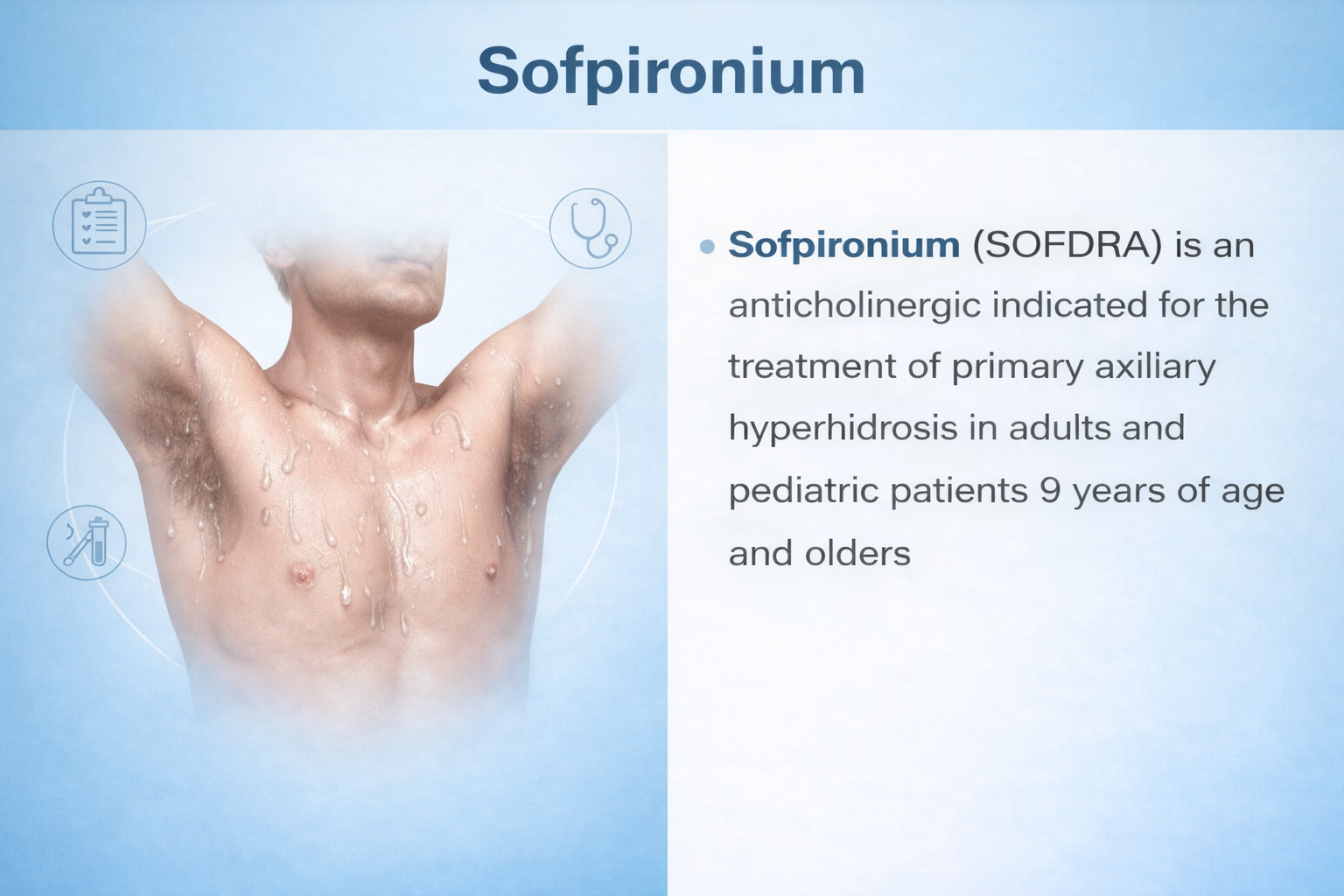
Sofpironium bromide is a new molecular entity and small molecule quaternary ammonium analogue of the anticholinergic glycopyrrolate. It reduces sweat production through selective, competitive inhibition of muscarinic receptor type 3 (M3) — the predominant receptor in axillary eccrine glands. Applied once daily at bedtime via a metered pump applicator, it was studied in adults and pediatric patients ≥9 years with primary axillary hyperhidrosis. NDA 217347 was submitted September 2022 and received a Complete Response in September 2023 due to human factors deficiencies; the clinical discipline recommended approval following a Class 2 resubmission reviewed in June 2024.
| Property | Detail |
|---|---|
| Pharmacologic class | Anticholinergic; muscarinic receptor M3 antagonist; quaternary ammonium analogue of glycopyrrolate |
| Code name | BBI-4000 |
| Molecular type | New molecular entity (NME); small molecule |
| Formulation | Gel, 15%; clear to slightly translucent, colorless to pale yellow; metered pump container with applicator cap |
| Dosing device | Metered pump bottle with applicator cap over the dispenser and a covering cap; one pump actuation per underarm per day |
| Sponsor | Botanix Pharmaceuticals |
| Japan approval | Sofpironium bromide gel 5% approved for marketing in Japan (tradename not specified in review) |
Source: NDA 217347 Multi-disciplinary Review, Ref ID 5249224; Class 2 Resubmission Review, Ref ID 5398431. Review date: June 14, 2024.
| Characteristic | Study 301 SB Gel 15% N=173 | Study 301 Vehicle N=177 | Study 302 SB Gel 15% N=180 | Study 302 Vehicle N=171 |
|---|---|---|---|---|
| Age — Mean (SD), years | 32.9 (11.6) | 32.4 (10.9) | 32.1 (12.2) | 31.7 (11.1) |
| Age — Range | 11, 64 | 14, 71 | 10, 76 | 11, 69 |
| Age 9–11 years, n (%) | 1 (1%) | 0 (0%) | 2 (1%) | 2 (1%) |
| Age 12–17 years, n (%) | 14 (8%) | 12 (7%) | 13 (7%) | 8 (5%) |
| Age 18–64 years, n (%) | 158 (91%) | 163 (92%) | 161 (89%) | 158 (92%) |
| Age ≥65 years, n (%) | 0 (0%) | 2 (1%) | 4 (2%) | 3 (2%) |
| Female, n (%) | 98 (57%) | 99 (56%) | 92 (51%) | 103 (60%) |
| Male, n (%) | 75 (43%) | 78 (44%) | 88 (49%) | 68 (40%) |
| White, n (%) | 140 (81%) | 130 (73%) | 141 (78%) | 133 (78%) |
| Black or African American, n (%) | 31 (18%) | 43 (24%) | 32 (18%) | 34 (20%) |
| Asian, n (%) | 1 (1%) | 3 (2%) | 4 (2%) | 1 (1%) |
| American Indian or Alaska Native, n (%) | 0 (0%) | 0 (0%) | 2 (1%) | 1 (1%) |
| Unknown / not reported, n (%) | 1 (1%) | 1 (1%) | 1 (1%) | 2 (1%) |
| Hispanic or Latino, n (%) | 61 (35%) | 60 (34%) | 48 (27%) | 45 (26%) |
| Not Hispanic or Latino, n (%) | 111 (64%) | 117 (66%) | 132 (73%) | 124 (73%) |
| Not reported, n (%) | 1 (1%) | 0 (0%) | 0 (0%) | 2 (1%) |
Note: ITT population includes duplicate subject enrollments. Race reflects predominant race if multiple races selected. Source: CSR 301 (page 58) and CSR 302 (page 60); reproduced by statistical reviewer using adsl.xpt.
| Characteristic | Study 301 SB Gel 15% N=173 | Study 301 Vehicle N=177 | Study 302 SB Gel 15% N=180 | Study 302 Vehicle N=171 |
|---|---|---|---|---|
| HDSM-Ax-7 — Mean (SD) | 3.5 (0.3) | 3.5 (0.3) | 3.6 (0.3) | 3.6 (0.3) |
| HDSM-Ax-7 — Median | 3.4 | 3.6 | 3.6 | 3.6 |
| HDSM-Ax-7 — Range | 3.0, 4.0 | 2.9, 4.0 | 3.0, 4.0 | 3.0, 4.0 |
| GSP — Mean (SD), mg | 296.2 (257.1) | 298.5 (223.4) | 313.8 (283.7) | 308.4 (267.2) |
| GSP — Median, mg | 214.1 | 228.6 | 207.7 | 231.1 |
| GSP — Range, mg | 38.4, 1512.1 | 20.4, 1523.8 | 38.6, 1773.6 | 8.9, 2356.6 |
| Duration of Symptoms — Mean (SD), months | 179.3 (115.2) | 184.4 (116.9) | 202.6 (131.9) | 194.4 (117.3) |
| Duration of Symptoms — Median, months | 156.3 | 157.2 | 193.6 | 172.4 |
| Duration of Symptoms — Range, months | 6.5, 564.7 | 19.9, 588.6 | 9.1, 712.0 | 16.5, 495.4 |
HDSM-Ax-7 = Hyperhidrosis Disease Severity Measure-Axillary-7-item scale; Baseline/Day 1 (Visit 4) assessment. GSP = Gravimetric Sweat Production; baseline value is the median of observations on Visits 2, 3, and 4 (Visits 2 and 3 within 14 days prior to Baseline/Day 1). Source: Reviewer analysis using adhdsm.xpt, adgsp.xpt, and adsl.xpt.
| Population / Disposition | Study 301 SB Gel 15% N=173 | Study 301 Vehicle N=177 | Study 302 SB Gel 15% N=180 | Study 302 Vehicle N=171 |
|---|---|---|---|---|
| ITT¹, n (%) | 173 (100%) | 177 (100%) | 180 (100%) | 171 (100%) |
| mITT², n (%) | 169 (98%) | 173 (98%) | 180 (100%) | 169 (99%) |
| Safety Population³, n (%) | 173 (100%) | 176 (99%) | 180 (100%) | 171 (100%) |
| Discontinued treatment, n (%) | 19 (11%) | 10 (6%) | 19 (11%) | 13 (8%) |
| Discontinued study, n (%) | 23 (13%) | 15 (8%) | 20 (11%) | 16 (9%) |
| — Adverse event | 5 (3%) | 0 (0%) | 9 (5%) | 0 (0%) |
| — Lost to follow-up | 10 (6%) | 8 (5%) | 4 (2%) | 8 (5%) |
| — Withdrawal by subject | 4 (2%) | 4 (2%) | 6 (3%) | 6 (4%) |
| — Protocol violation | 2 (1%) | 3 (2%) | 0 (0%) | 2 (1%) |
| — Pregnancy | 1 (1%) | 0 (0%) | 0 (0%) | 0 (0%) |
| — Physician decision | 0 (0%) | 0 (0%) | 1 (1%) | 0 (0%) |
| — Other | 1 (1%) | 0 (0%) | 0 (0%) | 0 (0%) |
¹ All randomized subjects (includes subjects with multiple randomizations). ² All subjects randomized only once. ³ Randomized and treated subjects (includes subjects with multiple randomizations). Note: All subjects who discontinued due to adverse events were on the SB gel arm. Four subjects were randomized multiple times across both studies and are excluded from mITT. Source: CSR 301 (page 52) and CSR 302 (page 54); reproduced by statistical reviewer using adsl.xpt.
| Parameter | Detail |
|---|---|
| Design | Multicenter, randomized, double-blind, vehicle-controlled, parallel-group Phase 3 pivotal efficacy and safety study |
| Randomization | 1:1 (SB gel 15%:vehicle); approximately 350 subjects per study |
| Treatment duration | 42 days (6 weeks); once-daily application at bedtime to each axilla; planned mean duration ~42 days |
| Key inclusion criteria | Age ≥9 years; primary axillary hyperhidrosis; HDSM-Ax-7 score 3–4 at screening and baseline; gravimetric sweat production ≥50 mg/axilla and ≥150 mg combined (both axillae) in 5 minutes; symptoms ≥6 months’ duration |
| Co-primary endpoints | (1) Proportion of subjects ≥12 years with ≥2-point improvement in HDSM-Ax-7 score from baseline to end of treatment (EOT); (2) Change from baseline to EOT in gravimetric sweat production (GSP; ranked analysis) |
| Sites | Study 301: 39 U.S. sites, 35 randomized subjects. Study 302: 42 U.S. sites, 33 randomized subjects |
| Trial identifiers | Study 301: BBI-4000-CL-301 (NCT03836287) | Study 302: BBI-4000-CL-302 (NCT03948646) |
| Pediatric note | Only 5 subjects aged 9 to <12 years enrolled across both studies; HDSM-Ax-7 Child Version used; results presented for ≥12 years (Adult Version) per FDA recommendation |
Source: NDA 217347 Multi-disciplinary Review, Ref ID 5249224, Tables 15, 17, and 18 (Section 8). ITT = all randomized subjects. HDSM-Ax-7 = Hyperhidrosis Disease Severity Measure-Axillary-7-item scale. GSP = Gravimetric Sweat Production.
| Endpoint | Study 301 SB Gel N=173 | Study 301 Vehicle N=177 | Study 302 SB Gel N=180 | Study 302 Vehicle N=171 |
|---|---|---|---|---|
| ≥2-pt HDSM-Ax-7 improvement (≥12 yrs) | 50.4% | 32.1% | 63.3% | 47.1% |
| Treatment difference (95% CI) | 18.3% (8.0, 28.7) | 16.2% (5.4, 26.9) | ||
| p-value (HDSM-Ax-7) | 0.0005 | 0.0040 | ||
| Median change in GSP (mg) | −127.8 | −100.3 | −142.6 | −134.2 |
| p-value (GSP ranked analysis) | 0.0019 | 0.0296 | ||
Source: NDA 217347 Multi-disciplinary Review, Ref ID 5249224, Table 1 and Tables 22–29. ITT population; multiple imputation. GSP ranked analysis per protocol (non-normality confirmed). HDSM-Ax-7 = Hyperhidrosis Disease Severity Measure-Axillary-7-item scale; GSP = Gravimetric Sweat Production.
| Adverse Reaction | Sofpironium (N=353) | Vehicle (N=347) |
|---|---|---|
| Dry mouth | 51 (14%) | 2 (0.6%) |
| Vision blurred | 30 (9%) | 1 (0.3%) |
| Mydriasis | 23 (7%) | 0 |
| Urinary retention | 8 (2%) | 0 |
Source: FDA PI NDA 217347 (Ref ID 5399984), §6.1 Table 1. COVID-19 occurred in 8 (2%) sofpironium and 2 (0.6%) vehicle subjects.
| Application Site Reaction | Sofpironium (N=353) | Vehicle (N=347) |
|---|---|---|
| Application site pain | 29 (8%) | 6 (2%) |
| Application site erythema | 23 (7%) | 1 (0.3%) |
| Application site dermatitis | 21 (6%) | 1 (0.3%) |
| Application site pruritus | 16 (5%) | 2 (0.6%) |
| Application site irritation | 8 (2%) | 1 (0.3%) |
| Application site exfoliation | 7 (2%) | 1 (0.3%) |
Source: FDA PI NDA 217347 (Ref ID 5399984), §6.1 Table 2.
| Adverse Reaction | Sofpironium (N=197) — 48 weeks |
|---|---|
| Vision blurred | 19% |
| Dry mouth | 17% |
| Application site pruritus | 15% |
| Application site pain | 15% |
| Application site dermatitis | 11% |
| Application site erythema | 8% |
| Application site irritation | 6% |
| Mydriasis | 5% |
| Application site rash | 4% |
| Upper respiratory tract infection | 4% |
| Dry eye | 4% |
| Urinary retention | 4% |
| Application site exfoliation | 3% |
| Application site folliculitis | 3% |
| Hypertension | 3% |
| Application site dryness | 2% |
| Viral upper respiratory tract infection | 2% |
| Influenza | 2% |
| Headache | 2% |
Source: FDA PI NDA 217347 (Ref ID 5399984), §6.1 ARGYLE long-term safety data.
Source: NDA 217347 Multi-disciplinary Review, Ref ID 5249224; Class 2 Resubmission Review, Ref ID 5398431. Safety population = randomized and treated subjects.
Source: FDA PI NDA 217347 (Ref ID 5399984), Sections 1–5; NDA 217347 Medical Review, Ref ID 5249224; Class 2 Resubmission Review, Ref ID 5398431.
| Interacting Drug/Class | Effect | Recommendation |
|---|---|---|
| Other anticholinergics (§7.1) | Additive anticholinergic adverse effects (e.g., dry mouth, blurred vision, urinary retention, decreased sweating) | Avoid coadministration |
| Strong CYP2D6 inhibitors (§7.2) — e.g., paroxetine 20 mg oral | Paroxetine increased sofpironium Cmax and AUC₀‑t approximately 2-fold in vivo | Avoid coadministration |
| CYP3A4 inhibitors, OCT2 inhibitors, MATE1/MATE2-K inhibitors | No clinically significant differences in sofpironium PK observed in drug interaction studies | No dose adjustment required |
Source: FDA PI NDA 217347 (Ref ID 5399984), §7.1–7.2, §12.3 Drug Interaction Studies.
| Parameter | Recommendation |
|---|---|
| Dose | 1 pump actuation per underarm (axilla) once daily at bedtime; total 2 pump actuations per day |
| Application surface | Clean, dry, intact skin of the underarm area only; do not apply to broken skin |
| Pre-application | Do not shave armpits ≥8 hours before use; do not shower ≥30 minutes before use |
| Post-application | Allow to dry completely (~5 minutes) before putting on clothing; do not shower or wash underarms for ≥8 hours after application |
| Hand hygiene | Wash hands immediately with soap and water after each application — residual gel on hands can cause blurred vision if eyes are touched |
| Occlusion | Avoid occlusive dressings; do not touch underarms after applying |
| Flammability | Avoid fire, flame, and smoking during and immediately following application (gel contains 77.2% v/v dehydrated alcohol) |
| Periocular area | Avoid transfer of gel to periocular area |
| Frequency | Do not use more than once daily |
Source: FDA PI NDA 217347 (Ref ID 5399984), §2 Dosage and Administration.
| Item | Detail |
|---|---|
| Product name | Sofdra™ (sofpironium) topical gel, 12.45% |
| INN / active moiety | Sofpironium (as sofpironium bromide) |
| Dosage form & strength | Topical gel; 12.45% w/w sofpironium (equivalent to 15% sofpironium bromide); clear to translucent, colorless to pale yellow viscous gel |
| Container / delivery device | 50 mL airless bottle with multi-dose metered pump and applicator cap; one pump actuation delivers 0.67 mL (72 mg sofpironium / 87 mg sofpironium bromide); 60 pump actuations per bottle |
| Inactive ingredients | Citric acid; 77.2% v/v dehydrated alcohol; hexylene glycol; hydroxypropyl cellulose; isopropyl myristate |
| NDC | 83723-010-50 |
| Storage | Store upright at 20°C–25°C (68°F–77°F); excursions permitted 15°C–30°C (59°F–86°F) [USP Controlled Room Temperature]. Flammable — keep away from heat or flame. |
| Applicant / manufacturer | Botanix SB Inc., Wayne, PA 19087 |
| Initial U.S. approval | 2024 |
| PI revision date | 06/2024 |
| PI Reference ID | 5399984 |
Source: FDA PI NDA 217347 (Ref ID 5399984), §12.1–12.3 Tables 3 and 4.
| Contact | Detail |
|---|---|
| Reference IDs | 5249224 (original cycle multi-disciplinary review) / 5398431 (Class 2 resubmission review, June 14, 2024) |
| Reviewing division | Division of Dermatology and Dentistry (DDD), Office of Immunology and Inflammation (OII), CDER |
| Clinical reviewer | Roselyn E. Epps, M.D., FAAP, FAAD; Clinical Team Leader: David Kettl, M.D. |
Source: NDA 217347 Class 2 Resubmission Review, Ref ID 5398431; NDA 217347 Multi-disciplinary Review, Ref ID 5249224.
| Domain | Detail |
|---|---|
| PMR/PMC identifier | Not reported in clinical review documents provided (Ref IDs 5249224, 5398431) |
| Postmarketing surveillance | Routine pharmacovigilance; Japan approval (sofpironium bromide 5% gel) provides additional postmarketing safety data |
| REMS | Not required |
| Aspect | Detail |
|---|---|
| Application number | NDA 217347 (Orig1s000) |
| Applicant | Botanix Pharmaceuticals |
| Submission / receipt date | September 23, 2022 |
| PDUFA goal date | September 23, 2023 |
| Review type | Standard Review; Original NDA; New Molecular Entity |
| Complete Response date | September 22, 2023 — HF deficiency only |
| Class 2 resubmission date | December 20, 2023 (SDN 24) |
| Pivotal trials | BBI-4000-CL-301 (NCT03836287) and BBI-4000-CL-302 (NCT03948646) |
| Co-primary endpoints met | Study 301: HDSM-Ax-7 50.4% vs 32.1% (p=0.0005); GSP ranked p=0.0019. Study 302: HDSM-Ax-7 63.3% vs 47.1% (p=0.0040); GSP ranked p=0.0296. All statistically significant. |
| Boxed Warning | None required |
| REMS | Not required |
| Priority Review / Breakthrough | Standard Review; no breakthrough or priority designation reported |
| Japan approval | Sofpironium bromide gel 5% approved in Japan; pharmacovigilance report submitted with resubmission — events consistent with approved labeling |
| Reference IDs | 5249224 (original cycle multi-disciplinary review) / 5398431 (Class 2 resubmission review, June 14, 2024) |
Source: NDA 217347 Class 2 Resubmission Review, Ref ID 5398431 (June 14, 2024); NDA 217347 Multi-disciplinary Review, Ref ID 5249224. Reviewed under Division of Dermatology and Dentistry (DDD), Office of Immunology and Inflammation (OII), CDER.
