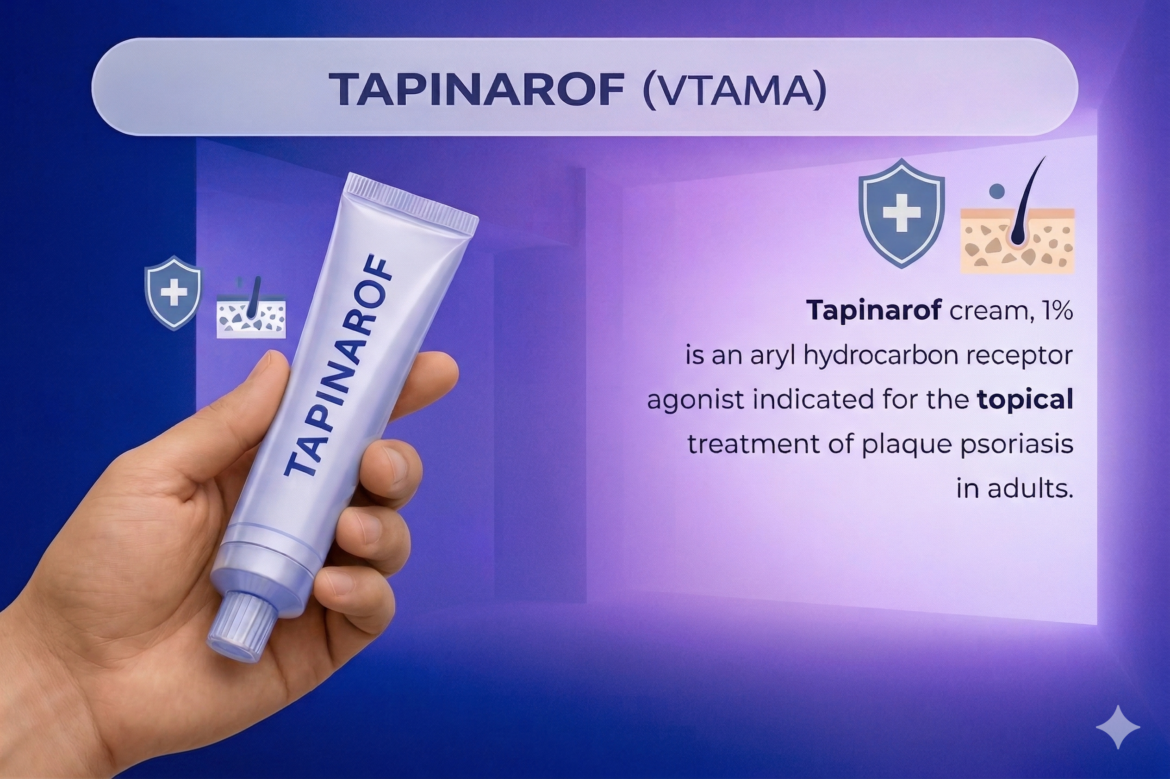
Tapinarof
Tapinarof is a first-in-class aryl hydrocarbon receptor (AhR) agonist for topical use. Activation of the AhR signaling pathway downregulates pro-inflammatory cytokines including IL-17A/F, IL-4, IL-5, IL-6, IL-13, and eotaxin, while upregulating skin barrier proteins including filaggrin, hornerin, and involucrin. Applied once daily as a 1% cream, tapinarof requires no black box warning and carries no contraindications. Approved May 2022 for the topical treatment of plaque psoriasis in adults, it represents a novel non-steroidal mechanism in the dermatology armamentarium.
Drug Overview
NDA 215272Drug Class & Chemistry
| Property | Detail |
|---|---|
| Pharmacologic class | Aryl hydrocarbon receptor (AhR) modulating agonist |
| Chemical name | 3,5-dihydroxy-4-isopropyl-trans-stilbene; also known as (E)-2-isopropyl-5-styrylbenzene-1,3-diol |
| Empirical formula | C₁₇H₁₈O₂; molecular weight 254.32 |
| Physical description | White to pale brown powder |
| Formulation | Cream, 1%; each gram contains 10 mg tapinarof in a white to off-white cream base |
| Sponsor | Dermavant Sciences GMBH / Dermavant Sciences Inc., 3780 Kilroy Airport Way, Long Beach, CA 90806 |
| Initial U.S. Approval | 2022 |
| Code name | N/A (prior research name: GSK2894512) |
AhR Pathway — Mechanism Detail
Source: NDA 215272 label, Ref ID 4986645, Revised 5/2022; NDA 215272 Multi-disciplinary Review, Ref ID 4984343.
Clinical Efficacy
Section 14 — PSOARING 1 & 2Primary Efficacy Endpoint — PGA Treatment Success at Week 12
PGA Treatment Success = PGA score of 0 (“Clear”) or 1 (“Almost Clear”) with ≥2-grade improvement from baseline. ITT population; multiple imputation for missing data.
Secondary Efficacy Endpoints at Week 12
Combined Efficacy Summary Table
| Endpoint | Study 3001 Tapinarof N=340 | Study 3001 Vehicle N=170 | Study 3002 Tapinarof N=343 | Study 3002 Vehicle N=172 |
|---|---|---|---|---|
| PGA Treatment Success (primary) | 35% | 6% | 40% | 6% |
| PASI-75 | 36% | 10% | 48% | 7% |
| PGA 0 or 1 (unrestricted) | 38% | 10% | 44% | 8% |
| PASI-90 | 19% | 2% | 21% | 2% |
| Mean change in %BSA (LS Mean) | −3.5% | −0.2% | −4.2% | +0.1% |
All secondary endpoints statistically superior to vehicle in both trials (p<0.001). ITT population; multiple imputation.
Baseline Demographics (ITT)
| Characteristic | Study 3001 Tapinarof N=340 | Study 3001 Vehicle N=170 | Study 3002 Tapinarof N=343 | Study 3002 Vehicle N=172 |
|---|---|---|---|---|
| Mean Age (SD) | 50 (14) | 49 (13) | 50 (13) | 50 (14) |
| Male, n (%) | 213 (63%) | 86 (51%) | 188 (55%) | 102 (59%) |
| White, n (%) | 286 (84%) | 146 (86%) | 300 (87%) | 138 (80%) |
| Moderate PGA (3), n (%) | 271 (80%) | 133 (78%) | 288 (84%) | 144 (84%) |
| Mean PASI (SD) | 8.7 (4.0) | 9.2 (4.4) | 9.1 (3.7) | 9.3 (4.0) |
| Mean BSA% (SD) | 7.8 (4.6) | 8.2 (5.1) | 7.8 (4.4) | 7.3 (4.1) |
Source: NDA 215272 Multi-disciplinary Review, Ref ID 4984343; NDA 215272 label, Ref ID 4986645, Section 14. NCT IDs: PSOARING 1 = NCT03956355; PSOARING 2 = NCT03983980.
Clinical Pharmacology & Pharmacokinetics
Section 1212.3 Pharmacokinetics — Key Parameters (Day 1 Maximal Use Study, N=21)
Absorption, Distribution, Metabolism, Excretion
| Parameter | Detail |
|---|---|
| Absorption | No accumulation with repeat topical application. Systemic exposure very low — 68% of samples BQL at LLOQ 50 pg/mL. Mean daily dose in PK study: 5.23 g. Cmax and AUC declined substantially from Day 1 to Day 29, consistent with resolution of psoriatic lesions reducing absorption. |
| Distribution | Human plasma protein binding approximately 99% in vitro. Terminal half-life could not be reliably estimated in most subjects due to low plasma concentrations; estimated in only 2 of 21 subjects in the maximal use study. |
| Metabolism | Metabolized in the liver via multiple pathways including oxidation, glucuronidation, and sulfation in vitro. Major biotransformation is extensive across species. CYP enzymes responsible for oxidative metabolism studied in human hepatocytes; minor contributions from CYP1A1, 1A2, 2C8, 2C9, 2C19, 2D6, and 3A4/5. |
| Excretion / Half-life | Terminal half-life not reliably estimable in humans due to BQL concentrations in the elimination phase. Low potential for drug interactions given minimal systemic exposure. |
| Cardiac Electrophysiology | At the approved recommended dosage, VTAMA does not prolong the QTc interval to any clinically relevant extent. QT changes well below the regulatory threshold for concern (<10 ms). |
Drug Interaction Profile (In Vitro)
| Category | Finding |
|---|---|
| CYP Inhibition | Not an inhibitor of CYP2B6, CYP2C8, CYP2C9, CYP2C19, CYP2D6, or CYP3A4/5 |
| CYP Induction | Not an inducer of CYP1A2, CYP2B6, or CYP3A4 |
| Transporter Inhibition | Not an inhibitor of BCRP, MATE1, MATE-2K, OAT1, OAT3, OATP1B1, OATP1B3, OCT1, OCT2, or P-gp |
| Transporter Substrate | Not a substrate for BCRP, OATP1B1, OATP1B3, or P-gp |
| Overall DDI Risk | Low potential for clinically significant drug interactions; topical application to target site means CYP inducers would also not impact efficacy |
Pharmacodynamics
| Parameter | Detail |
|---|---|
| Pharmacodynamics | Pharmacodynamics of VTAMA cream are unknown (per label Section 12.2). No established PK/PD relationship for efficacy; systemic plasma concentrations do not predict efficacy as drug acts directly on target tissue. |
| Exposure–Response | No trend observed between PASI/PGA scores and Cmax or Cmin across Phase 2 and Phase 3 studies. No trend between safety endpoints (headache, contact dermatitis, folliculitis) and systemic exposure. |
| Mechanistic PD | AhR agonism → nuclear translocation → downregulation of IL-4, IL-5, IL-6, IL-13, IL-17A, IL-17F, eotaxin; upregulation of filaggrin, hornerin, involucrin. Dual anti-inflammatory and skin-barrier repair mechanism. |
Nonclinical Toxicology (Section 13)
| Study Type | Finding |
|---|---|
| Carcinogenicity (mice) | No drug-related neoplasms after 98 (females) to 102 (males) weeks of daily topical administration at doses up to 3% tapinarof cream (44× MRHD based on AUC) |
| Carcinogenicity (rats) | No drug-related neoplasms in female rats after 83 weeks of subcutaneous administration at doses up to 1 mg/kg/day (9× MRHD based on AUC) |
| Genotoxicity | No evidence of mutagenicity or clastogenicity: negative in Ames assay, in vitro mammalian chromosomal aberration assay, in vitro mouse lymphoma assay, and two in vivo micronucleus assays (mice and rats) |
| Fertility | Tapinarof did not impair female fertility at subcutaneous doses up to 30 mg/kg/day (268× MRHD based on AUC) |
Source: NDA 215272 label, Ref ID 4986645, Sections 12.1–12.3 and 13.1; NDA 215272 Multi-disciplinary Review, Ref ID 4984343, Sections 5 and 6.
Safety & Adverse Drug Reactions
Section 6Adverse Reactions ≥1% (12-Week Controlled Trials, PSOARING 1 + 2)
| Adverse Reaction | VTAMA cream N=683 n (%) | Vehicle cream N=342 n (%) |
|---|---|---|
| Folliculitisa | 140 (20%) | 3 (1%) |
| Nasopharyngitisb | 73 (11%) | 31 (9%) |
| Contact dermatitisc | 45 (7%) | 2 (1%) |
| Headached | 26 (4%) | 5 (1%) |
| Prurituse | 20 (3%) | 2 (1%) |
| Influenzaf | 14 (2%) | 2 (1%) |
aFolliculitis includes application site folliculitis and folliculitis. bNasopharyngitis includes nasopharyngitis, nasal congestion, pharyngitis, RTI viral, rhinorrhea, sinus congestion, upper RTI, and viral upper RTI. cContact dermatitis includes dermatitis, contact dermatitis, hand dermatitis, and rash. dHeadache includes headache, migraine, and tension headache. ePruritus includes application site pruritus, pruritus, generalized pruritus, and genital pruritus. fInfluenza includes influenza and influenza-like illness.
Key Safety Findings
Warnings & Precautions
- Folliculitis — most common adverse reaction (20%); leading cause of treatment discontinuation (2.8%). Monitor for signs of folliculitis during treatment.
- Contact dermatitis — 7% incidence in controlled trials; leading cause of treatment discontinuation (2.9%). Includes application site dermatitis, hand dermatitis, and rash. Discontinue if severe.
- Urticaria — 0.3% in controlled trials; 1.0% in LTE study. Two subjects developed urticaria in controlled phase.
Use in Specific Populations (Section 8)
Source: NDA 215272 label, Ref ID 4986645, Sections 6.1 and 8; NDA 215272 Multi-disciplinary Review, Ref ID 4984343.
Dosing & Contraindications
Sections 2, 3, 4Standard Dosing
- Apply a thin layer of VTAMA cream to affected areas once daily
- Apply only to psoriasis skin lesions; avoid unaffected areas of skin
- Wash hands after application unless treating the hands
- No dose adjustment specified for body weight or BSA
- Formulation: Cream 1%; each gram contains 10 mg tapinarof
- Supplied in 60 g laminated tubes
Special Populations
- Renal impairment: Not reported in label — systemic exposure minimal with topical use; no dose adjustment expected to be necessary
- Hepatic impairment: Not reported in label — minimal systemic absorption; formal hepatic impairment studies not conducted
- Pediatric (<18 years): Not approved; safety and efficacy not established
- Geriatric (≥65 years): No dose adjustment necessary; no differences in efficacy or safety observed vs. younger adults
- Pregnancy: Use only if potential benefit justifies potential risk; insufficient human data
Contraindications
- None. (Section 4)
Route & Formulation Details
- Route: Topical (cutaneous) only
- NOT for oral, ophthalmic, or intravaginal use
- Active ingredient: tapinarof 10 mg/g (1%)
- Appearance: white to off-white cream
- Apply to any lesion regardless of anatomic location (per pivotal trial design)
Inactive Ingredients (Section 11)
Source: NDA 215272 label, Ref ID 4986645, Sections 2, 3, 4, and 11.
Labeling — How Supplied, Storage & Handling
Section 16| Item | Detail |
|---|---|
| Product description | VTAMA (tapinarof) cream, 1%; white to off-white cream; each gram contains 10 mg tapinarof |
| Package size | 60 g laminated tubes |
| NDC | 81672-5051-1 |
| Storage temperature | Store at 20°C to 25°C (68°F to 77°F); excursions permitted between 15°C and 30°C (59°F and 86°F) |
| Freezing | Do not freeze |
| Heat | Protect from exposure to excessive heat |
| Child safety | Keep out of reach of children |
| Active ingredient | Tapinarof 10 mg/g (1%) |
| Inactive ingredients | Benzoic acid, butylated hydroxytoluene, citric acid monohydrate, diethylene glycol monoethyl ether, edetate disodium, emulsifying wax, medium-chain triglycerides, polyoxyl 2 stearyl ether, polyoxyl 20 stearyl ether, polysorbate 80, propylene glycol, purified water, and sodium citrate dihydrate |
| Marketed by | Dermavant Sciences Inc., 3780 Kilroy Airport Way, Long Beach, CA 90806 |
| Trademark | VTAMA® is a registered trademark of Dermavant Sciences, GmbH or its affiliates |
| Patents | www.dermavant.com/patents |
Patient Support & Adverse Event Reporting
| Contact Type | Detail |
|---|---|
| Patient / HCP information | www.VTAMA.com or call 1-8DERMAVANT |
| Report adverse reactions (sponsor) | Dermavant Sciences, Inc. at 1-8DERMAVANT |
| Report adverse reactions (FDA) | FDA at 1-800-FDA-1088 or www.fda.gov/medwatch |
| Reference ID (label) | 4986645 |
| Label revision date | Revised: 5/2022; Patient Information issued 5/2022 |
Patient Counseling Information (Section 17)
- Apply VTAMA cream once daily to psoriasis skin lesions only — avoid unaffected areas of skin.
- Wash hands after applying VTAMA cream unless treating the hands. If someone else applies the cream, they should also wash their hands after application.
- VTAMA cream is for external (skin) use only. Do not use in the eyes, mouth, or vagina.
- Inform healthcare provider if pregnant, planning pregnancy, or breastfeeding.
Source: NDA 215272 label, Ref ID 4986645, Sections 16 and 17. Label Revised 5/2022. For current labeling, visit https://www.fda.gov/drugsatfda.
Regulatory History
NDA 215272 — Standard ReviewRegulatory Timeline
Regulatory Submission Summary
| Aspect | Detail |
|---|---|
| Application number | NDA 215272 (Orig1s000) |
| Applicant | Dermavant Sciences GMBH |
| Submission / receipt date | May 26, 2021 |
| PDUFA goal date | May 26, 2022 |
| Review type | Standard Review; Original NDA; New Molecular Entity |
| Pivotal trials | DMVT-505-3001 (NCT03956355) and DMVT-505-3002 (NCT03983980) — two adequate and well-controlled Phase 3 trials |
| Primary endpoint met | Study 3001: 35% vs 6% (difference 29%, p<0.001); Study 3002: 40% vs 6% (difference 34%, p<0.001) |
| Regulatory recommendation | Approval recommended by review team based on favorable benefit/risk assessment |
| Boxed Warning | None |
| Contraindications | None |
| Post-marketing requirements (PMR) | Not reported in label |
| REMS | Not required |
| Priority Review / Breakthrough | Standard Review; no breakthrough or priority designation reported in label or review |
| Reference IDs | 4986645 (label, Revised 5/2022) / 4984343 (multi-disciplinary review) |
| Safety database at approval | 683 subjects in 12-week vehicle-controlled studies; 763 subjects in open-label LTE study (PSOARING 3, DMVT-505-3003) for up to 40 additional weeks |
Source: NDA 215272 Multi-disciplinary Review, Ref ID 4984343; NDA 215272 label, Ref ID 4986645, Revised 5/2022. Reviewed under Division of Dermatology and Dentistry (DDD), Office of Immunology and Inflammation (OII), CDER. Tapinarof is the first AhR agonist approved for dermatological use.