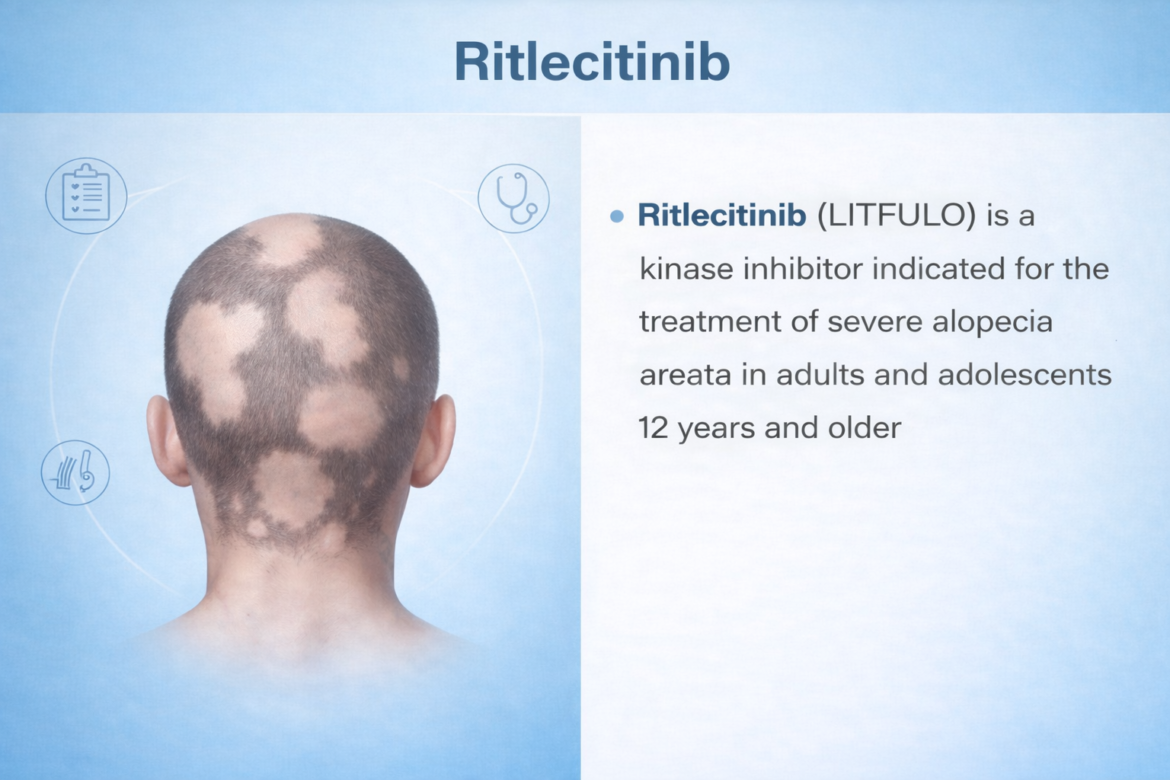
A first-in-class irreversible, covalent inhibitor of JAK3 and the TEC kinase family with a dual mechanism of action — the only approved kinase inhibitor for alopecia areata that targets both JAK3-dependent cytokine signaling and TEC family–dependent immune receptor pathways. Ritlecitinib is indicated for severe alopecia areata (≥50% scalp hair loss) in adults and adolescents ≥12 years, making it the first FDA-approved therapy for adolescents with this condition. Carries a Boxed Warning for serious infections, mortality, malignancy, MACE, and thrombosis consistent with the JAK inhibitor class.
NDA Number215830
Application TypeNDA / Standard Review
Approval DateJune 23, 2023
Dose50 mg orally QD
RouteOral capsule (with or without food)
Reference ID5196496 / 5195916
Drug Overview
NDA 215830
⚠ BOXED WARNING — SERIOUS INFECTIONS, MORTALITY, MALIGNANCY, MACE, THROMBOSIS: Increased risk of serious bacterial, fungal, viral, and opportunistic infections including TB; interrupt treatment if serious infection occurs. Higher rates of all-cause mortality (including sudden CV death), malignancies (lymphomas, lung cancers), MACE (CV death, MI, stroke), and thrombosis (PE, VTE, arterial) observed with another JAK inhibitor vs TNF blockers in RA patients. LITFULO is not approved for RA patients.
Indication
Severe Alopecia Areata
Adults and adolescents ≥12 years; requires ≥50% scalp hair loss (including alopecia totalis and universalis)
Mechanism
JAK3 + TEC Inhibitor
Irreversible covalent inhibitor of JAK3 (cytokine signaling) and TEC kinase family (immune receptor signaling) via ATP binding site blockade
Primary Efficacy (Wk 24)
23.0%
SALT ≤20 response vs 1.6% placebo; Δ +21.4% (95% CI 13.4–29.5%); p<0.00001 — statistically significant at α=0.00125
Pediatric Approval
≥12 Years
First FDA-approved therapy for severe alopecia areata in adolescents 12 to <18 years; efficacy consistent with adults
Mechanism of Action
Section 12.1
Ritlecitinib is a covalent, irreversible kinase inhibitor that blocks the ATP binding site of JAK3 and the TEC kinase family (ITK, BMX, BTK, TEC, TXK). This dual mechanism distinguishes ritlecitinib from reversible JAK inhibitors (baricitinib, abrocitinib, upadacitinib). JAK3 inhibition blocks cytokine-induced STAT phosphorylation mediated by JAK3-dependent receptors (IL-2Rγ/γc chain cytokines: IL-2, IL-4, IL-7, IL-9, IL-15, IL-21). TEC kinase inhibition blocks signaling of immune receptors dependent on TEC family members, including T cell receptor (TCR) and B cell receptor (BCR) signaling via ITK and BTK, respectively. In alopecia areata, cytotoxic CD8+ T cells and NK cells attack anagen-phase hair follicles after loss of immune privilege; JAK3/TEC pathway inhibition suppresses this immune-mediated follicle destruction. The relevance of inhibition of specific JAK or TEC family enzymes to therapeutic effectiveness is not currently known per the prescribing information.
Covalent, irreversible binding: Ritlecitinib forms a covalent bond with a cysteine residue in the ATP-binding site of JAK3 and TEC kinases. This irreversible mechanism means recovery of kinase activity requires de novo protein synthesis rather than drug dissociation — the pharmacodynamic half-life exceeds the plasma half-life (~2 hours). This property supports once-daily dosing despite the short plasma t½ and may contribute to the distinct safety and immunological profile compared to reversible JAK inhibitors.
Label note (Section 12.1): The relevance of inhibition of specific JAK or TEC family enzymes to the therapeutic effectiveness in alopecia areata is not currently known.
Competitive Landscape — FDA-Approved Oral JAK Inhibitors for Severe Alopecia Areata (US)
⚠ Cross-trial comparison caveat: The three approved JAK inhibitors were evaluated in separate trials with different primary endpoint timepoints (Week 24 for ritlecitinib and deuruxolitinib; Week 36 for baricitinib), different populations, different baseline disease severity distributions, and different dosing regimens. No head-to-head RCTs exist. Cross-trial SALT ≤20 response rates are presented for descriptive reference only and should not be used to infer relative efficacy.
Drug (Brand)
NDA / Sponsor
FDA Approval
Dose
Selectivity
SALT ≤20 — Primary Endpoint
Timepoint
Population
Ritlecitinib (LITFULO)
NDA 215830 / Pfizer
Jun 23, 2023
50 mg QD oral
JAK3 + TEC kinase family (irreversible covalent)
23.0% vs 1.6% placebo; Δ +21.4% (95% CI 13.4–29.5%); p<0.00001 at α=0.00125
Week 24
Adults + adolescents ≥12 yrs; no CYP2C9 restriction; first approved for adolescents
29% (AA-1) / 32% (AA-2) vs 1% placebo; Δ +28%/+31% (95% CI 23–33%/25–37%)
Week 24
Adults ≥18 only; CYP2C9 PGx required; contraindicated in CYP2C9 PMs and with CYP2C9 inhibitors
Disease context — Alopecia Areata: AA is a chronic autoimmune T-cell–mediated disease targeting anagen hair follicles causing nonscarring hair loss. ~5% develop alopecia totalis; ~1% develop alopecia universalis. Mean age of onset ~30 years. Prior to baricitinib approval in June 2022, no FDA-approved systemic therapy existed for severe AA. Prior to ritlecitinib approval in June 2023, no therapy was approved for adolescents ≥12 years.
Sources: NDA 215830 label, Ref ID 5196496 (Revised 6/2023); Medical Review Ref ID 5195916. Baricitinib: King B et al., N Engl J Med 2022;386:1687–1699, DOI: 10.1056/NEJMoa2110343. Deuruxolitinib: NDA 217900 label, Ref ID 5418989 (Revised 7/2024). Cross-trial comparisons are descriptive — different timepoints (Wk 24 vs Wk 36) and populations preclude direct efficacy ranking. Ritlecitinib is not recommended in combination with other JAK inhibitors, biologic immunomodulators, cyclosporine, or other potent immunosuppressants.
Baseline & Trial Characteristics
Table 8–9, NDA 215830 Medical Review (Study B7981015)
Total Enrolled (Pivotal Trial)
718
Study B7981015; 7 treatment arms; 128 centers across 18 countries; 195 (27%) US subjects
Subjects ≥12 years; ≥50% scalp hair loss due to alopecia areata; no evidence of terminal scalp hair regrowth within prior 6 months; current episode duration ≤10 years
2:2:2:2:1:1:1 (arms A:B:C:D:E:F:G); stratified by age (<18 vs ≥18 years) and AT/AU status
Primary endpoint (FDA)
SALT ≤20 (≤20% scalp hair loss) at Week 24; overall α = 0.00125
Key secondary endpoint (FDA)
SALT ≤10 (≤10% scalp hair loss) at Week 24
Additional secondary endpoints
SALT ≤20 and SALT ≤10 at Weeks 4, 8, 12, 18, 28, 34, 40, 48; SALT75 (75% improvement) at multiple visits; EBA (eyebrow) and ELA (eyelash) assessments — not included in labeling due to multiplicity control
Statistical method
Miettinen-Nurminen method for 95% CI; multiplicity control: graphical procedure (200/50 mg → 50 mg + 200/30 mg via Holm → 30 mg); 10 mg not included
SALT score context: The Severity of Alopecia Tool (SALT) measures the percentage of scalp hair loss by summing hair loss across four scalp regions (left, right, top, back). Scores range from 0 (no hair loss) to 100 (complete hair loss). Entry criterion of ≥50% scalp hair loss with mean baseline SALT of ~90 confirms a population with near-total/complete hair loss. The stringent entry criteria (no regrowth within 6 months; episode duration ≤10 years) ensured enrollment of subjects with established, active severe disease rather than recent-onset cases likely to spontaneously resolve.
Source: NDA 215830 Medical Review, Ref ID 5195916. AT = alopecia totalis (100% scalp); AU = alopecia universalis (all body hair). Randomization stratified by age (<18 vs ≥18 years) and AT/AU status. Enrollment targets: ~40% AT/AU, ~15% adolescents. Higher proportion of Asian subjects in ritlecitinib 50 mg arm (33%) vs placebo (24%) — consistent efficacy across race subgroups confirmed. Note: some European countries only enrolled adults (18–74 years).
STUDY B7981015 (N=718) · Phase 2b/3 · 18 Countries · 128 Centers
Proportion of subjects with ≤20% scalp hair loss (SALT ≤20) at Week 24. All four higher-dose arms statistically significant vs placebo at prespecified α=0.00125 under graphical multiplicity procedure. Marketed dose is ritlecitinib 50 mg QD (without loading dose).
Ritlecitinib 200/50 mg (N=124)
30.6%
⭢ Ritlecitinib 50 mg QD (N=124) ← marketed
23.4%
Ritlecitinib 200/30 mg (N=121)
22.3%
Ritlecitinib 30 mg QD (N=119)
14.3%
Ritlecitinib 10 mg QD (N=59)
1.7%
Placebo (N=130)
1.5%
Label Efficacy Table — Ritlecitinib 50 mg vs Placebo at Week 24
Label Table 7 / Medical Review Table 1 (FAS/Analysis #4)
Endpoint
Ritlecitinib 50 mg QD (N=130)
Placebo (N=131)
Difference from Placebo (95% CI)
p-value
SALT ≤20 at Week 24 (Primary — ≤20% scalp hair loss)
23.0% (30/130)
1.6% (2/131)
+21.4% (13.4%, 29.5%)
<0.00001
SALT ≤10 at Week 24 (Key Secondary — ≤10% scalp hair loss)
13.4% (17/127)
1.5% (2/131)
+11.9% (5.4%, 18.3%)
Significant
Sensitivity analyses (Analysis #1–#4)
22.3%–23.7%
1.5%–1.6%
All four prespecified analyses: p<0.000001 — consistent across all missing data methods
Subgroup Analysis — SALT ≤20 at Week 24, Ritlecitinib 50 mg vs Placebo
Table 12, FAS/Analysis #1
Subgroup
Ritlecitinib 50 mg n/N (%)
Placebo n/N (%)
Treatment Difference (95% CI)
Age <18 years
4/16 (25.0%)
0/19 (0%)
+25.0% (5.5%, 49.9%)
Age 18–64 years
24/105 (22.9%)
1/106 (0.9%)
+22.0% (14.4%, 31.0%)
Female
25/69 (36.2%)
2/85 (2.4%)
+33.8% (22.7%, 46.0%)
Male
4/55 (7.3%)
0/45 (0%)
+7.3% (−0.9%, 17.3%)
White
18/74 (24.3%)
1/93 (1.1%)
+23.2% (14.3%, 34.3%)
Asian
10/42 (23.8%)
1/31 (3.2%)
+20.6% (4.8%, 36.1%)
AT/AU at baseline (SALT=100)
4/55 (7.3%)
0/60 (0%)
+7.3% (1.0%, 17.3%)
Non-AT/AU at baseline
25/69 (36.2%)
2/70 (2.9%)
+33.3% (22.4%, 46.6%)
Hispanic or Latino
5/11 (45.5%)
0/11 (0%)
+45.5% (13.1%, 72.5%)
Subgroup heterogeneity note: Treatment effects were larger in female subjects than male subjects (36.2% vs 7.3%) and in non-AT/AU subjects than AT/AU subjects (36.2% vs 7.3%). This pattern was consistent across all dose groups and is clinically meaningful: subjects with complete hair loss (AT/AU) have lower absolute response rates than those with severe but not complete alopecia. Effects were consistent across pediatric and adult age groups and across White and Asian race subgroups.
Eyebrow and eyelash endpoints (EBA/ELA): Secondary endpoints for eyebrow and eyelash assessment showed favorable numerical trends with ritlecitinib vs placebo. However, these endpoints were not included in labeling because multiplicity control was not extended to the set of secondary endpoints in the FDA submission plan. Per medical review: “the efficacy results for these secondary endpoints will not be included in the product labeling.” Eyebrow abnormality at baseline: ~83% of subjects. Eyelash abnormality: ~75%.
Source: NDA 215830 label Table 7, Ref ID 5196496; Medical Review Tables 1, 10–12, Ref ID 5195916. SALT = Severity of Alopecia Tool (0–100; 0=no hair loss, 100=complete hair loss). FAS = Full Analysis Set (all randomized subjects). Primary endpoint at α=0.00125 reflecting multiplicity across 4 dose comparisons. Analysis #1 (COVID-19 excluded/other NRI) reported in medical review Table 10; Analysis #4 (MI/MAR for COVID-19/NRI for other) reported in label Table 7. All analyses concordant. Loading dose regimen (200/50 mg) showed faster initial response but equivalent Week 48 efficacy vs 50 mg flat-dose, with worse lymphopenia safety profile — rationale for selecting 50 mg QD without loading dose as the marketed regimen.
Safety Profile
Section 6.1 (Label) / Integrated Safety Database
⚠ BOXED WARNING (JAK Inhibitor Class): Serious infections (including TB, COVID-19, opportunistic); higher all-cause mortality (including sudden CV death) vs TNF blockers in RA; malignancies (lymphoma, lung cancer); MACE (CV death, MI, stroke); thrombosis (PE, DVT, arterial) — all observed with another JAK inhibitor vs TNF blockers in RA patients ≥50 years with ≥1 CV risk factor. LITFULO not approved for RA.
Safety database overview: Safety evaluated in three randomized placebo-controlled trials plus one long-term trial. Total exposure: 1,628 subjects treated with ritlecitinib representing 2,085 subject-years; 1,011 subjects with ≥1 year of exposure. In the placebo-controlled period: 668 subjects on ritlecitinib (130 on 50 mg QD for up to 24 weeks). No deaths through Week 48. 2 subjects (1.5%) on ritlecitinib 50 mg discontinued due to adverse reactions.
Adverse Reactions ≥1% in Placebo-Controlled Period (Label Table 2)
Ritlecitinib 50 mg QD N=130 vs Placebo N=213; up to 24 weeks
Adverse Reaction
Ritlecitinib 50 mg N=130
Placebo N=213
Notes
Headache (incl. migraine)
14 (10.8%)
18 (8.5%)
Most common ADR; modest excess over placebo
Diarrhea (incl. frequent bowel movements)
13 (10.0%)
8 (3.8%)
GI adverse effect; consistent with JAK inhibitor class
Acne (incl. acne pustular)
8 (6.2%)
10 (4.7%)
Similar to placebo; skin-related
Rash (incl. allergic dermatitis)
7 (5.4%)
2 (0.9%)
Notable excess vs placebo; monitor; may require interruption
Urticaria
6 (4.6%)
3 (1.4%)
8.23 vs 4.03/100 pt-yrs (50 mg vs placebo); median onset 8 wks; median duration 7 days; mostly mild-moderate
Folliculitis
4 (3.1%)
4 (1.9%)
Minor excess; skin-related
Pyrexia
4 (3.1%)
0 (0%)
Excess vs placebo; monitor for infection
Atopic dermatitis
3 (2.3%)
1 (0.5%)
May be comorbid condition in AA population
Dizziness
3 (2.3%)
3 (1.4%)
Minor excess
Blood CPK increased
2 (1.5%)
0 (0%)
Monitor CPK at baseline; elevated CPK associated with ritlecitinib vs placebo
Herpes zoster
2 (1.5%)
0 (0%)
1.17/100 pt-yrs across all trials; multi-dermatomal HZ reported (opportunistic); recommend prophylactic HZ vaccination pre-treatment
Red blood cell count decreased
2 (1.5%)
0 (0%)
Monitor CBC; ALC and platelet monitoring required
Stomatitis
2 (1.5%)
0 (0%)
Oral mucosal adverse effect
Specific Safety Events — Integrated Across All Clinical Trials
Serious Infections
12 subjects (0.66/100 pt-yrs) across all trials on ritlecitinib 50 mg or higher. Most common: appendicitis, COVID-19 pneumonia, sepsis. Multi-dermatomal herpes zoster (opportunistic): 2 subjects (0.1/100 pt-yrs). Overall infections: 50.71/100 pt-yrs vs 80.35/100 pt-yrs for placebo.
Herpes Zoster
21 subjects (1.17/100 pt-yrs) across all trials. Multi-dermatomal HZ (opportunistic) reported. Recommend prophylactic HZ vaccination prior to treatment initiation. Consider treatment interruption if HZ develops until episode resolves.
Malignancy
7 subjects (0.37/100 pt-yrs) excluding NMSC across all trials on ritlecitinib 50 mg or higher. 1 breast cancer reported in higher-dose placebo-controlled period. Periodic skin examination recommended. Higher risk of lymphoma/lung cancer with JAK inhibitors observed in RA studies (class warning).
Thromboembolic Events
1 PE (0.06/100 pt-yrs); 1 retinal artery occlusion; 1 acute MI — all across integrated trials. Avoid ritlecitinib in patients at increased thrombosis risk. Interrupt treatment if thrombosis or embolism symptoms occur.
Hematologic — Lymphocytes
Dose-dependent decreases in ALC, T cells (CD3, CD4, CD8), and NK cells (CD16/56) — stable through Week 48. B cells (CD19) unaffected. Confirmed ALC <500/mm³: 1 subject (<0.1%) at 50 mg. ALC must be ≥500/mm³ before initiating; interrupt if ALC falls below. Age (≥65) is risk factor for lower ALC.
Hematologic — Platelets
Decreased platelet count observed; maximum effect within 4 weeks, then stable. 1 subject (<0.1%) with confirmed platelet count <100,000/mm³; no subject <75,000/mm³. Platelet count ≥100,000/mm³ required before initiating; discontinue if platelets fall <50,000/mm³.
Liver Enzyme Elevations
ALT/AST ≥5× ULN observed in clinical trials (excess vs placebo). Evaluate at baseline; interrupt if drug-induced liver injury suspected. Prompt investigation of cause required. Monitor per routine patient management.
Animal Toxicology — Axonal Dystrophy (Dogs)
In 9-month dog studies, dose-related reversible axonal dystrophy in brainstem, spinal cord, sciatic nerve, myenteric plexuses at ≥20 mg/kg/day (14× MRHD). Reversible hearing loss and BAEP deficits at 40 mg/kg/day (33× MRHD). No auditory deficits at 6 months after dosing cessation. Mechanism not attributed to JAK3/TEC inhibition. Not observed at doses ≤20 mg/kg/day. Clinical relevance at 50 mg QD human dose unclear; referenced in Section 13.2 of label.
Warnings & Precautions
Section 5
Serious Infections (5.1): Screen for TB before treatment; do not initiate in active TB; start anti-TB therapy for latent TB before ritlecitinib. Screen for viral hepatitis. Interrupt treatment if serious infection develops; resume once controlled. Most common: appendicitis, COVID-19 pneumonia, sepsis.
Mortality (5.2): Higher all-cause mortality including sudden CV death with another JAK inhibitor vs TNF blockers in RA patients ≥50 years with ≥1 CV risk factor. LITFULO not approved for RA.
Malignancy and Lymphoproliferative Disorders (5.3): Malignancies including NMSC observed in LITFULO trials. Higher rates of lymphoma and lung cancer with JAK inhibitor class vs TNF blockers. Consider risks/benefits in patients with known malignancy (except treated NMSC or cervical cancer). Periodic skin examination.
MACE (5.4): Higher rate of CV death, non-fatal MI, non-fatal stroke with another JAK inhibitor vs TNF blockers in RA. Discontinue ritlecitinib if patient experiences MI or stroke.
Thromboembolic Events (5.5): PE and retinal artery occlusion reported. Higher thrombosis rates with JAK inhibitor class vs TNF blockers in RA. Avoid in patients at increased thrombosis risk; interrupt and evaluate promptly if symptoms occur.
Hypersensitivity (5.6): Anaphylactic reactions, urticaria, and rash reported. Discontinue and treat if clinically significant hypersensitivity occurs.
Laboratory Abnormalities (5.7): Monitor ALC and platelet count before initiation, at 4 weeks, then per routine management. Interrupt if ALC <500/mm³; discontinue if platelets <50,000/mm³. Monitor LFTs and CPK.
Vaccinations (5.8): Avoid live vaccines during or shortly prior to treatment. Update all immunizations including prophylactic herpes zoster vaccine before initiating ritlecitinib.
Source: NDA 215830 label, Ref ID 5196496 (Revised 6/2023); Medical Review, Ref ID 5195916. Boxed Warning class warnings derived from ORAL Surveillance study of tofacitinib (another JAK inhibitor) in RA patients; not from ritlecitinib studies. Ritlecitinib safety database: 2,085 subject-years, 1,628 subjects; 1,011 with ≥1 year of exposure. No deaths through Week 48 in ritlecitinib clinical trials.
Pharmacology & Pharmacokinetics
Section 12 / Label
Oral Bioavailability
~64%
Absolute oral bioavailability. Ritlecitinib peak plasma concentrations reached within 1 hour of oral dose. Dose-proportional AUC up to 200 mg.
Half-Life (t½)
1.3–2.3 h
Mean terminal half-life. Short plasma t½ — once-daily dosing supported by irreversible covalent binding (pharmacodynamic duration exceeds plasma t½). Steady state reached ~Day 4.
Protein Binding
~14%
Approximately 14% of circulating ritlecitinib bound to plasma proteins — very low protein binding; high free fraction. No significant plasma protein binding–based DDI expected.
Tmax
<1 hour
Peak plasma concentrations reached within 1 hour of oral dose. Food reduces Cmax ~32% and increases AUC ~11% (high-fat meal); not clinically significant — administer with or without food.
Excretion
66% urine / 20% feces
66% of radiolabeled dose excreted in urine; 20% in feces. Only ~4% excreted unchanged in urine — extensive metabolism. >90% eliminated within 48 hours.
QTc Effect
No effect
At 12× mean maximum exposure of the 50 mg QD dose, no clinically relevant QTc interval prolongation observed (Section 12.2 Cardiac Electrophysiology).
Detailed PK Summary
Section 12.3
PK Parameter
Details
Absorption
Absolute oral bioavailability ~64%; Tmax <1 hour; dose-proportional AUC₀-tau and Cmax up to 200 mg; steady state by Day 4
Effect of food
High-fat meal: Cmax reduced ~32%, AUCinf increased ~11% — not clinically significant; administer with or without food
Distribution
~14% plasma protein bound (very low); volume of distribution not specified in label
Metabolism
Multiple pathways — no single route >25% of total. Glutathione S-transferase (GST): cytosolic GST A1/3, M1/3/5, P1, S1, T2, Z1 and microsomal GST 1/2/3; CYP enzymes (CYP3A, CYP2C8, CYP1A2, CYP2C9). Ritlecitinib is NOT an inhibitor of CYP2D6, UGTs, GSTs, SULTs, P-gp, or BSEP.
Excretion
~66% in urine; ~20% in feces; ~4% unchanged in urine; >90% eliminated within 48 hours after a single oral dose up to 800 mg
Half-life
Mean terminal t½ 1.3–2.3 hours (short PK t½ — once-daily dosing supported by irreversible covalent MOA with pharmacodynamic half-life >> plasma t½)
Renal impairment
Severe RI (eGFR <30): AUC 55.2% higher — not clinically significant; no dose adjustment for any renal impairment severity. Not studied in ESRD or renal transplant recipients.
Hepatic impairment
Moderate HI (Child Pugh B): AUC +18.5%, Cmax +4.0% — no dose adjustment. Severe HI (Child Pugh C): not studied; not recommended.
Intrinsic factors
No clinically relevant PK differences by age (12–73 years), body weight, gender, GST genotype, or race per population PK analysis
Monitor and consider dose adjustment of sensitive CYP3A substrates
CYP1A2 substrate (caffeine)
↑ substrate
AUCinf ×2.65 (at 200 mg — 4× approved dose)
Monitor and consider dose adjustment of sensitive CYP1A2 substrates
Oral contraceptives (EE/LNG)
Minor ↓ LNG
AUC LNG ×0.88 — not clinically significant
No clinically significant interaction
CYP2B6, CYP2C, OATP1B1/BCRP/OAT3, OCT1 substrates
Minimal
Not clinically significant
No dose adjustment required
Pharmacodynamics (Section 12.2 — Lymphocyte Subsets): Ritlecitinib produces a dose-dependent early decrease in absolute lymphocyte levels, T lymphocytes (CD3), T lymphocyte subsets (CD4, CD8), and NK cells (CD16/56) — effects remain stable at lower levels through Week 48. At 50 mg QD, the initial decrease in median lymphocyte levels remained consistent up to Week 48. B lymphocytes (CD19) showed no change in any treatment group, consistent with selective JAK3/TEC inhibition (JAK3 signaling relevant to T and NK cells but not B cell development). This sparing of B cells distinguishes ritlecitinib from broader JAK1/2 inhibitors.
Source: NDA 215830 label, Ref ID 5196496 (Sections 12.1–12.3). Drug interaction studies at 200 mg ritlecitinib (4× approved dose) and 400–800 mg (8× approved dose) used for DDI characterization; CYP3A and CYP1A2 inhibition at the 50 mg approved dose expected to be substantially lower. Ritlecitinib molecular formula (tosylate salt): C₂₂H₂₇N₅O₄S; MW 457.55 g/mol. Chemical name: 1-{(2S,5R)-2-Methyl-5-[(7H-pyrrolo[2,3-d]pyrimidin-4-yl)amino]piperidin-1-yl}prop-2-en-1-one 4-methylbenzene-1-sulfonic acid.
Dosing, Administration & Contraindications
Section 2, 4, 5 / Label
Recommended Dose
50 mg QD
Once daily, with or without food; swallow capsules whole — do not crush, split, or chew
Population
≥12 Years
Adults and adolescents 12 years and older; not established in patients <12 years of age
Missed Dose
8-Hour Rule
Take missed dose as soon as possible; skip if <8 hours before next scheduled dose. Interruption <6 weeks not expected to cause significant hair loss.
Contraindication
Hypersensitivity
Known hypersensitivity to ritlecitinib or any of its excipients. No other contraindications listed.
Pre-Treatment Evaluation Checklist
Section 2.1
Required Before Initiating
TB evaluation: Screen for active and latent TB. Do not initiate in active TB. Start anti-TB therapy for latent TB or high-risk negative test prior to initiation.
Viral hepatitis screening: Per clinical guidelines. Not recommended in hepatitis B or C.
ALC: Must be ≥500/mm³. Do not initiate if ALC <500/mm³.
Platelet count: Must be ≥100,000/mm³. Do not initiate if platelets <100,000/mm³.
Liver function tests (LFTs): Evaluate at baseline.
Immunizations: Update all immunizations including prophylactic herpes zoster vaccine according to current guidelines before starting treatment.
Laboratory Monitoring During Treatment
ALC and platelets: Repeat at 4 weeks after initiation and thereafter per routine management.
Interrupt ritlecitinib if ALC <500/mm³; may restart once ALC returns above this value.
Discontinue ritlecitinib if platelet count <50,000/mm³.
LFTs / CPK: Monitor per routine management; prompt investigation if ALT/AST elevation >3× ULN. Interrupt if drug-induced liver injury suspected.
Live vaccines: Avoid during treatment and shortly prior to initiation.
Temporary interruption: <6 weeks not expected to result in significant loss of regrown scalp hair.
Special Populations
Section 8
Population
Guidance
Pregnancy (8.1)
Insufficient data in pregnant women. Animal studies: fetotoxicity and malformations at 49× (rats) and 55× MRHD (rabbits) — only at supratherapeutic doses. Pregnancy registry: 1-877-390-2940. No developmental toxicity in rats at 16× MRHD, rabbits at 12× MRHD.
Lactation (8.2)
No human breast milk data. Ritlecitinib present in rat milk (milk:plasma AUC ratio 2.2). Do not breastfeed during treatment and for 14 hours after last dose (~6 elimination half-lives) due to serious infection and malignancy risks.
Pediatric Use (8.4)
Safety and efficacy established in patients 12–<18 years. 181 pediatric patients enrolled across AA trials; 105 in pivotal placebo-controlled trial. Efficacy consistent with adults. AE profile similar to adults. Not established <12 years.
Geriatric Use (8.5)
No dose adjustment for ≥65 years. Only 28 patients ≥65 years in AA trials (none ≥75 years). Caution due to higher general infection risk in elderly; age is risk factor for lower ALC.
Hepatic Impairment (8.6)
No dose adjustment for mild (Child Pugh A) or moderate (Child Pugh B) HI. NOT RECOMMENDED in severe HI (Child Pugh C) — not studied.
Renal Impairment
No dose adjustment for any renal impairment severity (mild, moderate, severe). Not studied in ESRD or renal transplant recipients.
Storage & Supply
Section 16
Item
Detail
Storage
20°C–25°C (68°F–77°F); excursions permitted 15°C–30°C (59°F–86°F); keep in original package
Capsule description
Size 3, opaque; yellow body printed “RCB 50”; blue cap printed “Pfizer” in black
NDC
0069-0334-28 (28 count bottle in child-resistant HDPE bottle with desiccant canister)
Manufacturer
Pfizer Labs, Division of Pfizer Inc., New York, NY 10001
Limitations of use
Not recommended in combination with other JAK inhibitors, biologic immunomodulators, cyclosporine, or other potent immunosuppressants
Source: NDA 215830 label, Ref ID 5196496, Revised 6/2023. LAB-1469-0.8. Contact Pfizer for adverse reactions: 1-800-438-1985. FDA MedWatch: 1-800-FDA-1088. Pregnancy registry: 1-877-390-2940. Medical information: www.pfizermedinfo.com or 1-800-438-1985.
Regulatory History
NDA 215830 — Standard Review
Application Type
NDA 505(b)(1)
New Drug Application; Standard Review. New Molecular Entity (NME). PREA triggered as new active ingredient.
Reviewing Division
DDD/OII
Division of Dermatology and Dentistry, Office of Immunology and Inflammation, CDER. Review completed June 22, 2023.
PDUFA Goal Date
Jun 24, 2023
Submitted and received June 24, 2022; approved June 23, 2023 — one day before PDUFA goal date
Approval Date
Jun 23, 2023
First kinase inhibitor approved for adolescents ≥12 years with severe alopecia areata; second JAK inhibitor approved for AA after baricitinib (June 2022)
FDA primary endpoint changed from SALT ≤10 to SALT ≤20 at Week 24 for FDA/PMDA submissions (SALT ≤10 moved to key secondary). Overall significance level set at α=0.00125 for multiplicity across dose comparisons.
JUNE 2022
Baricitinib (OLUMIANT) Approved for Severe AA
First FDA-approved systemic therapy for adults with severe AA (NDA 213049, approved Jun 13, 2022). Adults only; ritlecitinib would later become first therapy approved for adolescents ≥12 years.
JUNE 24, 2022
NDA 215830 Submitted and Received
Pfizer submitted NDA 215830 for ritlecitinib 50 mg once daily for treatment of alopecia areata. Standard Review. PDUFA goal date: June 24, 2023. Triggered PREA as new active ingredient.
JUNE 22, 2023
Multi-Disciplinary Review Completed
NDA 215830 multi-disciplinary review completed. Recommendation: Approval for treatment of severe alopecia areata in adults and adolescents ≥12 years. Single adequate and well-controlled trial (B7981015) sufficient for approval given stringent significance threshold (α=0.00125).
JUNE 23, 2023
FDA Approval — NDA 215830
LITFULO (ritlecitinib) 50 mg capsules approved for severe alopecia areata in adults and adolescents ≥12 years. First kinase inhibitor approved for adolescents with AA. Ref ID 5196496 (label), 5195916 (medical review). Label Revised: 6/2023.
Regulatory Submission Summary
Aspect
Detail
Application number
NDA 215830 (Orig1s000)
Code name
PF-06651600
Applicant
Pfizer, Inc. / Pfizer Labs, Division of Pfizer Inc., New York, NY 10001
Submission / receipt date
June 24, 2022
PDUFA goal date
June 24, 2023
Review completion date
June 22, 2023
Approval date
June 23, 2023
Pivotal trial
Study B7981015 (Phase 2b/3, N=718) — single adequate and well-controlled trial; significance threshold α=0.00125
Primary endpoint met
SALT ≤20 at Week 24: 23.0% (ritlecitinib 50 mg) vs 1.6% (placebo); Δ +21.4%; p<0.00001 — significant at α=0.00125
Statistical standard
Single trial with high internal and external validity; all four pre-specified supplementary analyses concordant; consistent across centers, demographic subgroups, and all missing data methods
PREA obligations
Triggered as new active ingredient; post-marketing requirements for pediatric studies in patients 6–<12 years (efficacy/safety studies); pediatric long-term extension study (B7981032) ongoing
Source: NDA 215830 label, Ref ID 5196496, Revised 6/2023; NDA 215830 Multi-disciplinary Review, Ref ID 5195916, completed June 22, 2023. Reviewed under Division of Dermatology and Dentistry (DDD), Office of Immunology and Inflammation (OII), CDER, FDA. Ritlecitinib is the second JAK inhibitor approved for alopecia areata in the US and the first approved for adolescents 12–<18 years with severe AA.