Physical Address
304 North Cardinal St.
Dorchester Center, MA 02124
Physical Address
304 North Cardinal St.
Dorchester Center, MA 02124

Clarity in Trials, Confidence in Decisions
Clarity in Trials, Confidence in Decisions
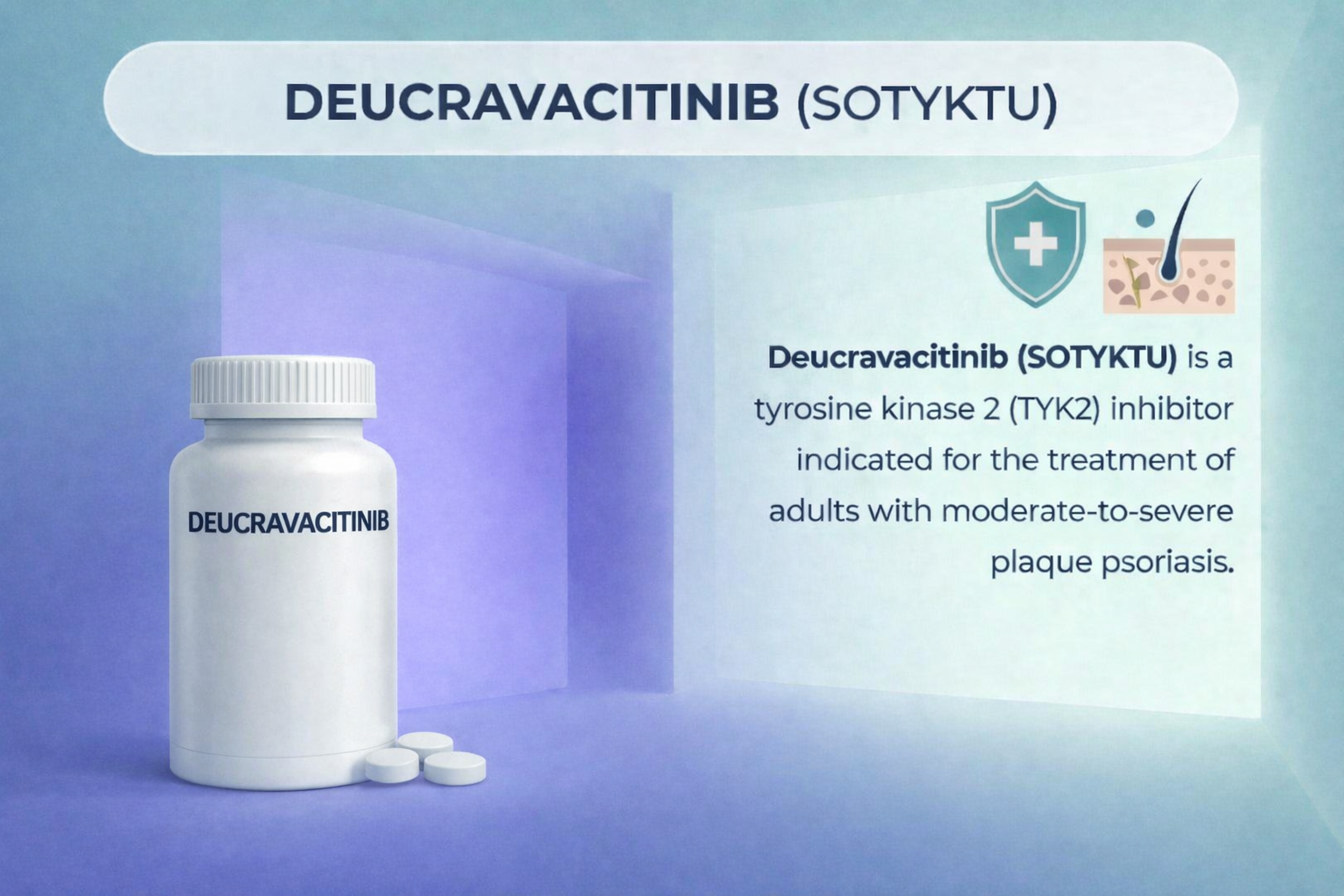
The world’s first tyrosine kinase 2 (TYK2) inhibitor approved for any indication. Deucravacitinib binds selectively to the regulatory pseudokinase (JH2) domain of TYK2 — not the catalytic domain — producing allosteric inhibition distinct from all approved JAK inhibitors. This unique binding mechanism underpins an efficacy advantage over apremilast and a differentiated safety profile compared to JAK1/2 inhibitors, without the full JAK inhibitor Boxed Warning. Approved September 2022 for moderate-to-severe plaque psoriasis in adults who are candidates for systemic therapy or phototherapy.
Deucravacitinib is an inhibitor of tyrosine kinase 2 (TYK2). TYK2 is a member of the JAK kinase family. Unlike tofacitinib, baricitinib, upadacitinib, abrocitinib, and ritlecitinib — all of which bind the ATP-binding catalytic (JH1) domain — deucravacitinib binds the regulatory pseudokinase (JH2) domain of TYK2, stabilising an autoinhibitory interaction between the regulatory and catalytic domains. This results in allosteric inhibition of receptor-mediated TYK2 activation and downstream STAT phosphorylation in cell-based assays. TYK2 pairs with JAK1 to mediate type I IFN and IL-10, IL-6, IL-12, and IL-23 pathways, and pairs with JAK2 to transmit additional signals. In psoriasis, TYK2 mediates key pathogenic cytokine signals including IL-12, IL-23, and type I IFN — all implicated in Th17/Th1 differentiation and the inflammatory cascade driving plaques. In patients with psoriasis, deucravacitinib reduced IL-17A, IL-19, and beta-defensin by 47–50%, 72%, and 81–84% respectively following 16 weeks of treatment. The precise mechanism linking TYK2 inhibition to therapeutic effectiveness in plaque psoriasis is not currently known per the label.
| Parameter | Detail |
|---|---|
| Disease burden | Chronic, inflammatory multi-system disorder affecting ~2–3% of the US population; ~20% have moderate-to-severe disease; one third have concomitant psoriatic arthritis |
| Comorbidities | Cardiovascular disease, metabolic syndrome, depression/suicide, and autoimmune disease are associated with psoriasis; patients with psoriasis are at higher baseline CV risk than the general population |
| Treatment landscape at approval | Anti-metabolites (methotrexate); TNF inhibitors (adalimumab, etanercept, infliximab, certolizumab); IL-12/23 blocker (ustekinumab); IL-17A blockers (secukinumab, ixekizumab); IL-17RA antagonist (brodalumab); IL-23 inhibitors (guselkumab, tildrakizumab, risankizumab); oral small molecules (cyclosporine, acitretin, apremilast); phototherapy |
| Apremilast comparison context | Apremilast (PDE4 inhibitor) achieves sPGA 0/1 (clear/almost clear) in ~16–18% of patients — deucravacitinib’s 50–54% sPGA 0/1 represents a substantially higher response rate, supporting its positioning as the first oral therapy with efficacy approaching lower-tier biologics |
| Approval significance | First approved TYK2 inhibitor for any indication globally; first new oral mechanism class for plaque psoriasis since apremilast (2014); provides an injectable-free oral option with superior efficacy to apremilast |
Source: NDA 214958 label, Ref ID 5043643 (Revised 9/2022); Medical Review Ref ID 5043097. Code name: BMS-986165. Limitations of use: not recommended in combination with other potent immunosuppressants. Not approved for psoriatic arthritis. Deucravacitinib is being evaluated in multiple other indications including lupus and other inflammatory diseases; approved only for plaque psoriasis as of label date.
| Parameter | PSO-1 (IM011046) | PSO-2 (IM011047) |
|---|---|---|
| ClinicalTrials.gov | NCT03624127 | NCT03611751 |
| Design | Multicenter, randomized, double-blind, placebo- and active-controlled (apremilast); 52-week trial with 16-week primary endpoint assessment period | |
| Sample size | Deucravacitinib N=330; Placebo N=166; Apremilast N=168 | Deucravacitinib N=511; Placebo N=255; Apremilast N=254 |
| Co-primary endpoints (vs placebo at Wk 16) | 1. sPGA 0/1 (clear/almost clear) with ≥2-grade improvement from baseline; 2. PASI 75 (≥75% reduction in PASI from baseline) | |
| Secondary endpoints vs placebo (Wk 16) | PASI 90, PASI 100, sPGA 0, ss-PGA 0/1 (scalp), PSSD Symptom Score 0 | |
| Secondary endpoints vs apremilast (Wk 16 & 24) | PASI 75, PASI 90, sPGA 0/1, sPGA 0, ss-PGA 0/1 (scalp) | |
| Inclusion criteria | Adults ≥18 years; moderate-to-severe plaque psoriasis; BSA ≥10%; PASI ≥12; sPGA ≥3 (moderate); candidates for systemic therapy or phototherapy | |
| Placebo switch | All placebo subjects switched to deucravacitinib at Week 16; other subjects could continue or switch at Week 24 | |
| Randomized withdrawal (PSO-2) | Not applicable | PASI 75 responders at Week 24 re-randomized to continue deucravacitinib or withdraw (placebo) to Week 52 — durability assessment |
| Missing data handling | Non-responder imputation (NRI) as primary method; sensitivity: LOCF, LOCF+NRI, MI/FCS, worst-case scenario — all concordant | |
| Statistical method | CMH test stratified by region, body weight, and prior biologic use; multiplicity controlled by pre-specified hierarchical testing procedure | |
| Long-term follow-up | Open-label extension trial; total 1,519 subjects received deucravacitinib; 1,141 exposed ≥1 year | |
| Characteristic | PSO-1 Deucravacitinib (N=330) | PSO-2 Deucravacitinib (N=511) |
|---|---|---|
| Mean age, years (SD) | 45.8 (13.7); range 18–80 | 46.9 (13.4); range 18–84 |
| Age ≥65 years, n (%) | 26 (8%) | 54 (11%) |
| Male, n (%) | 230 (70%) | 336 (66%) |
| White, n (%) | 265 (80%) | 474 (93%) |
| Asian, n (%) | 59 (18%) | 24 (5%) |
| Black or African American, n (%) | 2 (1%) | 8 (2%) |
| Hispanic or Latino (pooled, both trials) | 13% across both trials | |
| Mean weight, kg (SD) | 88.0 (21.8) | 92.3 (21.9) |
| Weight ≥90 kg, n (%) | 131 (40%) | 270 (53%) |
| US subjects, n (%) | 107 (32%) | 163 (32%) |
| Characteristic | PSO-1 Deucravacitinib (N=330) | PSO-2 Deucravacitinib (N=511) |
|---|---|---|
| Mean PASI (SD); Median; Range | 21.8 (8.6); 20; 12–59 | 20.7 (7.5); 19; 12–56 |
| Mean BSA (SD); Median | 26.6% (15.9); 21% | 26.3% (15.8); 20% |
| sPGA 3 (moderate), n (%) | 255 (77%) | 408 (80%) |
| sPGA 4 (severe), n (%) | 75 (23%) | 103 (20%) |
| Scalp involvement (ss-PGA ≥3), n (%) | 209 (63%) | 305 (60%) |
| Nail involvement (PGA-F ≥3), n (%) | 43 (13%) | 69 (14%) |
| Mean disease duration, years (SD); Median | 17.0 (12.4); 13 years | 18.6 (13.1); 16 years |
| Prior systemic therapy (any), n (%) | 199 (60%) | 274 (54%) |
| Prior systemic therapy-naive, n (%) | 131 (40%) | 237 (46%) |
| Prior biologic therapy (pooled) | 35% across both trials | |
| Prior non-biologic systemic therapy | 41% across both trials | |
| Prior phototherapy | 40% across both trials | |
| History of psoriatic arthritis | ~18% across both trials | |
Source: NDA 214958 Medical Review Table 34, Ref ID 5043097. FAS = Full Analysis Set (all randomized subjects; Site 0092 in Trial IM011046 removed per FDA review). PSO-1 had a higher proportion of Asian subjects (18% vs 5% in PSO-2) and lower proportion of White subjects (80% vs 93%) due to inclusion of Asian sites. Demographics were balanced across treatment arms within each trial. APR = apremilast; PBO = placebo; DEUC = deucravacitinib.
Co-primary endpoints vs placebo at Week 16. Secondary endpoints vs apremilast. All p<0.001 for primary comparisons.
sPGA 0/1 RESPONSE
PASI 75 RESPONSE
Confirmatory trial; identical design to PSO-1. Consistent results across both co-primary endpoints. All p<0.001.
sPGA 0/1 RESPONSE
PASI 75 RESPONSE
| Endpoint | PSO-1 DEUC (N=330) | PSO-1 PBO (N=166) | PSO-1 APR (N=168) | PSO-2 DEUC (N=511) | PSO-2 PBO (N=255) | PSO-2 APR (N=254) |
|---|---|---|---|---|---|---|
| sPGA 0/1 Wk 16 (co-primary) | 178 (54%) | 12 (7%) | 54 (32%) | 253 (50%) | 22 (9%) | 86 (34%) |
| PASI 75 Wk 16 (co-primary) | 193 (58%) | 21 (13%) | 59 (35%) | 271 (53%) | 24 (9%) | 101 (40%) |
| PASI 90 Wk 16 | 118 (36%) | 7 (4%) | 33 (20%) | 138 (27%) | 7 (3%) | 46 (18%) |
| PASI 100 Wk 16 | 47 (14%) | 1 (1%) | — | 52 (10%) | 3 (1%) | — |
| sPGA 0 Wk 16 | 58 (18%) | 1 (1%) | 8 (5%) | 80 (16%) | 3 (1%) | 16 (6%) |
| ss-PGA 0/1 Wk 16 (scalp) | 147/209 (70%) | 21/121 (17%) | 43/110 (39%) | 182/305 (60%) | 30/173 (17%) | 61/166 (37%) |
| sPGA 0/1 Wk 24 | 194 (59%) | — | 52 (31%) | 251 (49%) | — | 75 (30%) |
| PASI 75 Wk 24 | 228 (69%) | — | 64 (38%) | 296 (58%) | — | 96 (38%) |
| PASI 90 Wk 24 | 140 (42%) | — | 37 (22%) | 164 (32%) | — | 50 (20%) |
| Response Measure | Week 24 Responders | Week 52 Maintained | Source / Trial |
|---|---|---|---|
| sPGA 0/1 | 194/330 (59%) | 151/194 (78%) | PSO-1 (all continued on deucravacitinib) |
| PASI 75 | 228/330 (69%) | 187/228 (82%) | PSO-1 (all continued on deucravacitinib) |
| PASI 90 | 140/330 (42%) | 103/140 (74%) | PSO-1 |
| sPGA 0/1 — continued deucravacitinib | 118/— re-randomized | 83/118 (70%) | PSO-2 randomized withdrawal arm |
| sPGA 0/1 — withdrawn to placebo | 119/— re-randomized | 28/119 (24%) | PSO-2 withdrawal arm; median time to loss ~8 weeks |
| PASI 75 — continued deucravacitinib | 148/— re-randomized | 119/148 (80%) | PSO-2 randomized withdrawal arm |
| PASI 75 — withdrawn to placebo | 150/— re-randomized | 47/150 (31%) | PSO-2 withdrawal; median time to loss ~12 weeks |
Source: NDA 214958 label Tables 2–3 and Section 14, Ref ID 5043643. Medical Review Tables 35, 39–41, 48, Ref ID 5043097. FAS = Full Analysis Set. NRI = Non-Responder Imputation. DEUC = deucravacitinib; PBO = placebo; APR = apremilast. ss-PGA analysis includes only subjects with baseline ss-PGA ≥3. Examination of age, gender, race, body weight, baseline disease severity, and prior systemic therapy did not identify differences in response to deucravacitinib at Week 16 among these subgroups.
| Adverse Reaction | Deucravacitinib 6 mg QD (N=840) | Placebo (N=419) | Exposure-Adjusted Rate (DEUC vs PBO, /100 pt-yrs, Wk 0–16) | Notes |
|---|---|---|---|---|
| Upper respiratory infections (incl. URTI, nasopharyngitis, pharyngitis, sinusitis, rhinitis, laryngitis, tonsillitis) | 161 (19.2%) | 62 (14.8%) | 116 vs 83.7 per 100 pt-yrs (all infections) | Most common ADR; majority non-serious, mild-moderate; did not lead to discontinuation |
| Blood creatine phosphokinase (CPK) increased | 23 (2.7%) | 5 (1.2%) | 9.3 vs 4.1 /100 pt-yrs (incl. Grade 4) | Rhabdomyolysis cases reported — see Warnings. Discontinue if markedly elevated or myopathy suspected. |
| Herpes simplex (oral, genital, herpes simplex, herpes virus) | 17 (2.0%) | 1 (0.2%) | 6.8 vs 0.8 /100 pt-yrs | Notable excess vs placebo. Multi-dermatomal HZ reported in one immunocompetent subject. |
| Mouth ulcers (aphthous ulcer, stomatitis, tongue ulceration) | 16 (1.9%) | 0 (0.0%) | — | No cases in placebo group; mechanism not established |
| Folliculitis | 14 (1.7%) | 0 (0.0%) | — | No cases in placebo group |
| Acne (acne, acne cystic, dermatitis acneiform) | 12 (1.4%) | 1 (0.2%) | — | Modest excess vs placebo |
| Herpes zoster | <1% | <1% | — | Occurred in <1% in SOTYKTU group (not listed in Table 1); majority of zoster events across trials in subjects <50 years of age |
Source: NDA 214958 label Sections 5–6, Ref ID 5043643 (Revised 9/2022). Safety through Week 52: the exposure-adjusted incidence rate of adverse reactions in subjects treated continuously from Week 0 through Week 52 did not increase compared to the first 16 weeks. Geriatric use (≥65 years): higher rate of overall serious adverse reactions (including serious infections) and discontinuations during Week 0–16 in subjects ≥65 years vs younger adults; no overall difference in effectiveness.
High-fat, high-calorie meal (951 kcal; 52% fat, 33% CHO, 15% protein): Cmax reduced ~24% and AUC reduced ~11%; Tmax prolonged ~1 hour for parent. BMT-153261 similarly reduced ~23% Cmax and ~10% AUC, Tmax prolonged ~2 hours. These changes are not clinically significant. Administer with or without food.
| Population | Deucravacitinib PK Effect | BMT-153261 Effect | Recommendation |
|---|---|---|---|
| Mild RI (eGFR 60–89) | Cmax −14%; AUCinf unchanged | Cmax −11%; AUCinf −2% | No dose adjustment |
| Moderate RI (eGFR 30–59) | Cmax +6%; AUCinf +39% | Cmax −8%; AUCinf +24% | No dose adjustment |
| Severe RI (eGFR <30) | Cmax unchanged; AUCinf +28% | Cmax +28%; AUCinf +81% | No dose adjustment |
| ESRD on dialysis | AUCinf +34%; dialysis removes 5.4% | AUCinf +27% | No dose adjustment |
| Mild HI (Child Pugh A) | Cmax +4%; AUCinf +10% | Cmax −25%; AUCinf −3% | No dose adjustment |
| Moderate HI (Child Pugh B) | Cmax +10%; AUCinf +40% | Cmax −59%; AUCinf −20% | No dose adjustment |
| Severe HI (Child Pugh C) | Cmax +1%; AUCinf +43% | Cmax −79%; AUCinf −50% | NOT RECOMMENDED |
| Body weight, gender, race, age | No clinically meaningful effect on deucravacitinib exposure | No dose adjustment | |
| Interacting Agent | Direction | Magnitude / Notes | Recommendation |
|---|---|---|---|
| CYP1A2 inhibitor (fluvoxamine) | No significant effect on deucravacitinib PK | Not clinically significant | No dose adjustment |
| CYP1A2 inducer (ritonavir) | No significant effect on deucravacitinib PK | Not clinically significant | No dose adjustment |
| Dual Pgp/BCRP inhibitor (cyclosporine) | No significant effect | Not clinically significant | No dose adjustment (DDI only; cyclosporine as potent immunosuppressant is addressed in Limitations of Use) |
| UGT1A9 inhibitor (diflunisal) | No significant effect | Not clinically significant | No dose adjustment |
| OCT1 inhibitor (pyrimethamine) | No significant effect | Not clinically significant | No dose adjustment |
| H2 blocker (famotidine) / PPI (rabeprazole) | No significant effect | pH-dependent solubility does not affect systemic exposure | No dose adjustment |
| Rosuvastatin, methotrexate, MMF, OCP (norethindrone + EE) | No significant effect on co-administered drug PK | Not clinically significant | No dose adjustment for any co-administered drug |
| BCRP substrate / inhibitor | In vitro: BCRP substrate and BCRP inhibitor; also OATP1B3 inhibitor | Clinical significance not established | Monitor per clinical judgement for sensitive BCRP substrates |
Source: NDA 214958 label Section 12, Ref ID 5043643. Molecular formula: C₂₀H₁₉D₃N₈O₃; MW 425.47 (free base). Chemical name: 6-(cyclopropanecarbonylamido)-4-[2-methoxy-3-(1-methyl-1,2,4-triazol-3-yl)anilino]-N-(trideuteriomethyl)pyridazine-3-carboxamide. The D3 (trideuteriomethyl) substitution reduces CYP1A2-mediated N-demethylation, contributing to the longer t½ (10 hours) compared to the non-deuterated analogue. BMT-153261 (active metabolite) has comparable potency to parent but contributes only ~20% of total drug-related exposure at steady state.
| Population | Guidance |
|---|---|
| Pregnancy (8.1) | Insufficient data from case reports. No embryo-fetal toxicity in animals at doses ≥91× MRHD. Advisable to avoid — 13 inadvertent exposures in trials, no reported adverse outcomes. Pregnancy registry: 1-800-721-5072. |
| Lactation (8.2) | No human data. Deucravacitinib and/or metabolites present in rat milk. Consider benefits of breastfeeding vs potential risks. |
| Pediatric Use (8.4) | Safety and effectiveness NOT established. Not approved for any pediatric indication. |
| Geriatric Use (8.5) | 152 subjects (10%) aged ≥65; 21 (1.4%) aged ≥75. Higher rate of serious ADRs including serious infections and discontinuations in ≥65 years during Wk 0–16. No overall difference in effectiveness vs younger adults. |
| Renal Impairment (8.6) | No dose adjustment for mild, moderate, severe renal impairment or ESRD on dialysis. AUCinf modestly higher in moderate (+39%), severe (+28%), and ESRD (+34%); not considered clinically significant. |
| Hepatic Impairment (8.7) | No dose adjustment for mild (Child Pugh A) or moderate (Child Pugh B). NOT RECOMMENDED in severe HI (Child Pugh C). |
| Item | Detail |
|---|---|
| Storage | 20°C–25°C (68°–77°F); excursions 15°–30°C; USP Controlled Room Temperature |
| Tablet description | 6 mg; pink, round, biconvex, film-coated; laser-printed “BMS 895” and “6 mg” on one side |
| NDC | 0003-0895-11 (bottles of 30, child-resistant closure) |
| Manufacturer | Bristol-Myers Squibb Company, Princeton, NJ 08543 USA |
| Patient support | SOTYKTU 360 SUPPORT: 1-888-SOTYKTU (768-9588); www.sotyktu.com |
| Adverse events | 1-800-721-5072 (BMS); FDA MedWatch 1-800-FDA-1088 |
Source: NDA 214958 label, Ref ID 5043643, Revised 9/2022. Inactive ingredients: anhydrous lactose, croscarmellose sodium, hypromellose acetate succinate, magnesium stearate, microcrystalline cellulose, silicon dioxide. Film coating (Opadry® II Pink): iron oxide red, iron oxide yellow, polyethylene glycol, polyvinyl alcohol, talc, titanium dioxide. Solubility of deucravacitinib is pH-dependent; decreases with increasing pH.
| Aspect | Detail |
|---|---|
| Application number | NDA 214958 (Orig1s000) |
| Code name | BMS-986165 |
| Applicant | Bristol-Myers Squibb Company, Princeton, NJ 08543 USA |
| Submission / receipt date | September 10, 2021 |
| PDUFA goal date | September 10, 2022 |
| Review completion date | September 9, 2022 |
| Approval date | September 9, 2022 (Initial U.S. Approval: 2022) |
| Pivotal trials | PSO-1 (IM011046; NCT03624127) and PSO-2 (IM011047; NCT03611751) — two adequate and well-controlled Phase 3 trials |
| Primary endpoints met | sPGA 0/1 at Wk 16: 54% vs 7% (PSO-1) and 50% vs 9% (PSO-2) placebo; PASI 75 at Wk 16: 58% vs 13% (PSO-1) and 53% vs 9% (PSO-2); all p<0.001 |
| Active comparator superiority | Superior to apremilast for sPGA 0/1, PASI 75, PASI 90, ss-PGA 0/1 at Weeks 16 and 24 in both trials; all p<0.001 |
| Unique regulatory features | 1. First TYK2 inhibitor approved for any indication globally. 2. Novel pseudokinase (JH2) domain binding mechanism — allosteric, not competitive ATP-site inhibition. 3. No Boxed Warning despite TYK2 being in the JAK family — per MPPRC decision, labelling communicates scientific information and potential risks but does not impose the full JAK inhibitor Boxed Warning. 4. Post-approval long-term randomised clinical trial with active comparator in psoriasis required as PMR. |
| Reference IDs | 5043643 (label, Revised 9/2022) / 5043097 (multi-disciplinary review) |
| Safety database at approval | 1,519 subjects; 1,141 exposed ≥1 year; two 52-week controlled trials + open-label extension |
Source: NDA 214958 label, Ref ID 5043643, Revised 9/2022; NDA 214958 Multi-disciplinary Review, Ref ID 5043097, completed September 9, 2022. Reviewed under Division of Dermatology and Dentistry (DDD), Office of Immunology and Inflammation (OII), CDER. Deucravacitinib is a new molecular entity with no prior approval in any indication globally at the time of FDA approval. The approval positioned deucravacitinib as the first oral therapy for psoriasis with demonstrated superiority over apremilast in Phase 3 RCTs.
