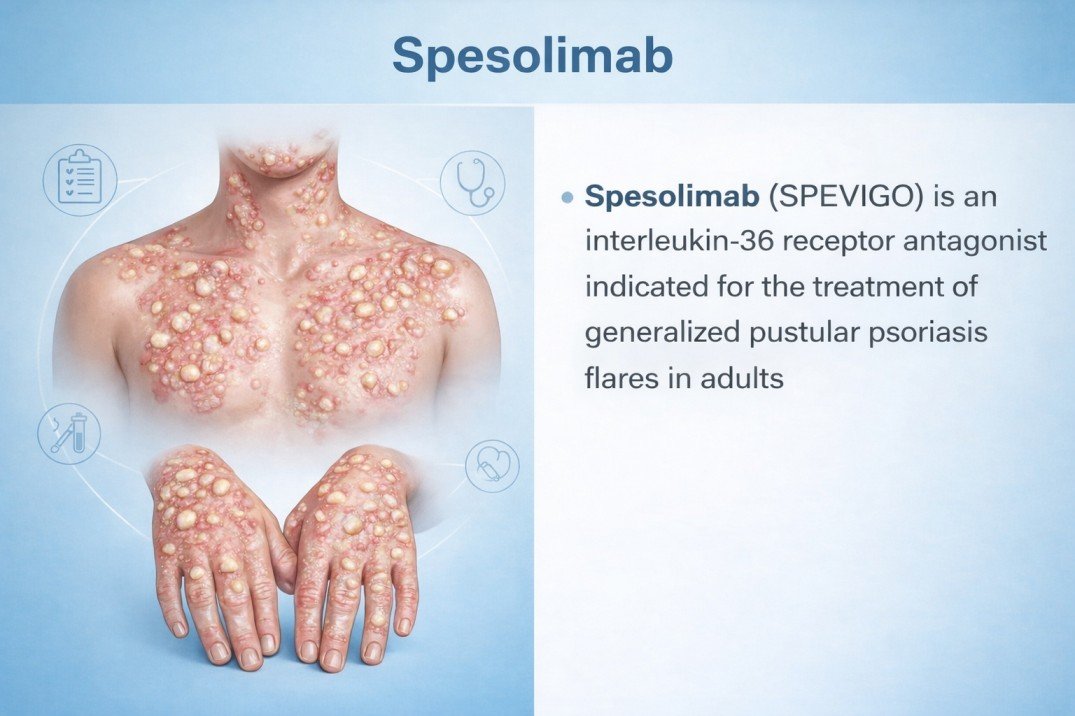
Indication
GPP Flares
Generalized Pustular Psoriasis in adults
Mechanism
IL-36R Antagonist
Humanized monoclonal IgG1 antibody (~146 kDa)
Approved Dose
900 mg IV
Single infusion over 90 min; optional 2nd dose at Week 1
Disease Status
First-in-Class
No prior FDA-approved GPP-specific therapy
Spesolimab-sbzo is a humanized monoclonal IgG1 antibody that inhibits interleukin-36 (IL-36) signaling by specifically binding to the IL-36 receptor (IL36R). By occupying IL36R, spesolimab prevents the binding of all three cognate ligands — IL-36α, IL-36β, and IL-36γ — thereby blocking downstream activation of pro-inflammatory and pro-fibrotic pathways. In GPP, dysregulated IL-36 signaling drives the sterile neutrophilic pustule cascade involving keratinocyte activation, neutrophil recruitment, and systemic inflammation.
Genetic context: Loss-of-function mutations in IL36RN (encoding IL-36Ra, the endogenous IL-36R antagonist) are found in a subset of GPP patients, creating a hyper-activated IL-36 signaling state. The drug is effective regardless of IL36RN mutation status.
Mechanistic note (PI §12.1): The precise mechanism linking reduced IL36R activity and the treatment of GPP flares is not fully elucidated per the prescribing information. Downstream targets include NF-κB and MAPK pathways, which regulate cytokine amplification, keratinocyte hyperproliferation, and neutrophil trafficking characteristic of GPP flare pathophysiology.
| Drug | Target | Approval / Status | Route | Population |
|---|
| Spesolimab (SPEVIGO) | IL-36R antagonist | September 1, 2022 | IV (900 mg) | Adults — GPP flares |
| Imsidolimab (ANB019) | IL-36R antagonist | NDA submitted (AnaptysBio) | SC | Adults — GPP flares (investigational) |
| Acitretin / Cyclosporine | Non-specific immunosuppression | Off-label use | Oral | Conventional systemic therapy |
| TNF-α inhibitors | TNFα | Off-label use | SC / IV | Used off-label in severe GPP |
Primary endpoint: Proportion of subjects with GPPPGA pustulation sub-score of 0 (no visible pustules) at Week 1 after a single 900 mg IV dose. Statistical framework: two-sided Fisher’s exact test; risk difference with 95% CI. Study was not powered for traditional multiplicity-adjusted co-primary analyses given the rare disease context.
Primary Endpoint
GPPPGA Pustulation = 0
No visible pustules at Week 1 post-treatment
Trial Design
RCT, DB, Placebo-Ctrl
2:1 randomization; 12–17 week follow-up
Randomized (N)
53
35 spesolimab · 18 Placebo
Eligibility (GPPPGA)
≥ 3
Moderate-to-severe GPP flare with fresh pustules
Spesolimab 900 mg IV (N=35)
Risk difference vs placebo: 49% (95% CI: 21%–67%) · Source: PI Table 2, BLA 761179 (Ref ID: 5039554)
Source: FDA Prescribing Information, Section 14 (Table 2), BLA 761179 (Ref ID: 5039554). Only Week 1 (primary endpoint) and Week 2 (secondary, 2nd-dose cohort) values are explicitly reported. Subsequent timepoints not reported as discrete response rates in the PI; placebo arm crossed to open-label spesolimab at Week 1 for non-responders — data not separately available for original placebo group beyond Week 1.
| Endpoint | Spesolimab (N=35) | Placebo (N=18) | Note |
|---|
| GPPPGA pustulation sub score = 0 at Week 1 | 54% (19/35) | 6% (1/18) | Primary Endpoint |
| 2nd dose required at Week 1 (symptoms persist) | 34% (12/35) | 83% (15/18) | Open-label rollover |
| GPPPGA pustulation = 0 at Week 2 (among 2nd-dose recipients in spesolimab arm) | 42% (5/12) | — | 2nd dose sub-group |
| Rescue dose required (flare recurrence, Weeks 1–12) | 6 subjects total across both groups received rescue open-label dose | Open-label rescue |
Study limitations: Effisayil-1 enrolled only 53 subjects, reflecting the rarity of GPP. The study did not include sufficient numbers to determine differential response according to biological sex, age, race, baseline GPPPGA pustulation sub score, or baseline GPPPGA total score.
| Characteristic | Spesolimab (N=35) | Placebo (N=18) |
|---|
| Mean Age (range) | 43 years (21–69) | 43 years |
| Female | 68% | 68% |
| Race: Asian | 55% | 55% |
| Race: White | 45% | 45% |
| GPPPGA pustulation sub score 3 | 43% | Not reported separately |
| GPPPGA pustulation sub score 4 | 36% | Not reported separately |
| GPPPGA total score 3 (moderate) | 81% | Not reported separately |
| GPPPGA total score 4 (severe) | 19% | Not reported separately |
| Prior biologic therapy for GPP | 25% | Not reported separately |
| WBC >12 × 10⁹/L at baseline | 45% | 31% |
| Temperature >38°C at baseline | 17% | 11% |
| Both WBC >12 × 10⁹/L and temp >38°C | 12% | 6% |
Boxed Warning: None. No boxed warning in the SPEVIGO (spesolimab-sbzo) prescribing information.
Safety Population (RCT)
53
35 spesolimab · 18 placebo (1-week controlled period)
Clinical Dev. Exposure
~750
Subjects across all spesolimab-sbzo studies (multiple indications)
Infection Rate (Week 1)
14%
Spesolimab vs 6% placebo; most mild-to-moderate
DRESS Cases (Effisayil-1)
2
RegiSCAR: “no DRESS” + “possible DRESS”
- Infections (PI §5.1): Spesolimab may increase infection risk. 14% of spesolimab-treated subjects vs 6% placebo had infections during Week 1 (Effisayil-1). Serious infection (UTI) in 1 subject (3%). Do not initiate during clinically important active infection.
- Tuberculosis (PI §5.2): Evaluate all patients for TB before initiating treatment. Do not administer to patients with active TB. Consider anti-TB therapy for latent TB or unconfirmed TB history before starting spesolimab. Monitor during and after treatment.
- Hypersensitivity & Infusion-Related Reactions (PI §5.3): Includes immediate (anaphylaxis) and delayed (DRESS) reactions. Discontinue immediately for serious hypersensitivity. For mild-to-moderate IRR: stop infusion, treat with antihistamines/corticosteroids, restart at slower rate. Total infusion time must not exceed 180 minutes.
- Vaccinations (PI §5.4): Avoid live vaccines in patients treated with spesolimab. No formal studies of live vaccines in spesolimab-treated patients.
| Adverse Reaction | Spesolimab (N=35)
n (%) | Placebo (N=18)
n (%) |
|---|
| Asthenia and Fatigue | 3 (9%) | 0 |
| Nausea and Vomiting | 3 (9%) | 1 (6%) |
| Headache | 3 (9%) | 1 (6%) |
| Pruritus and Prurigo | 2 (6%) | 0 |
| Infusion site hematoma and bruising | 2 (6%) | 0 |
| Urinary tract infection | 2 (6%) | 0 |
| Bacteremia | 1 (3%) | 0 |
| Bacteriuria | 1 (3%) | 0 |
| Cellulitis | 1 (3%) | 0 |
| Herpes dermatitis and oral herpes | 1 (3%) | 0 |
| Upper respiratory tract infection | 1 (3%) | 0 |
| Dyspnea | 1 (3%) | 0 |
| Eye edema | 1 (3%) | 0 |
| Urticaria | 1 (3%) | 0 |
Week 12 — Single Randomized Spesolimab Dose
Additional mild-to-moderate infections: device-related infection (3%), subcutaneous abscess (3%), furuncle (3%), influenza (3%).
Week 17 — Open-Label 2nd Dose (Week 1 Rollover)
Otitis externa (7%), vulvovaginal candidiasis (4%), vulvovaginal mycotic infection (4%), latent tuberculosis (4%), diarrhea (11%), gastritis (4%).
Guillain-Barré Syndrome — Clinical Development
3 cases reported among ~750 subjects across clinical development (various doses, various indications, not from Effisayil-1 GPP trial). Causal relationship to spesolimab unconfirmed.
Injection Site Reactions — Clinical Development
Erythema, swelling, pain, induration, and warmth observed in clinical development. Manage per infusion reaction protocol.
| SAE Term | Spesolimab (N=35) | Placebo (N=18) | Notes |
|---|
| Urinary tract infection (serious) | 1 (3%) | 0 | Serious infection requiring intervention; resolved |
| DRESS (Drug Reaction with Eosinophilia and Systemic Symptoms) | 2 cases reported | 0 | RegiSCAR validation: 1 “no DRESS”, 1 “possible DRESS” |
ADA development: In Effisayil-1, anti-drug antibodies (ADAs) developed with a median onset of 2.3 weeks after infusion. By Weeks 12–17, 24% (12/50) of subjects had maximum ADA titers >4000 with neutralizing activity. Females had substantially higher immunogenicity rates (30% vs 12% in males). ADA titers <4000 had no apparent PK impact; titers >4000 were associated with significantly reduced plasma spesolimab concentrations. Data on safety/efficacy impact of ADAs upon retreatment are limited.
| Population | Guidance |
|---|
| Pregnancy (8.1) | Limited human data insufficient to inform drug-associated risk. IgG crosses placenta; spesolimab may be transmitted to fetus. Mouse surrogate studies: no embryo-fetal lethality or malformations at IV doses up to 50 mg/kg twice weekly during organogenesis. |
| Lactation (8.2) | No data on presence in human milk. Monoclonal antibodies expected to be present in milk. Weigh benefits of breastfeeding vs maternal clinical need and potential infant risk. |
| Pediatric (8.4) | Safety and effectiveness not established in pediatric patients. |
| Geriatric (8.5) | Only 2 subjects (6%) aged 65–74 enrolled in Effisayil-1; no subjects ≥75 years. Insufficient data to determine differential response in patients ≥65 years. |
Carcinogenicity
Not conducted with spesolimab-sbzo.
Mutagenicity
Not conducted with spesolimab-sbzo.
Fertility (Mouse Surrogate IL36R mAb)
No adverse effects on male or female fertility at IV doses up to 50 mg/kg twice weekly.
Embryo-Fetal / Pre- and Postnatal (Mouse)
Twice-weekly IV dosing up to 50 mg/kg through organogenesis (GD6–LD18): no embryo-fetal lethality, malformations, maternal effects, or postnatal developmental/neurobehavioral/reproductive toxicity in offspring.
Route
IV Infusion
900 mg over 90 minutes; 100% bioavailable (IV)
Cmax (ADA-negative GPP)
238 mcg/mL
95% CI: 218–256 mcg/mL after single 900 mg IV dose
AUC₀–∞
4750 mcg·day/mL
95% CI: 4510–4970; ADA-negative GPP patients
Volume of Distribution (Vss)
6.4 L
Typical steady-state Vd; consistent with vascular compartment
Clearance
0.184 L/day
95% CI: 0.175–0.194 L/day; 70 kg ADA-negative patient
Terminal Half-Life (t½)
25.5 days
95% CI: 24.4–26.3 days; dose-independent (linear range)
Dose proportionality: AUC increases dose-proportionally from 0.3 to 20 mg/kg. CL and terminal half-life are independent of dose. Population PK model was developed from healthy subjects, GPP patients, and patients with other diseases.
Distribution is primarily within the vascular compartment (typical Vss 6.4 L). As a humanized IgG1 monoclonal antibody, spesolimab-sbzo is not expected to undergo significant tissue distribution beyond the circulatory system.
| Parameter | Detail |
|---|
| Metabolic pathway | Not characterized. Expected degradation to small peptides and amino acids via catabolic pathways, similar to endogenous IgG. |
| Clearance (typical 70 kg, ADA-negative) | 0.184 L/day (95% CI: 0.175–0.194 L/day) |
| Terminal t½ | 25.5 days (95% CI: 24.4–26.3 days) |
| Hepatic elimination | Not expected (monoclonal antibody); no formal study conducted |
| Renal elimination | Not expected (monoclonal antibody); no formal study conducted |
| Factor | PK Effect | Clinical Significance |
|---|
| Age | No effect identified in popPK analysis | No dose adjustment required |
| Gender | No effect identified in popPK analysis | No dose adjustment required |
| Race | No effect identified in popPK analysis | No dose adjustment required |
| Body weight | Lower concentrations in higher-weight subjects | Clinical impact unknown; fixed-dose regimen used |
| Hepatic impairment | Not studied formally | Not expected to affect elimination; no guidance available |
| Renal impairment | Not studied formally | Not expected to affect elimination; no guidance available |
| ADA titer >4000 | Significantly reduced plasma spesolimab concentrations | Median ADA onset 2.3 weeks; 24% of subjects affected by Weeks 12–17 |
No formal DDI studies conducted. No formal drug interaction studies have been conducted with spesolimab-sbzo per PI §12.3. As a monoclonal antibody, spesolimab is not expected to interact with CYP enzymes or drug transporters. Concurrent use with other immunosuppressants has not been specifically studied in the approved indication.
Spesolimab-sbzo is a humanized monoclonal immunoglobulin G1 antibody that inhibits interleukin-36 (IL-36) signaling by specifically binding to the IL-36 receptor (IL36R). Binding of spesolimab-sbzo to IL36R prevents the subsequent activation of IL36R by all three cognate ligands (IL-36α, IL-36β, and IL-36γ) and downstream activation of pro-inflammatory and pro-fibrotic pathways. The precise mechanism linking reduced IL36R activity and the treatment of flares of GPP is unclear per the prescribing information.
| Molecular Feature | Detail |
|---|
| Antibody class | Humanized monoclonal IgG1 (~146 kDa) |
| Target | Interleukin-36 receptor (IL36R) |
| Ligands blocked | IL-36α, IL-36β, IL-36γ (all three cognate agonist ligands) |
| Downstream effect | Prevention of downstream pro-inflammatory and pro-fibrotic pathway activation |
| Production system | Chinese hamster ovary (CHO) cells; recombinant DNA technology |
| Pharmacodynamics (12.2) | Not fully characterized per prescribing information |
| Formulation pH | 5.0–6.0 |
| Excipients | Arginine hydrochloride (39.5 mg), glacial acetic acid (2.4 mg), polysorbate 20 (3.0 mg), sodium acetate (24.5 mg), sucrose (386 mg), Water for Injection USP |
Approved Dose
900 mg
Single IV infusion; optional 2nd dose at Week 1
Route
Intravenous
90-minute infusion; diluted in 100 mL NS
Frequency
As Needed
Flare treatment; not a maintenance regimen
Max Infusion Time
180 min
Including any stop time if infusion interrupted
Standard Dosing
- 900 mg IV as a single infusion over 90 minutes
- No loading dose or maintenance regimen specified
- If GPP flare symptoms persist at Week 1: may administer an additional 900 mg IV dose one week after the initial dose
- Maximum 3 total doses throughout the study (including rescue doses, per Effisayil-1 design)
- No dose adjustments for age, sex, race, hepatic or renal impairment per PI
Preparation
- Use aseptic technique
- Draw and discard 15 mL from a 100 mL container of sterile 0.9% Sodium Chloride Injection
- Replace with 15 mL of spesolimab (complete content from two vials of 450 mg/7.5 mL)
- Mix gently before use; do not shake
- Colorless to slightly brownish-yellow; discard if cloudy, discolored, or particulate
- Diluted solution: use immediately or refrigerate ≤4 hours at 2°–8°C; protect from light
Administration Instructions
- Do not mix with other medicinal products
- Infuse through sterile, non-pyrogenic, low protein-binding in-line filter (0.2 micron pore size)
- Total infusion time (including any stop time) must not exceed 180 minutes
- A pre-existing IV line may be used; flush with 0.9% NaCl before and after infusion
- No other infusion in parallel via the same IV access
- Compatible with PVC, PE, PP, polybutadiene, PUR tubing; PES and polyamide filter membranes
Pre-Treatment Evaluation
- Evaluate for active or latent tuberculosis before initiation (PI §2.3)
- Do not initiate during any clinically important active infection
- Consider anti-TB therapy before starting if latent TB or unconfirmed TB history
- Avoid live vaccines concurrent with and after treatment
- Screen for chronic or recurrent infection history
| Parameter | Detail |
|---|
| Concentration | 60 mg/mL (450 mg in 7.5 mL per vial) |
| Vials per carton | 2 single-dose glass vials (NDC 0597-0035-10) |
| Appearance | Sterile, preservative-free, colorless to slightly brownish-yellow, clear to slightly opalescent |
| Storage (unopened) | Refrigerate 2°–8°C in original carton; protect from light; do not freeze. May store at 20°–25°C (room temperature) for up to 24 hours before use. |
Contraindication: SPEVIGO is contraindicated in patients with severe or life-threatening hypersensitivity to spesolimab-sbzo or to any of the excipients in SPEVIGO. Reactions have included drug reaction with eosinophilia and systemic symptoms (DRESS).
-
Infections (§5.1): Spesolimab may increase the risk of infections. During the 1-week placebo-controlled period in Effisayil-1, infections were reported in 14% of subjects treated with spesolimab vs 6% with placebo. In patients with a chronic infection or history of recurrent infection, consider potential risks vs expected clinical benefits. Treatment is not recommended in patients with any clinically important active infection until resolved or adequately treated.
-
Tuberculosis (§5.2): Evaluate all patients for TB infection prior to initiating spesolimab. Do not administer to patients with active TB. Consider initiating anti-TB therapy prior to spesolimab in patients with latent TB or a history of TB in whom adequate prior treatment cannot be confirmed. Monitor for signs and symptoms of active TB during and after treatment.
-
Hypersensitivity & Infusion-Related Reactions (§5.3): Spesolimab-associated hypersensitivity reactions may include immediate reactions (anaphylaxis) and delayed reactions (DRESS). DRESS has been reported in clinical trials. If anaphylaxis or other serious hypersensitivity occurs, discontinue spesolimab immediately and initiate appropriate treatment. For mild or moderate infusion-related reactions: stop infusion, administer systemic antihistamines and/or corticosteroids as appropriate, and upon resolution restart at a slower rate with gradual increase.
-
Vaccinations (§5.4): Avoid use of live vaccines in patients treated with spesolimab. No specific studies have been conducted in spesolimab-treated patients who have recently received live viral or live bacterial vaccines.
No formal DDI studies: No formal drug interaction studies have been conducted with spesolimab-sbzo. As a monoclonal antibody, spesolimab is not metabolized by CYP enzymes and is not expected to interact with standard small-molecule drugs via pharmacokinetic mechanisms.
| Population | Recommendation |
|---|
| Pregnancy (8.1) | Limited human data; inadequate to inform drug-associated risk. IgG crosses placental barrier — spesolimab may be transmitted to developing fetus. Animal data (mouse surrogate): no reproductive toxicity at IV doses up to 50 mg/kg. Use based on clinical need with appropriate risk/benefit discussion. |
| Lactation (8.2) | No data on presence in human milk, effects on breastfed infant, or milk production. Monoclonal antibodies expected to be present in human milk. Consider benefits of breastfeeding vs. maternal need for spesolimab and potential infant risk. |
| Pediatric (8.4) | Safety and effectiveness not established. Use not recommended in patients <18 years. |
| Geriatric (8.5) | Insufficient data (only 2 subjects aged 65–74 in Effisayil-1; no subjects ≥75) to determine if elderly patients respond differently from younger adults. |
| Body Weight | Spesolimab concentrations are lower in subjects with higher body weight. Clinical impact of body weight on plasma concentrations is unknown. No weight-based dosing specified. |
| Parameter | Detail |
|---|
| Application Number | BLA 761179 |
| Application Type | BLA 351(a) — Biologics License Application (novel biologic) |
| Applicant | Boehringer Ingelheim Pharmaceuticals, Inc. |
| Licensed From | Boehringer Ingelheim International GmbH, Ingelheim, Germany |
| Actual Approval Date | September 1, 2022 |
| Review Type | Priority Review |
| Orphan Drug Designation | Not reported in PI |
| Advisory Committee | Not reported in PI |
| Medical Review Ref ID | Not reported in PI; PI Ref ID: 5039554 |
| PI Ref ID | 5039554 |
| Initial U.S. Approval | 2022 (as stated in PI Highlights) |
| Manufacturer / US License | Boehringer Ingelheim Pharmaceuticals, Inc. · Ridgefield, CT · US License #2006 |
| NDC | 0597-0035-10 (carton of 2 × 450 mg/7.5 mL single-dose vials) |
2018–2020
Phase 1 / Early Clinical Development
Spesolimab entered clinical development for GPP and other inflammatory indications including hidradenitis suppurativa and psoriatic arthritis. Dose-ranging and safety studies conducted.
NCT03782792 · 2019–2021
Effisayil-1 Phase 2 Pivotal Trial
Randomized, double-blind, placebo-controlled trial in 53 adults with moderate-to-severe GPP flares (GPPPGA ≥3). 2:1 randomization; primary endpoint: GPPPGA pustulation sub score = 0 at Week 1; 12–17 week follow-up.
2022 (Pre-Approval)
BLA 761179 Submission
Boehringer Ingelheim submitted BLA for spesolimab-sbzo (SPEVIGO) for GPP flares in adults. Priority Review designation granted based on the serious and rare nature of GPP and unmet medical need.
September 1, 2022
FDA Approval — SPEVIGO (spesolimab-sbzo)
First drug approved specifically for GPP flares in adults. First-in-class IL-36R antagonist. Approved dose: 900 mg IV × 1 (with optional 2nd dose at Week 1 if symptoms persist). Indication: treatment of GPP flares in adults.
September 2022
Prescribing Information Published (Ref ID: 5039554)
Initial U.S. prescribing information issued. Includes Effisayil-1 efficacy and safety data. Risk communication: infections, TB screening, DRESS, infusion reactions, vaccination precautions.
Small Pivotal Trial (N=53)
The approval was based on a single Phase 2 trial with only 53 randomized subjects — one of the smallest pivotal trial populations for any approved drug. The FDA accepted this given the extreme rarity of GPP and the absence of any prior approved GPP-specific therapy, combined with a statistically robust and clinically meaningful primary endpoint result (49% risk difference, 95% CI: 21%–67%).
DRESS Signal
Two DRESS cases in clinical trials prompted inclusion as a listed contraindication trigger and as a specific Warnings & Precautions item. RegiSCAR validation applied: cases scored as “no DRESS” and “possible DRESS”, limiting definitive causal assignment but warranting label-level vigilance.
Guillain-Barré Syndrome (GBS)
Three GBS cases observed across ~750 subjects in clinical development (various indications, not Effisayil-1). FDA included this as a notable safety signal from broader clinical development data. No GBS cases occurred in the approved GPP indication.
Immunogenicity & Retreatment Uncertainty
High ADA titers (>4000) associated with significant PK attenuation in 24% of subjects. Limited retreatment data due to low flare recurrence in open-label extension. Impact of ADA on efficacy upon repeat dosing not fully characterized at time of approval.
Note: Specific PMR/PMC identifiers and study designs are not reported in the prescribing information (Ref ID: 5039554). Postmarketing studies (including pediatric GPP and maintenance dosing investigations) are anticipated based on the approval context; consult the FDA PDUFA commitment letters at Drugs@FDA for formal PMR/PMC documentation.
Benefit-Risk Conclusion: FDA concluded that the benefit-risk profile of spesolimab-sbzo is favorable for treatment of GPP flares in adults based on: (1) clinically meaningful and statistically significant primary endpoint; (2) serious unmet medical need in a rare disease with no prior approved therapies; (3) acceptable safety profile dominated by manageable infection risk; (4) Priority Review designation reflecting disease severity. The label explicitly notes that the study was not powered to detect subgroup differences.
| Domain | Note |
|---|
| Approval Basis | Single Phase 2 randomized controlled trial (Effisayil-1, NCT03782792); N=53; Priority Review |
| Indication Scope | GPP flares only in adults; no maintenance, pediatric, or off-label indications approved |
| Immunogenicity Labeling | ADA incidence, titer thresholds, PK impact, and female-predominant immunogenicity pattern fully disclosed per §12.6 |
| Companion Diagnostic | None required; drug is approved regardless of IL36RN mutation status |
| REMS | No REMS program required at approval |
| Source Documents | PI Ref ID: 5039554 (09/2022); BLA 761179; ClinicalTrials.gov NCT03782792 |