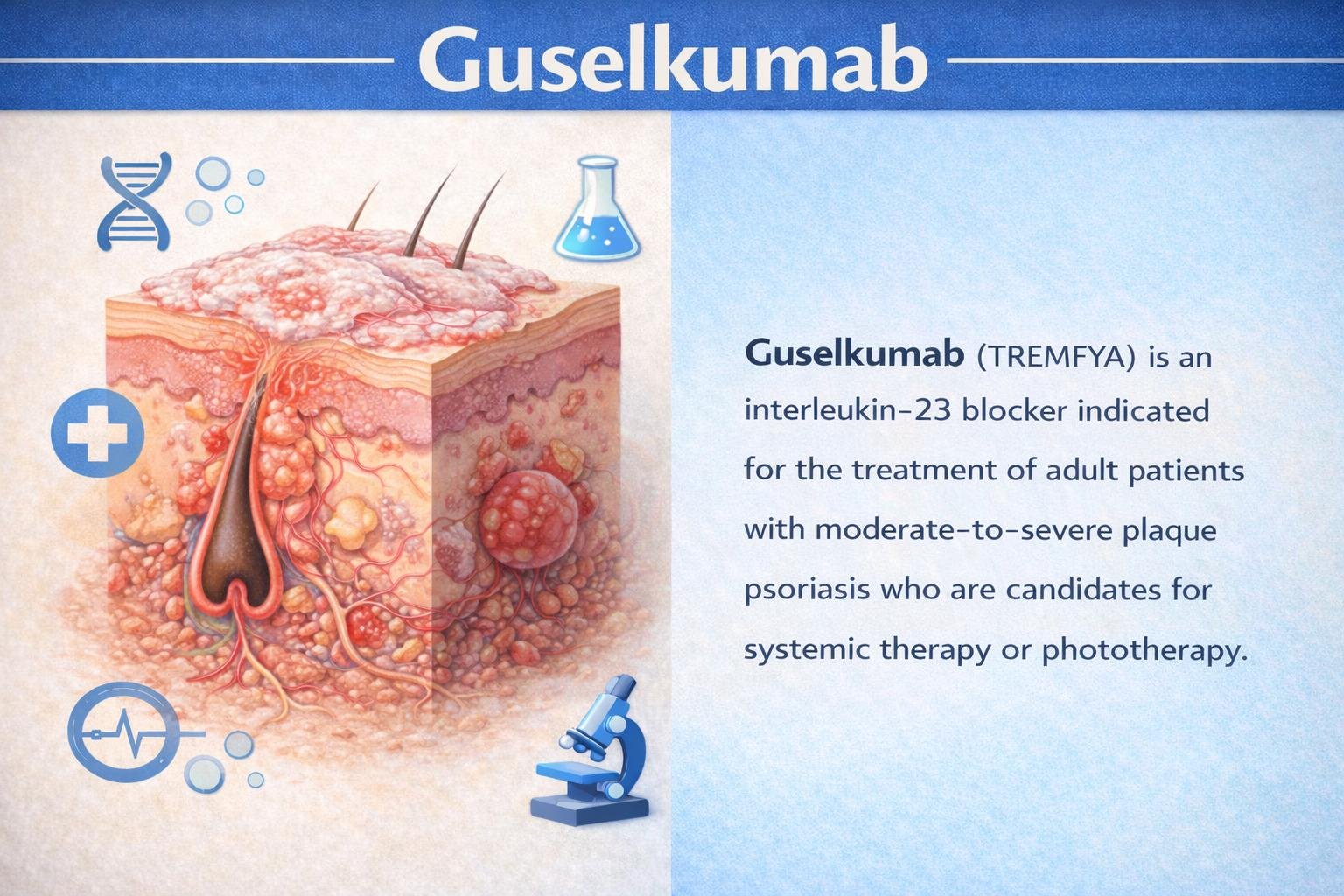
Human IgG1λ monoclonal antibody selectively binding the p19 subunit of IL-23, preventing IL-23/IL-23R interaction and downstream Th17 cytokine release. Approved for moderate-to-severe plaque psoriasis.
BLA Number761061
FDA ApprovalJuly 13, 2017
Priority StatusPriority Review
Formulation100 mg/mL SC
Pharmacologic ClassIL-23 Blocker
ApplicantJanssen Biotech
Overview
§1
Indication
Moderate-to-Severe Plaque Psoriasis
Adults eligible for systemic therapy or phototherapy
Mechanism
IL-23 p19 Subunit Blockade
Human IgG1λ mAb; first-in-class selective IL-23 inhibitor
Dose & Schedule
100 mg SC
Weeks 0, 4, then every 8 weeks
Phase 3 Program
3 Pivotal Trials
VOYAGE 1, VOYAGE 2, NAVIGATE (n=1,711 randomized)
Mechanism of Action: Guselkumab is a human monoclonal IgG1λ antibody that selectively binds the p19 subunit of IL-23, blocking its interaction with the IL-23 receptor. By disrupting IL-23 signalling, guselkumab suppresses downstream Th17-mediated inflammation, reducing serum levels of IL-17A, IL-17F and IL-22. It is the first approved biologic that specifically targets the p19 subunit of IL-23, distinguishing it from ustekinumab (anti-p40, shared IL-12/IL-23).
Clinical Trial Programme
§1.2
Trial
NCT
Design
N (Randomised)
Duration
Comparator(s)
Primary Endpoint
VOYAGE 1 (PSO3001)
NCT02207231
R, DB, PC, AC, Phase 3
837
48 weeks
Adalimumab, Placebo
IGA 0/1 & PASI 90 at Week 16
VOYAGE 2 (PSO3002)
NCT02207244
R, DB, PC, AC, Phase 3
992
48 weeks (with re-randomisation)
Adalimumab, Placebo
IGA 0/1 & PASI 90 at Week 16; withdrawal/maintenance
NAVIGATE (PSO3003)
NCT02203032
R, DB, Phase 3
268
60 weeks
Ustekinumab (continued)
IGA 0/1 with ≥2-grade improvement at Week 28 in ustekinumab inadequate responders
R=randomised; DB=double-blind; PC=placebo-controlled; AC=active-controlled. VOYAGE 2 included a withdrawal/re-randomisation phase at Week 28 for PASI 90 responders. All Phase 3 subjects aged ≥18 years with IGA ≥3, PASI ≥12, BSA ≥10%.
Baseline Characteristics
§2
Pooled VOYAGE 1 & 2 (PSO3001/3002): 1,829 randomised subjects across both trials (guselkumab n=825, adalimumab n=582, placebo n=422). Demographics and baseline disease severity were well-balanced across treatment arms in both trials.
Demographics — VOYAGE 1 & 2
§2.1
Parameter
Guselkumab V1 (N=329)
Adalimumab V1 (N=334)
Placebo V1 (N=174)
Guselkumab V2 (N=496)
Adalimumab V2 (N=248)
Placebo V2 (N=248)
Age, mean (SD), yrs
44 (13)
43 (13)
45 (13)
44 (12)
43 (12)
43 (12)
Male sex, n (%)
240 (73%)
249 (75%)
119 (68%)
349 (70%)
170 (69%)
173 (70%)
White race, n (%)
262 (80%)
277 (83%)
145 (83%)
408 (82%)
200 (81%)
206 (83%)
Asian race, n (%)
51 (15%)
47 (14%)
23 (13%)
72 (15%)
37 (15%)
27 (11%)
Weight, mean (SD), kg
89.5 (20.1)
90.5 (21.8)
88.0 (24.4)
89.6 (20.8)
87.6 (21.0)
88.6 (20.0)
North America (US+CA), n (%)
115 (35%)
115 (34%)
62 (36%)
160 (32%)
81 (33%)
79 (32%)
Baseline Disease Severity — VOYAGE 1 & 2
§2.2
Parameter
Guselkumab V1 (N=329)
Adalimumab V1 (N=334)
Placebo V1 (N=174)
Guselkumab V2 (N=496)
Adalimumab V2 (N=248)
Placebo V2 (N=248)
IGA 3 (Moderate), n (%)
252 (77%)
241 (72%)
131 (75%)
380 (77%)
195 (79%)
191 (77%)
IGA 4 (Severe), n (%)
77 (23%)
90 (27%)
43 (25%)
115 (23%)
53 (21%)
57 (23%)
PASI, mean (SD)
22.1 (9.5)
22.4 (9.0)
20.4 (8.7)
21.9 (8.8)
21.7 (9.0)
21.5 (8.0)
PASI, median
18.6
20.0
17.4
19.2
19.0
19.0
BSA affected, mean (SD), %
28.3 (17.1)
28.6 (16.7)
25.8 (15.9)
28.5 (16.4)
29.1 (16.7)
28.0 (16.5)
BSA affected, median, %
22.0
23.0
20.0
24.0
25.0
22.0
Prior biologic therapy, %
~23% (both trials)
~23% (both trials)
Psoriatic arthritis history, %
~18% (both trials)
~18% (both trials)
Source: FDA Medical Review BLA761061 (Statistical Reviewer’s Analysis). ITT population, all randomised subjects. Demographics and disease severity were balanced across arms.
Efficacy Results
§3
Co-Primary Endpoints (VOYAGE 1 & 2): Proportion achieving IGA 0/1 and PASI 90 at Week 16 vs. placebo (p<0.001 for both endpoints in both trials). Missing data handled by non-responder imputation (NRI).
Guselkumab vs. US-Licensed Adalimumab (North America Subgroup)
§3.2
Active Comparator Analysis (North America Sites Only): The comparison vs. adalimumab was a secondary endpoint. Only North American subjects received US-licensed adalimumab (Humira); non-US sites used EU-approved adalimumab, which FDA considered a distinct product. Results shown are from the North American subgroup per the FDA statistical review.
VOYAGE 1 — Guselkumab vs. US-Licensed Adalimumab (North America)Guselkumab N=115 / Adalimumab N=115 | NRI
PASI 75 at Week 16 — Guselkumab
91%
PASI 75 at Week 16 — Adalimumab
70%
PASI 90 at Week 16 — Guselkumab
73%
PASI 90 at Week 16 — Adalimumab
41%
PASI 90 at Week 24 — Guselkumab
80%
PASI 90 at Week 24 — Adalimumab
44%
PASI 90 at Week 48 — Guselkumab
73%
PASI 90 at Week 48 — Adalimumab
46%
IGA 0 (Cleared) at Week 24 — Guselkumab
53%
IGA 0 (Cleared) at Week 24 — Adalimumab
23%
IGA 0/1 at Week 48 — Guselkumab
79%
IGA 0/1 at Week 48 — Adalimumab
54%
Maintenance & Durability of Response (VOYAGE 2)
§3.3
VOYAGE 2 Withdrawal Design: PASI 90 responders at Week 28 were re-randomised to continue guselkumab (q8w) or withdraw (placebo). At Week 48, 89% of continuous guselkumab arm maintained PASI 90 vs. 37% of the withdrawal arm. Median time to loss of PASI 90 after withdrawal was approximately 15 weeks.
VOYAGE 2 — Maintenance of PASI 90 at Week 48 (re-randomised PASI 90 responders at Wk 28)Continuous guselkumab vs. withdrawal to placebo
PASI 90 at Week 48 — Continuous guselkumab
89%
PASI 90 at Week 48 — Withdrawal (placebo)
37%
NAVIGATE — Ustekinumab Inadequate Responders
§3.4
NAVIGATE Design: Subjects with inadequate response (IGA ≥2 at Week 16) to open-label ustekinumab were randomised to switch to guselkumab (100 mg at Weeks 16, 20, then q8w) or continue ustekinumab (q12w). Primary endpoint: IGA 0/1 with ≥2-grade improvement at Week 28. Guselkumab: 31% vs. continued ustekinumab: 14% (p-value significant).
Greater improvement with guselkumab vs. placebo in both VOYAGE 1 & 2
Week 16
PSSD Score of 0 (symptom-free)
Greater proportion vs. US-licensed adalimumab in both trials
Week 24
Scalp ss-IGA 0/1 (≥2-grade improvement)
Statistically superior to placebo (p<0.001) in both VOYAGE 1 & 2
Week 16
NRI=Non-Responder Imputation. All guselkumab vs. adalimumab comparisons are secondary endpoints (hierarchical testing). North America subgroup uses US-licensed Humira; non-US sites used EU adalimumab (treated as distinct product by FDA). Source: FDA Medical Review BLA761061, Tables 21, 25, 26, 27, 28.
Primary Endpoints Across Pivotal Trials & Timepoints
§3.6
Data sourced from: FDA Statistical Review BLA761061, Tables 21 & 25 (Statistical Reviewer’s Analysis, NRI). VOYAGE 1: guselkumab N=329, placebo N=174, North America adalimumab N=115/115. VOYAGE 2: guselkumab N=496, placebo N=248, North America adalimumab N=160/81. Wk 16 = full ITT vs. placebo (co-primary). Wk 24 & Wk 48 = North America subgroup vs. US-licensed adalimumab (secondary). VOYAGE 2 did not report Wk 48 adalimumab data (re-randomisation withdrawal design at Wk 28).
IGA 0/1 RESPONSE — Guselkumab vs. Placebo & vs. Adalimumab across TimepointsNRI | V1 = VOYAGE 1 · V2 = VOYAGE 2 · NA = North America subgroup
PASI 90 RESPONSE — Guselkumab vs. Placebo & vs. Adalimumab across TimepointsNRI | V1 = VOYAGE 1 · V2 = VOYAGE 2 · NA = North America subgroup
Co-primary endpoints (Wk 16, full ITT, vs. placebo): p<0.001 for all comparisons (CMH test stratified by investigational site). Secondary active-comparator timepoints (Wk 24, Wk 48) represent the North America subgroup only, where US-licensed adalimumab (Humira) was used. VOYAGE 2 did not contribute Wk 48 adalimumab data due to the withdrawal/re-randomisation design at Wk 28. Source: FDA Medical Review BLA761061, Tables 21 & 25 (Statistical Reviewer’s Analysis). NRI=Non-Responder Imputation.
Injection site reactions erythema, bruising, swelling, pruritus, pain, induration
37 (4.5%)
15 (7.7%)
12 (2.8%)
Arthralgia
22 (2.7%)
4 (2.0%)
9 (2.1%)
Diarrhea
13 (1.6%)
3 (1.5%)
4 (0.9%)
Gastroenteritis including viral gastroenteritis
11 (1.3%)
4 (2.0%)
4 (0.9%)
Tinea infections pedis, cruris, manuum
9 (1.1%)
0
0
Herpes simplex infections oral, genital, nasal
9 (1.1%)
0
2 (0.5%)
Adverse reactions occurring at ≥1% and at a higher rate in the guselkumab group than placebo. Overall AE rate: guselkumab 49%, placebo 47%, adalimumab 49%. Source: Prescribing Information Table 1 / FDA Medical Review BLA761061.
Specific Adverse Events of Interest
§4.2
Infections (Overall)
Infections in 23% (guselkumab) vs. 21% (placebo) through Week 16. Most common: URTI, gastroenteritis, tinea, herpes simplex — all mild-to-moderate severity. No discontinuations due to common infections.
Serious Infections
Serious infection rate ≤0.2% in both guselkumab and placebo groups through Week 16 (≤0.2 per 100 subject-years). No opportunistic infections or tuberculosis reactivation reported in subjects exposed to guselkumab across all Phase 3 trials.
Elevated Liver Enzymes
Reported in 2.6% (guselkumab) vs. 1.9% (placebo). Of 21 events in guselkumab group, all but one were mild-to-moderate; none led to discontinuation.
Serious Adverse Events (Week 0–16)
SAE rate: guselkumab 1.9% (6.3/100 PY) vs. placebo 1.4% (4.7/100 PY) vs. US-adalimumab 2.6% (9.9/100 PY). No clear trends; cardiac disorders SOC reported in 0.4% (guselkumab) vs. 0% (placebo).
Malignancies
Observed across Phase 3; included NMSC and one nasopharyngeal SCC (Week 60, possibly related). Malignancy incidence did not appear elevated compared to placebo over 16 weeks. Adjudicated; long-term surveillance ongoing.
MACE (Major Adverse Cardiovascular Events)
Adjudicated CV events assessed across Trials PSO2001, 3001, 3002, 3003. No increased risk of MACE identified. CV risk factors prevalent in trial population (hypertension 25.7%, diabetes 8.8%, tobacco use 51.3%).
Neuropsychiatric / Suicidal Ideation
Columbia C-CASA assessment performed for all subjects. No increased incidence of suicidal ideation and behaviour (SIB). One suicide death (Day 492 after 10 doses) assessed as not related by DPP reviewer.
Immunogenicity
Anti-drug antibodies (ADA) in ~6% by Week 52. Of ADA-positive subjects, ~7% had neutralising antibodies. In 46 evaluable ADA+ subjects, 21 had lower trough guselkumab concentrations; one subject experienced loss of efficacy with high ADA titer. Generally no correlation between ADA and clinical response or injection site reactions.
Infections: May increase infection risk. Do not initiate in active clinically important infection. Discontinue if serious infection develops. Pre-treat latent TB before initiating.
Tuberculosis: Screen for TB prior to initiation. 105 subjects with latent TB treated concurrently with prophylaxis — no active TB during mean 43-week follow-up.
Immunisations: Complete age-appropriate vaccines prior to initiation. Avoid live vaccines during treatment.
No contraindications listed in prescribing information.
Pharmacology & Pharmacokinetics
§5
Cmax (Single 100 mg SC)
8.09 mcg/mL
Mean ± SD: 8.09 ± 3.68 mcg/mL; healthy subjects; Tmax ~5.5 days
Bioavailability (F)
~49%
Absolute F following single 100 mg SC in healthy subjects (~48.7% in psoriasis studies)
Volume of Distribution
13.5 L
Apparent V/F by population PK in plaque psoriasis subjects; limited extravascular distribution
Apparent Clearance
0.516 L/day
Population PK estimate (CL/F) in plaque psoriasis; not dose-dependent
Half-Life (t½)
15–18 days
Mean t½ across Phase 3 studies; median 17 days following single SC dose
Steady-State Trough
~1.2 mcg/mL
Mean Ctrough at steady state (achieved by Week 20); no accumulation over time with q8w dosing
Mechanism of Action
§5.1
Selective IL-23 p19 Inhibition: Guselkumab selectively binds the p19 subunit of IL-23, blocking its interaction with the IL-23 receptor (IL-23R). Unlike ustekinumab (anti-p40), guselkumab does not inhibit IL-12. By blocking IL-23 signalling, guselkumab suppresses the IL-23/Th17 axis, reducing downstream production of IL-17A, IL-17F, and IL-22 — cytokines central to psoriatic plaque formation.
Pharmacodynamics
§5.2
Marker
Effect
Context
Serum IL-17A
Reduced relative to pre-treatment baseline
Exploratory PD analysis in Phase 3 psoriasis subjects
Serum IL-17F
Reduced relative to pre-treatment baseline
Exploratory PD analysis
Serum IL-22
Reduced relative to pre-treatment baseline
Exploratory PD analysis
Note: The relationship between these pharmacodynamic biomarker changes and the clinical mechanism(s) by which guselkumab exerts efficacy is not fully understood.
PK Properties Summary
§5.3
Parameter
Value / Characteristic
PK Model
One-compartment linear model with first-order absorption and first-order elimination (SC)
Linearity
Linear PK from 10–300 mg (IV and SC); dose-independent clearance
Absorption
Cmax in psoriasis subjects: 4.81–6.24 mcg/mL (range across studies); Tmax 2–7 days after single SC dose
Distribution
V/F ~13.5 L (population PK); typical of large mAb with limited tissue distribution
Metabolism
Not fully characterised; expected catabolism to small peptides and amino acids via endogenous IgG pathways
Achieved by approximately Week 20 with q8w regimen; no accumulation observed
Body weight effect
CL/F and V/F increase with body weight (population PK); no dose adjustment required per clinical trial data
Age (≥65 yrs)
No apparent difference in clearance; no dose adjustment required
Renal/Hepatic impairment
No formal studies conducted
Drug Interactions
§5.4
CYP450 Interaction: Exploratory DDI study (n=6–12 subjects, moderate-to-severe psoriasis). Guselkumab showed low potential for clinically relevant interactions for CYP3A4 (midazolam), CYP2C9 (S-warfarin), CYP2C19 (omeprazole), CYP1A2 (caffeine). For CYP2D6 (dextromethorphan): changes not clinically relevant in 9/10 subjects; however, one individual showed a 2.9-fold AUCinf change. Consider monitoring narrow therapeutic index CYP2D6 substrates upon guselkumab initiation.
CYP Enzyme
Probe Substrate
Interaction
CYP3A4
Midazolam
Not clinically relevant
CYP2C9
S-Warfarin
Not clinically relevant
CYP2C19
Omeprazole
Not clinically relevant
CYP1A2
Caffeine
Not clinically relevant
CYP2D6
Dextromethorphan
Not clinically relevant in 9/10 subjects; one subject: 2.9-fold AUCinf increase. Cannot fully exclude interaction.
NSAIDs / Analgesics
Ibuprofen, ASA, Acetaminophen
No effect on guselkumab clearance (population PK analysis)
Source: FDA Medical Review BLA761061 (Clinical Pharmacology Review); Prescribing Information Section 12.3.
Dosing & Contraindications
§6
Approved Indication
Treatment of adults with moderate-to-severe plaque psoriasis who are candidates for systemic therapy or phototherapy
Excludes guttate, erythrodermic, or pustular psoriasis (excluded from trials)
Dosing Regimen
100 mg SC injection at Week 0 and Week 4 (loading doses)
Then 100 mg SC every 8 weeks (maintenance)
No dose adjustment required for body weight, age ≥65 years, renal or hepatic impairment
Missed dose: inject as soon as remembered; resume scheduled timing
Formulation
100 mg/mL solution in single-dose prefilled syringe (1 mL)
Clear, colourless to light yellow; may contain small translucent particles (acceptable)
27G, ½-inch fixed needle with passive needle guard
pH 5.8; excipients: L-histidine, polysorbate 80, sucrose, water for injection
NDC: 57894-640-01
Storage & Handling
Refrigerate at 2–8°C (36–46°F)
Do not freeze; do not shake
Store in original carton protected from light
Allow 30 minutes to reach room temperature before injection
Preservative-free; discard unused portion
Inject within 5 minutes of removing needle cover
Contraindications
§6.2
None. No formal contraindications are listed in the prescribing information.
Warnings & Precautions
§6.3
Infections (§5.1): May increase infection risk. Do not initiate with clinically important active infection. Discontinue if serious infection develops and does not respond to standard therapy. In chronic infection or history of recurrent infection, weigh risks/benefits. Infection rate: 23% vs. 21% placebo through 16 weeks; serious infection rate ≤0.2% both groups.
Tuberculosis (§5.2): Screen for TB (TST or IGRA) prior to initiation. Treat latent TB before starting guselkumab. 105 subjects with latent TB received concurrent guselkumab + TB prophylaxis without developing active TB (mean follow-up 43 weeks). Monitor during and after treatment. Do not administer in active TB.
Immunisations (§5.3): Complete all age-appropriate vaccines prior to initiation per current guidelines. Avoid live vaccines during treatment. No data on response to live or inactivated vaccines.
Special Populations
§6.4
Population
Recommendation
Pregnancy (8.1)
No human data. IgG crosses placental barrier — guselkumab may be transmitted to fetus. Neonatal deaths observed in monkey offspring at 6–30× MRHD (significance unknown). Use only if benefit justifies risk. MRHD-based comparison: 100 mg/1.67 mg/kg for 60 kg subject.
Lactation (8.2)
No data on presence in human milk or effects on breastfed infant. Not detected in milk of lactating cynomolgus monkeys. Consider developmental benefits of breastfeeding vs. maternal need.
Paediatric (<18 yrs, §8.4)
Safety and efficacy not established.
Geriatric (≥65 yrs, §8.5)
93/1,748 subjects were ≥65 years; 4 were ≥75 years. No overall difference in safety or effectiveness. No dose adjustment required; insufficient numbers to determine if they respond differently.
Renal impairment
No formal studies. Population PK: no dose adjustment expected necessary.
Hepatic impairment
No formal studies conducted.
Regulatory Timeline
§7.1
November 16, 2016
BLA 761061 Submitted & Received
Priority Review BLA filed. Application type: original BLA (biologics). Sponsor: Janssen Biotech, Inc. Division: DDDP / ODE III. Sponsor code name: CNTO 1959.
July 16, 2017
PDUFA Goal Date
Priority Review PDUFA date set at 6 months from receipt date (vs. 12 months for Standard Review).
July 13, 2017
FDA Approval — Initial US Approval (ahead of PDUFA)
Approved indication: treatment of adults with moderate-to-severe plaque psoriasis who are candidates for systemic therapy or phototherapy. First FDA-approved selective IL-23 p19 inhibitor. US License No. 1864. Reference ID: 4123919.
July 2017
Initial Prescribing Information Published
Prescribing Information (PI), Medication Guide, and Instructions for Use approved. No REMS required. Multi-Discipline Review Reference ID: 4123785.
Post-Approval (Deferred)
Postmarketing Requirements (PMRs) Conveyed
Three PMRs under 505(o): PMR 1 — Pregnancy registry cohort; PMR 2 — Retrospective pregnancy outcomes study; PMR 3 — Long-term malignancy observational study (≥8 year follow-up). Plus deferred PREA paediatric studies (ages 6–<18 years).
Regulatory Summary
§7.2
Clinical/Regulatory Significance: Guselkumab was the first FDA-approved biologic to selectively target the p19 subunit of IL-23, distinguishing it from ustekinumab (anti-p40, shared IL-12/IL-23 blockade). The VOYAGE programme was the first Phase 3 programme in moderate-to-severe plaque psoriasis to demonstrate statistically significant superiority over a TNF inhibitor (adalimumab) at the PASI 90 and complete clearance (IGA 0) thresholds in a pre-specified head-to-head randomised comparison — establishing a new efficacy benchmark for the class. The three-trial design (two placebo/active-controlled superiority trials + one inadequate-responder switching trial) has since been widely adopted by subsequent IL-23 inhibitor programmes. No advisory committee meeting was convened; FDA approved ahead of the PDUFA date without a REMS.
Item
Detail
BLA Number
761061
Application Type
BLA (Biologics License Application) — Original
Review Priority
Priority Review
Pharmacologic Class
IL-23 Blocker (Interleukin-23 Inhibitor)
Sponsor Code Name
CNTO 1959
Applicant
Janssen Biotech, Inc., Horsham, PA 19044
US License No.
1864
NDC Code
57894-640-01
Review Division
DDDP / ODE III
Reference IDs
Multi-Discipline Review: 4123785 · Label: 4123919
Advisory Committee
Not convened
REMS Required
No — Medication Guide + routine pharmacovigilance deemed sufficient
VOYAGE 1 NCT
NCT02207231
VOYAGE 2 NCT
NCT02207244
NAVIGATE NCT
NCT02203032
Key Approval Considerations
§7.4
Efficacy Robustness
Treatment effects were large and consistent across both pivotal trials and all endpoints. Missing data at Week 16 was <5% in all arms. Sensitivity analyses under worst-case imputation (guselkumab→non-responder, placebo→responder) still yielded p<0.001 for both co-primary endpoints in both trials.
Active Comparator Issue — EU vs. US Adalimumab
Non-US sites used EU-approved adalimumab; FDA deemed this a distinct product from US-licensed Humira without adequate scientific bridge. Full-population adalimumab comparisons are therefore noted in the PI but labelling superiority claims are restricted to the North America subgroup and overall population data in the context of the approved label.
Class-First Selectivity
First agent to demonstrate selective p19 IL-23 blockade (vs. ustekinumab’s combined IL-12/IL-23 p40 blockade). FDA acknowledged this mechanistic distinction as clinically relevant. Exposure-response analyses supported the proposed dose and regimen.
Safety — No MACE or SIB Signal
Adjudicated MACE analyses (Trials PSO2001, 3001, 3002, 3003 combined) showed no increased CV risk. Columbia C-CASA retrospective assessment found no signal for suicidal ideation/behaviour. No active TB cases in the development programme. No serious hypersensitivity/anaphylaxis reported.
Long-Latency Malignancy Uncertainty
Biologically plausible malignancy risk with chronic immunosuppression. ARIA (Active Risk and Identification Analysis) system deemed insufficient for long-term malignancy surveillance due to limited follow-up and poor validation of certain malignancy types. PMR 3 mandated: long-term observational study with ≥8 years follow-up, primary endpoint of malignancy.
Pregnancy Data Limitation
Only 12 pregnancies reported in the development programme; outcome data unavailable in 50%. IgG placental transfer expected. Neonatal deaths seen in non-human primate studies at supratherapeutic doses. PMRs 1 and 2 required: prospective registry cohort + retrospective claims-based study. No REMS warranted.
Paediatric Deferral (PREA)
Guselkumab triggers PREA as a new active ingredient. Paediatric studies (ages 6–<18 years) included in the Agreed Initial Paediatric Study Plan (iPSP) and deferred post-approval. Specific study parameters were redacted (b)(4) in the publicly available Medical Review.
Statistical Issues — None Major
No major statistical issues affected the overall conclusions. Three-arm design (guselkumab, adalimumab, placebo) with pre-specified hierarchical testing. Subgroup analyses showed no differential response by age, sex, race, body weight, or prior biologic use.
Postmarketing Requirements & Commitments
§7.5
No REMS required. Risk management through: professional labelling (including Medication Guide), Rx-only status, routine pharmacovigilance, and ARIA system for short-term lymphoma surveillance. Three PMRs under 21 USC 505(o) and one deferred PREA paediatric requirement.
Maternal, fetal, and infant outcomes in women exposed to guselkumab during pregnancy vs. unexposed controls
Detect major/minor congenital malformations, spontaneous abortions, stillbirths, elective terminations, SGA, neonatal deaths, infant infections in first 6 months; infant follow-up through at least 1 year of life
PMR 2 505(o) requirement
Retrospective cohort (claims/EMR) or case-control
Adverse pregnancy outcomes (congenital malformations, SAB, stillbirth, SGA, neonatal deaths, infant infections) in guselkumab-exposed vs. unexposed women
Complementary to PMR 1; uses existing claims or electronic medical record databases
PMR 3 505(o) requirement
Long-term observational safety study (actual clinical care)
Enrolment over an initial period; minimum 8 years follow-up from enrolment. Pre-specified comparator population, hypothesis-driven analysis with sufficient power to detect clinically meaningful increase in malignancy vs. comparator background rate
PREA Deferred paediatric
Safety, efficacy, and PK study
Paediatric subjects aged 6 years to <18 years with moderate-to-severe plaque psoriasis
Agreed iPSP; deferred post-approval. Specific study parameters redacted (b)(4) in public Medical Review
Regulatory Notes
§7.6
Domain
Note
Benefit–Risk Conclusion
Clinical team and division director both recommended approval. Benefit–risk assessment positive: large, consistent efficacy signal; no MACE/SIB/TB signals; manageable AE profile. Need for additional therapies acknowledged (no permanent cure; existing products have AE profiles and inadequate response rates).
Labelling (Adalimumab Comparator)
Due to the EU/US adalimumab distinction, the label (PI Table 3) presents North America subgroup data for head-to-head comparisons. The full-population comparison appears in Table 25 of the Medical Review but is noted with the caveat about EU vs. US product differences.
Immunogenicity Labelling
ADA incidence ~6% by Week 52; ~7% of ADA+ subjects had neutralising antibodies. Noted in §6.2 of PI. One subject experienced loss of efficacy with high ADA titer. FDA determined ADA generally not associated with clinical response changes or ISRs.
CYP2D6 Caveat
Exploratory DDI study (n=6–12): one individual showed 2.9-fold AUCinf increase for dextromethorphan (CYP2D6 substrate). Cannot fully exclude interaction. Monitoring recommended for narrow TI CYP2D6 substrates upon initiation.
ARIA Pharmacovigilance
Active Risk and Identification Analysis (ARIA) system accepted for short-term lymphoma surveillance only. Deemed insufficient for long-term malignancy assessment — hence PMR 3 mandated as a long-term observational study with pre-specified statistical analysis for malignancy endpoints.
No Clinical Hold or RTF
No Refuse-to-File action, clinical hold, or complete response letter issued. Application reviewed without advisory committee input. Approved ahead of PDUFA date.
Source Documents
FDA Medical Review BLA761061 (Ref ID: 4123785) · FDA Prescribing Information (Ref ID: 4123919) · Drugs@FDA. This profile reflects the initial 2017 approval labelling; subsequent sNDA/sBLA submissions (e.g., PsA, IBD) are not included in this profile.