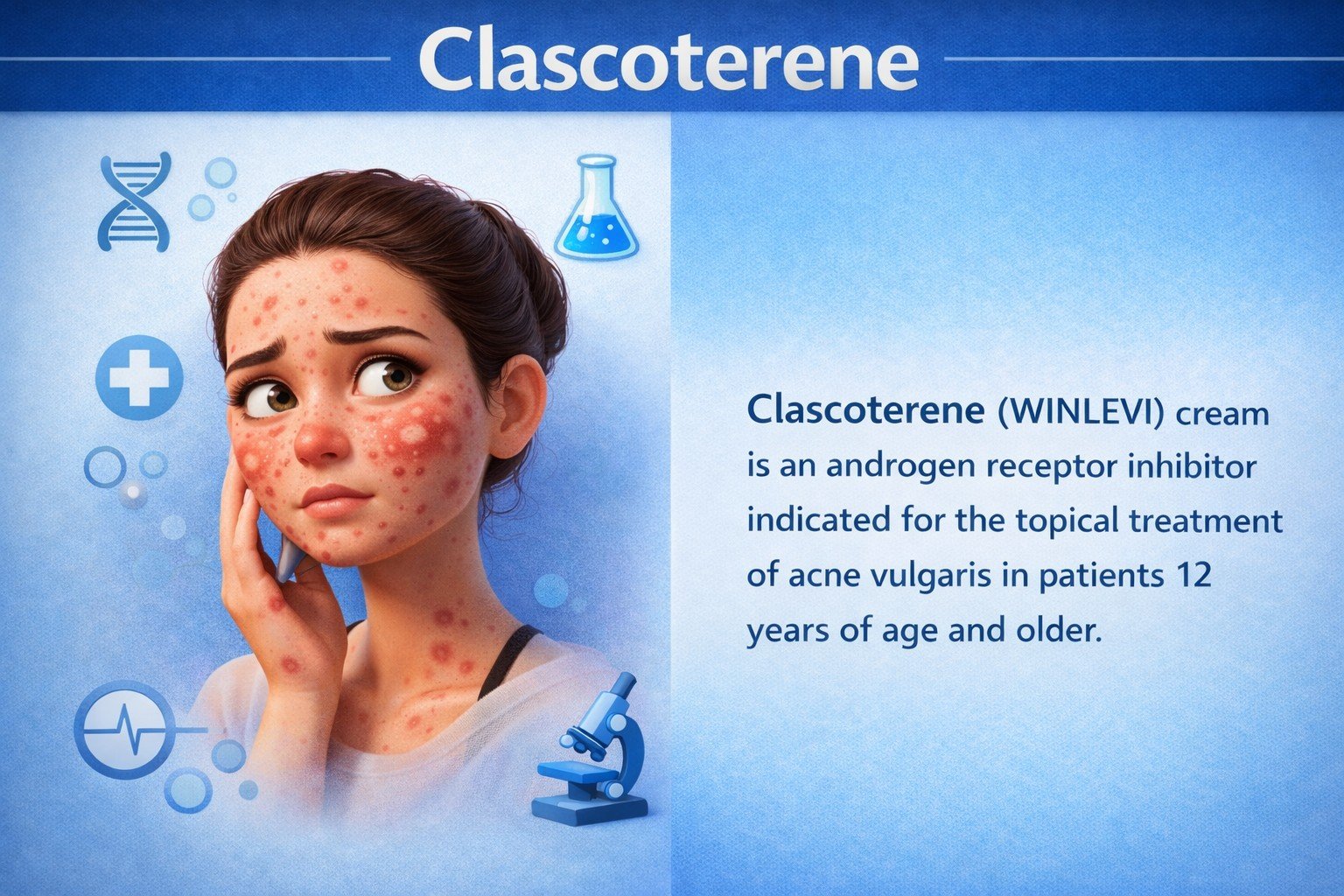
Indication
Acne Vulgaris (Facial)
Patients ≥12 years of age; moderate to severe
Mechanism
Androgen Receptor Inhibitor
Topical NME; first-in-class AR antagonist; cortexolone-17α-propionate
Dose & Schedule
~1 g topically BID
Thin layer to affected facial area; morning and evening
Phase 3 Programme
2 pivotal
CB-03-01/25 & /26; pooled N=1,440 (Pool A)
Mechanism of Action — Clascoterone is an androgen receptor (AR) inhibitor. Its chemical structure resembles dihydrotestosterone (DHT), allowing competitive binding to cutaneous androgen receptors in the pilosebaceous unit. By blocking local AR signalling, clascoterone reduces androgen-driven sebum production, sebocyte proliferation, and downstream inflammatory mediator release implicated in acne pathogenesis. Once absorbed systemically, it is hydrolysed to cortexolone. Per the FDA label: the precise mechanism of action of WINLEVI cream for the topical treatment of acne vulgaris is unknown.
Clinical context: Acne vulgaris is among the most prevalent dermatologic conditions worldwide, affecting up to 50 million Americans annually. The androgen axis is a key driver of sebaceous gland activity; clascoterone represents the first new mechanistic class targeting the androgen pathway topically for acne in decades. No other topical AR inhibitor is marketed in the United States.
| Study | NCT | Design | N (CLS) | Duration | Comparator | Primary Endpoint |
|---|
| CB-03-01/25 (Trial 1) | NCT02608450 | Ph3, RCT, DB, vehicle-controlled, parallel-group; 55 sites (US/UKR/Georgia) | 353 | 12 weeks | Vehicle cream BID | IGA success; absolute change in inflammatory & noninflammatory lesion counts at Week 12 |
| CB-03-01/26 (Trial 2) | NCT02608476 | Ph3, RCT, DB, vehicle-controlled, parallel-group; 48 sites (EU/US/Georgia) | 369 | 12 weeks | Vehicle cream BID | IGA success; absolute change in inflammatory & noninflammatory lesion counts at Week 12 |
| CB-03-01/27 (LTS) | — | Ph3, open-label, long-term safety extension (rollover from /25 and /26) | 607 | Up to 9 additional months (12 months total) | None (open-label) | Long-term safety; up to 12 months total exposure |
| 171-7151-202 (MUsT — adults/adolescents) | — | Ph2, open-label, sequential cohorts; HPA axis/PK — maximal use conditions | 42 | 14 days | None | HPA axis suppression; PK in adults ≥18 and adolescents 12–17 years |
| CB-03-01/28 (MUsT — paediatric) | — | Ph2, open-label; HPA axis/PK, paediatric population | 27 | 14 days | None | HPA axis suppression; PK in children 9–<12 years |
| 171-7151-201 (Ph2 dose-ranging) | — | Ph2, DB, vehicle-controlled, dose-response; ≥12 years | 288 (1% BID arm) | 12 weeks | Vehicle; multiple dose levels (0.1%, 0.5%, 1% QD/BID) | Dose selection and preliminary efficacy |
| CB-03-01/33 (TQT) | — | Ph1, RCT, DB, placebo-controlled; healthy subjects | 24 | 4 days (7.5% solution) | Placebo | QT/QTc safety at supratherapeutic exposure (~2× maximal use) |
| Drug (INN · Brand) | Target / Class | Formulation | US Approval | Approved Population |
|---|
| Clascoterone · WINLEVI | Androgen receptor inhibitor (topical NME) | Cream 1% | Aug 2020 | ≥12 years; acne vulgaris |
| Adapalene/BPO · EPIDUO | Retinoid + oxidant | Gel 0.1%/2.5% | 2008 | ≥9 years; acne vulgaris |
| Tretinoin · various | Retinoic acid receptor agonist | Cream/gel 0.025–0.1% | 1971 | ≥12 years; acne vulgaris |
| Clindamycin/BPO · DUAC | Topical antibiotic + oxidant | Gel 1%/5% | 2002 | ≥12 years; acne vulgaris |
| Dapsone · ACZONE | Anti-inflammatory/antibiotic | Gel 5%, 7.5% | 2005 | ≥12 years; acne vulgaris |
| Berdazimer · NUVECTRA | Nitric oxide-releasing molecule | Gel 10.3% | Jan 2024 | ≥9 years; acne vulgaris |
| Domain | Information |
|---|
| Proprietary Name | WINLEVI |
| INN / Generic Name | Clascoterone |
| Code Names | CB-03-01; cortexolone-17α-propionate |
| Manufacturer | Manufactured & Packaged by Cosmo S.p.A., Lainate, Milan, Italy; for Cassiopea SpA; Marketed by Cassiopea, Inc. |
| Pharmacologic Class | Androgen receptor inhibitor |
| Dosage Forms & Strengths | Cream, 1% (each gram contains 10 mg clascoterone) |
| NDC | 78334-001-60 (60-gram tube) |
| Storage — Prior to Dispensing | Refrigerator, 2°C–8°C (36°F–46°F); do not freeze |
| Storage — During Use | Room temperature 20°C–25°C (68°F–77°F); discard 180 days after dispensing or 1 month after first opening, whichever is sooner |
| Inactive Ingredients | Cetyl alcohol, citric acid monohydrate, edetate disodium, mineral oil, mono- and di-glycerides, polysorbate 80, propylene glycol, purified water, and vitamin E |
| Molecular Formula & MW | C24H34O5; MW 402.5 g/mol |
| Boxed Warning | None |
| PI Reference ID | 4661999 (August 2020) |
| Medical Review Reference ID | 4661201 (2020) |
Pooled trial summary (Pool A): CB-03-01/25 (Trial 1) and CB-03-01/26 (Trial 2) were identically designed, multicenter, randomised, double-blind, vehicle-controlled, 12-week trials enrolling subjects ≥9 years with IGA 3 or 4 facial acne vulgaris. Randomisation was 1:1 to clascoterone cream 1% BID or vehicle BID. Pool A: N=1,440 (clascoterone n=722, vehicle n=718). Trial 1 enrolled predominantly US/Ukrainian/Georgian sites; Trial 2 predominantly EU/US sites, resulting in higher White proportion in Trial 2.
| Characteristic | Clascoterone 1% BID (N=353) | Vehicle BID (N=355) |
|---|
| Mean age, years (SD) | 20.0 (6.7) | 19.9 (6.8) |
| Median age, years | 18.0 | 18.0 |
| Age 9–11 years, n (%) | 11 (3.1%) | 5 (1.4%) |
| Age 12–17 years, n (%) | 146 (41.4%) | 154 (43.4%) |
| Age ≥18 years, n (%) | 196 (55.5%) | 196 (55.2%) |
| Female, n (%) | 221 (62.6%) | 215 (60.6%) |
| White, n (%) | 298 (84.4%) | 297 (83.7%) |
| Black/African American, n (%) | 31 (8.8%) | 38 (10.7%) |
| IGA 3 — Moderate, n (%) | 292 (82.7%) | 291 (82.0%) |
| IGA 4 — Severe, n (%) | 61 (17.3%) | 64 (18.0%) |
| Mean inflammatory lesion count (SD) | 42.4 (11.8) | 42.9 (12.3) |
| Median inflammatory lesion count | 38.0 | 39.0 |
| Mean noninflammatory lesion count (SD) | 59.1 (22.2) | 60.7 (22.1) |
| Median noninflammatory lesion count | 53.0 | 57.0 |
| Characteristic | Clascoterone 1% BID (N=369) | Vehicle BID (N=363) |
|---|
| Mean age, years (SD) | 19.3 (5.6) | 19.0 (5.4) |
| Median age, years | 18.0 | 18.0 |
| Age 9–11 years, n (%) | 2 (0.5%) | 1 (0.3%) |
| Age 12–17 years, n (%) | 170 (46.1%) | 171 (47.1%) |
| Age ≥18 years, n (%) | 197 (53.4%) | 191 (52.6%) |
| Female, n (%) | 243 (65.9%) | 221 (60.9%) |
| White, n (%) | 357 (96.7%) | 348 (95.9%) |
| Black/African American, n (%) | 7 (1.9%) | 6 (1.7%) |
| IGA 3 — Moderate, n (%) | 305 (82.7%) | 313 (86.2%) |
| IGA 4 — Severe, n (%) | 64 (17.3%) | 50 (13.8%) |
| Mean inflammatory lesion count (SD) | 42.9 (12.2) | 41.3 (11.0) |
| Median inflammatory lesion count | 39.0 | 37.0 |
| Mean noninflammatory lesion count (SD) | 62.8 (21.4) | 63.3 (20.5) |
| Median noninflammatory lesion count | 61.0 | 63.0 |
| IGA Score | Grade | Definition |
|---|
| 0 | Clear | Absence of active disease; no inflammatory or noninflammatory lesions |
| 1 | Almost clear | Rare noninflammatory lesions; no more than one small inflammatory lesion |
| 2 | Mild | Some noninflammatory lesions; no more than a few inflammatory lesions (papules/pustules only) |
| 3 | Moderate | Up to many noninflammatory lesions; some inflammatory lesions; no more than one nodular/cystic lesion |
| 4 | Severe | Up to many noninflammatory and inflammatory lesions; no more than a few nodular/cystic lesions |
Co-primary endpoints (hierarchical, assessed at Week 12, ITT population): (P1) Proportion achieving IGA success (≥2-point reduction + IGA 0 or 1); (P2) Absolute change from baseline in noninflammatory lesion count; (P3) Absolute change from baseline in inflammatory lesion count. Binary endpoint analysed by logistic regression; continuous endpoints by ANCOVA with multiple imputation (MI) for missing data. Clascoterone was statistically superior to vehicle on all three co-primary endpoints in both trials (p ≤ 0.003).
P1 · IGA Success (≥2-point reduction + IGA 0/1)
Δ = 10.1% (95% CI: 4.1%, 16.0%); p <0.001
P3 · Mean Percent Reduction — Inflammatory Lesions
Mean absolute Δ = −3.9 (95% CI: 1.3, 6.5)
P2 · Mean Percent Reduction — Noninflammatory Lesions
Mean absolute Δ = −7.3 (95% CI: 3.5, 11.1)
P1 · IGA Success (≥2-point reduction + IGA 0/1)
Δ = 14.3% (95% CI: 8.9%, 19.7%); p <0.001
P3 · Mean Percent Reduction — Inflammatory Lesions
Mean absolute Δ = −7.5 (95% CI: 5.2, 9.9)
P2 · Mean Percent Reduction — Noninflammatory Lesions
Mean absolute Δ = −8.7 (95% CI: 4.5, 12.4)
| Endpoint | Trial 1 · CLS (N=342) | Trial 1 · Vehicle (N=350) | Trial 1 Δ (95% CI) | Trial 2 · CLS (N=367) | Trial 2 · Vehicle (N=362) | Trial 2 Δ (95% CI) |
|---|
| IGA Success (%) | 18.8% | 8.7% | 10.1% (4.1, 16.0)
p<0.001 | 20.9% | 6.6% | 14.3% (8.9, 19.7)
p<0.001 |
| Inflammatory lesions — mean absolute ↓ | −19.3 | −15.4 | −3.9 (1.3, 6.5) | −20.1 | −12.6 | −7.5 (5.2, 9.9) |
| Noninflammatory lesions — mean absolute ↓ | −20.4 | −13.0 | −7.3 (3.5, 11.1) | −19.5 | −10.8 | −8.7 (4.5, 12.4) |
| Inflammatory lesions — % reduction | 44.6% | 36.3% | 8.3% (2.2, 14.4) | 47.1% | 29.7% | 17.5% (11.8, 23.1) |
| Noninflammatory lesions — % reduction | 32.6% | 21.8% | 10.8% (3.9, 17.6) | 29.6% | 15.7% | 13.8% (7.5, 20.1) |
Source: FDA PI NDA 213433 (Ref ID: 4661999), Table 2. IGA success rates at Week 12 in subjects ≥12 years. Trial 1 = CB-03-01/25; Trial 2 = CB-03-01/26.
No efficacy demonstrated in subjects 9 to <12 years: Subgroup analysis showed no statistically significant or consistent treatment benefit in this age cohort across the co-primary endpoints. Additionally, HPA axis suppression incidence was 3× higher (15%) vs. adults (5%), and hyperkalemia shifts to high were dramatically elevated (~33% of the 9–11 age group vs. 3–6% in adolescents and adults). The FDA approved indication limited to ≥12 years, rejecting the applicant’s proposed age of ≥9 years.
No Boxed Warning. WINLEVI cream 1% carries no boxed warning per FDA-approved labelling (PI Section 5 header). No drug-related serious adverse events were identified in Phase 3 controlled trials.
Safety Pool (Controlled)
1,440
Pool A: CLS n=722, vehicle n=718; 12 weeks BID
Long-Term Exposure
607
LTS CB-03-01/27; 303 subjects ≥9 months; 123 ≥12 months total
Median Exposure
12 weeks
Controlled trials; up to 12 months in LTS
Most Common ADR (≥7%)
Erythema 12.2%
Similar to vehicle (15.4%); local skin reaction
Local Skin Reactions [PI §5.1]: WINLEVI cream may induce local irritation — erythema/redness, pruritus, scaling/dryness. Concomitant use of medicated or abrasive soaps, strong drying cosmetics, high-alcohol products, astringents, spices or lime should be limited. Do not apply to cuts, abrasions, eczematous or sunburned skin. If reactions occur, discontinue or reduce application frequency.
HPA Axis Suppression [PI §5.2]: HPA axis suppression was observed and may occur during or after treatment with clascoterone. All subjects returned to normal HPA axis function at follow-up 4 weeks after stopping treatment. Conditions augmenting systemic absorption include use over large surface areas, prolonged use, and occlusive dressings. If HPA axis suppression develops, attempt to withdraw the drug. Paediatric patients may be more susceptible to systemic toxicity.
Hyperkalemia [PI §6.1]: Elevated potassium levels were observed in some subjects during clinical trials. Shifts from normal to elevated potassium were seen in 5% of clascoterone-treated vs. 4% of vehicle-treated subjects overall. Markedly elevated rates in the 9–11 year age group (~33%). Monitor potassium in at-risk patients (renal impairment, concomitant medications affecting potassium).
| Category | Trial 1 · CLS (N=353) | Trial 1 · Vehicle (N=355) | Trial 2 · CLS (N=369) | Trial 2 · Vehicle (N=363) | Total · CLS (N=722) | Total · Vehicle (N=718) |
|---|
| Any TEAE | 40 (11.3%) | 41 (11.5%) | 42 (11.4%) | 50 (13.8%) | 82 (11.4%) | 91 (12.7%) |
| Serious TEAE | 0 (0.0%) | 1 (0.3%) | 0 (0.0%) | 1 (0.3%) | 0 (0.0%) | 2 (0.3%) |
| TEAE related to study drug | 4 (1.1%) | 9 (2.5%) | 8 (2.2%) | 13 (3.6%) | 12 (1.7%) | 22 (3.1%) |
| TEAE leading to discontinuation | 3 (0.8%) | 4 (1.1%) | 2 (0.5%) | 8 (2.2%) | 5 (0.7%) | 12 (1.7%) |
| Deaths | 0 | 0 | 0 | 0 | 0 | 0 |
| Local Skin Reaction | WINLEVI Cream 1% (N=674a) | Vehicle Cream (N=656a) |
|---|
| Erythema/redness | 82 (12.2%) | 101 (15.4%) |
| Scaling/dryness | 71 (10.5%) | 68 (10.4%) |
| Pruritus | 52 (7.7%) | 54 (8.2%) |
| Stinging/burning | 28 (4.2%) | 28 (4.3%) |
| Edema | 24 (3.6%) | 23 (3.5%) |
| Striae rubrae | 17 (2.5%) | 10 (1.5%) |
| Skin atrophy | 11 (1.6%) | 17 (2.6%) |
| Telangiectasia | 8 (1.2%) | 12 (1.8%) |
Deaths
No deaths in any Phase 3 trial (CB-03-01/25, /26, or /27). Zero deaths in both clascoterone and vehicle arms across Pool A (N=1,440).
Drug-related SAEs
Zero drug-related serious AEs in Phase 3. The 2 SAEs in vehicle arm (pneumonia; hematoma) were judged unrelated to treatment. No SAEs in clascoterone arm.
Discontinuations due to AEs
5/722 (0.7%) clascoterone vs. 12/718 (1.7%) vehicle. Clascoterone discontinuation reasons: application site hypersensitivity, oropharyngeal pain, sebaceous hyperplasia, contact dermatitis, hair colour changes. Lower rate than vehicle arm.
Most frequent TEAE (Pool A)
Nasopharyngitis: only TEAE reported in ≥1% of subjects — CLS 1.7% vs. vehicle 3.5%. All other individual TEAEs occurred in <1% of clascoterone subjects.
Study design: HPA axis suppression evaluated under maximal use conditions (face + upper back + shoulders, ~6 g BID × 14 days) in adults (n=20) and adolescents (n=22). Suppression defined as 30-minute post-cosyntropin stimulation serum cortisol ≤18 mcg/dL at Day 14. Paediatric data from CB-03-01/28 (face + trunk, n=27, 9–<12 years). All subjects returned to normal HPA axis function 4 weeks after stopping treatment.
Adults (≥18 yrs, n=20)
5%
1/20 subjects suppressed at Day 14
Adolescents (12–17 yrs, n=22)
9%
2/22 subjects suppressed at Day 14
Children 9–11 yrs (n=27)
15%
4/27 suppressed — 3× adult rate; primary basis for age restriction to ≥12 years
| Age Group | Clascoterone — Shift to High K⁺ | Vehicle — Shift to High K⁺ | Note |
|---|
| Overall (excl. haemolysed samples) | 26/488 (5.3%) | 4/103 (3.9%) | Risk difference 1.4% (−2.8%, 5.7%); not clinically significant |
| Age 9–11 years | 9/27 (33.3%) | — | Substantially elevated; primary driver of age restriction |
| Age 12–17 years | 5/150 (3.3%) | 2/37 (5.4%) | Within acceptable range; comparable to vehicle |
| Age ≥18 years | 12/311 (3.9%) | 2/66 (3.0%) | Comparable to vehicle |
| Population | Key Safety Data |
|---|
| Pregnancy | No human data. SC clascoterone in rats: malformations (omphalocele; cerebral ventricle dilation; external malformations) at all dose levels ≥1 mg/kg/day (≥8× MRHD by AUC); no dose-response relationship. In rabbits: post-implantation loss and resorptions at 1.5 mg/kg/day SC (39× MRHD by AUC). Developmental NOAEL not established in rats. Use with caution. |
| Lactation | No data on presence of clascoterone or metabolite in human milk, effects on breastfed infant, or milk production. Weigh developmental/health benefits of breastfeeding against mother’s clinical need and potential adverse effects. |
| Paediatric ≥12 years | Safety and efficacy established in 641 paediatric patients aged 12–18 years in two pivotal trials and 2 open-label PK studies. HPA suppression observed in 2/22 (9%) adolescents; all resolved within 4 weeks of stopping treatment. |
| Paediatric <12 years | Safety and efficacy NOT established. HPA suppression 15% (4/27); hyperkalemia shifts 33% (9/27). No efficacy demonstrated in 9–11-year age subgroup. Not approved for this population. |
| Geriatric (≥65 years) | Insufficient numbers in trials. No identified differences in response vs. younger patients. Dose selection should be cautious given greater frequency of decreased hepatic, renal, or cardiac function and concomitant drug therapy. |
Carcinogenicity (2-year rat study)
Clascoterone cream (0.1%, 1%, 5%) was not carcinogenic. Dose-related non-neoplastic finding: atrophy of skin and subcutis at application site at ≥1% in males and females; no tumours in either sex. Source: PI §13.1.
Genotoxicity
Not mutagenic (Ames reverse mutation assay). Not clastogenic (in vitro human lymphocyte chromosomal aberration assay). Equivocal micronucleus result in 2/5 rats at 2000 mg/kg SC only. Overall weight of evidence: no genotoxic risk. Source: PI §13.1.
Reproductive Toxicity
Rat embryo-fetal: malformations at all dose levels (1–25 mg/kg/day SC); developmental NOAEL not established. Rabbit embryo-fetal: post-implantation loss/resorptions at 1.5 mg/kg/day (39× MRHD). Prenatal/postnatal: no significant maternal or developmental toxicity up to 12.5 mg/kg/day (163× MRHD). Fertility: no effect on mating/fertility up to 12.5 mg/kg/day. Source: PI §8.1.
Cardiac Safety (TQT)
No clinically relevant QT prolongation at ~2× maximal use systemic exposure (225 mg clascoterone solution BID). ΔΔQTcF: 0.6 ms (90% CI: −3.1 to 4.3 ms) at mean Cmax ~2.3 ng/mL. No cardiac-related AEs in TQT study CB-03-01/33. Source: PI §12.2.
Reproductive adverse reactions identified in long-term study: Three cases of polycystic ovaries and one case of amenorrhoea were observed in females aged 13–29 years during the 12-month open-label extension (CB-03-01/27). These events were not observed in the 12-week Phase 3 controlled trials. These are included in FDA-approved labelling as reproductive ADRs (PI §6.1). Additionally, hyperkalemia was identified as a metabolic ADR listed in the label.
Steady-State
Day 5
Achieved by Day 5 (96 hours) following BID topical application
Cmax (SS, Day 14)
4.5 ± 2.9 ng/mL
Adults (n=20); ~6 g BID applied to face + chest/back under maximal use
AUCτ (SS, Day 14)
37.1 ± 22.3 h·ng/mL
Area under curve over dosing interval at steady state; adults
Cavg (SS, Day 14)
3.1 ± 1.9 ng/mL
Average plasma concentration at steady state; adults
Accumulation (Cmax)
~1.4×
Day 14 vs. Day 1; modest accumulation with BID dosing
Protein Binding
84–89%
Plasma protein binding; independent of concentration in vitro
Clascoterone (cortexolone-17α-propionate; C24H34O5; MW 402.5 g/mol) is a topical androgen receptor inhibitor. Its steroid backbone closely resembles DHT, enabling competitive binding to cutaneous androgen receptors in the pilosebaceous unit. By antagonising local AR signalling, clascoterone suppresses androgen-driven sebocyte proliferation and sebum hypersecretion — key pathogenic factors in comedogenesis and inflammation. Once absorbed systemically, it is hydrolysed to cortexolone. Clascoterone does not display systemic anti-androgenic activity (demonstrated by subcutaneous rat and topical hamster studies showing only local AR antagonism). Per the FDA label (PI §12.1): the precise mechanism of action of WINLEVI cream for the topical treatment of acne vulgaris is unknown.
| PK Parameter | Adults ≥18 yrs (n=20) | Adolescents 12–17 yrs (n=22) | Children 9–11 yrs (n=23 partial) |
|---|
| Mean dose per application | ~5.7 g (face + chest/back) | ~4.7 g (BSA-adjusted; ~6 g or ~4 g depending on size) | ~2.1 g (face + trunk) |
| Day 1 Cmax (ng/mL) | 3.23 ± 1.95 | 3.58 ± 4.20 | Trough only; ~0.58 ± 1.01 ng/mL (Day 7) |
| Day 14 Cmax (ng/mL) | 4.46 ± 2.93 | 4.61 ± 4.63 | Not fully characterised |
| Day 14 AUCτ (h·ng/mL) | 37.14 ± 22.30 | 30.97 ± 24.06 | Not fully characterised |
| Day 14 Cavg (ng/mL) | 3.10 ± 1.86 | 2.58 ± 2.00 | ~0.6 ng/mL (lower than adults/adolescents) |
| D14/D1 accumulation ratio (Cmax) | ~1.4× | ~1.3× | Not calculable |
| Parameter | Detail |
|---|
| Absorption | Low systemic absorption via topical route; steady-state achieved by Day 5. In vitro dermal penetration rate: 389 ng/cm²/hour with lag time ~5.82 hours (Franz diffusion cells, human skin). Following topical treatment for 2 weeks with mean dose of ~6 g BID, systemic concentrations were at steady state by Day 5 per PI §12.3. |
| Distribution | Plasma protein binding 84–89%; independent of concentration in vitro. Systemic Cmax in low ng/mL range consistent with limited systemic exposure at topical therapeutic doses. |
| Metabolism | Topically applied clascoterone undergoes hydrolysis to cortexolone (possible primary metabolite). Following topical treatment, plasma cortexolone concentrations were detectable and generally below or near the LLOQ (0.5 ng/mL) in subjects ≥12 years. In vitro: incubation of 10 µmol/L clascoterone with human cryopreserved hepatocytes generated cortexolone as the possible primary metabolite and other unidentified conjugated metabolites. |
| Excretion | Not fully characterised in humans (per PI §12.3). |
No clinical DDI studies conducted. No clinical studies evaluating the drug interaction potential of WINLEVI cream have been conducted (PI §12.3). In vitro data support the absence of clinically meaningful DDIs.
| Enzyme/Pathway | In Vitro Finding | Clinical Implication |
|---|
| CYP 1A2, 2B6, 2C8, 2C9, 2C19, 2D6, 2E1, 3A4 (inhibition) | IC50 >40 µM for all isoforms | No clinically meaningful inhibition of drugs metabolised by these isoforms |
| CYP 1A2, 2B6, 3A4 (induction) | No induction at up to 30 µM | No clinically meaningful induction |
| Clinical DDI studies | None conducted | In vitro data deemed sufficient by FDA to exclude clinically meaningful DDIs at topical therapeutic doses |
| Domain | Finding |
|---|
| HPA axis — adults | Suppression in 1/20 (5%) at Day 14 maximal use; resolved by 4 weeks post-treatment |
| HPA axis — adolescents (12–17) | Suppression in 2/22 (9%) at Day 14 maximal use; resolved by 4 weeks post-treatment |
| Potassium shifts | Shifts from normal to elevated in 5% of clascoterone-treated vs. 4% of vehicle-treated subjects |
| Cardiac — QT/QTc | ΔΔQTcF: 0.6 ms (90% CI: −3.1 to 4.3 ms) at ~2× maximal use systemic exposure — no clinically relevant QT prolongation |
| Local AR antagonism | Topical application to hamster flank organ: demonstrated local anti-androgenic effects. SC administration to rats: no systemic anti-androgenic activity. Supports topical-only MoA. |
| Phototoxicity / sensitisation | No significant absorption 290–700 nm (no phototoxic risk); not a sensitiser in guinea pig maximisation test |
Approved Dose
~1 gram
Thin uniform layer to affected facial area each application
Route
Topical
Facial application only; not ophthalmic, oral, or vaginal
Frequency
BID
Morning and evening; 12-week pivotal trials duration
Population
≥12 years
Paediatric <12 years: not approved
Standard Dosing Regimen
- Cleanse the affected area gently; allow skin to dry
- Apply a thin uniform layer (approximately 1 gram) of WINLEVI cream 1% to affected facial area
- Apply twice daily — morning and evening
- Wash hands after application
- No loading dose required; no titration schedule specified
- Long-term use: evaluate periodically; LTS data support up to 12 months
Dose Modifications
- Renal impairment: No dose adjustment recommended; no specific studies conducted. Use with caution in severe impairment (may affect K⁺ risk)
- Hepatic impairment: No dose adjustment recommended; no specific studies conducted
- Paediatric ≥12 years: No dose adjustment required; exposures similar to adults
- Paediatric <12 years: Not approved; substantially higher HPA suppression and K⁺ shift rates
- Geriatric: Insufficient data; start at lower end of dosing range; caution due to comorbidities
- If local reactions occur: Discontinue or reduce application frequency
Preparation & Administration
- For topical use only; not for ophthalmic, oral, or vaginal use
- Avoid accidental transfer to eyes, mouth, or mucous membranes; rinse thoroughly with water if contact occurs
- Do not apply to cuts, abrasions, eczematous, or sunburned skin
- Avoid occlusive dressings (increases systemic absorption → HPA risk)
- Limit concomitant use of medicated/abrasive soaps, strong drying cosmetics, high-alcohol products, astringents, spices, or lime
Formulation, NDC & Storage
- Cream 1%: each gram contains 10 mg clascoterone; white to almost-white cream
- NDC 78334-001-60: 60-gram epoxy-lined aluminium tube with polypropylene cap
- Prior to dispensing: Store at 2°C–8°C (36°F–46°F); do not freeze
- During use: Store at 20°C–25°C (68°F–77°F); discard 180 days after dispensing or 1 month after first opening, whichever is sooner
None formally listed. FDA PI Section 4 states “None.” No absolute contraindications have been identified for clascoterone cream 1%.
Local Skin Reactions [PI §5.1]: WINLEVI cream may induce local irritation — erythema/redness, pruritus, scaling/dryness. Limit concomitant use of medicated/abrasive soaps, strong drying cosmetics, high-alcohol products, astringents, spices or lime. Do not apply to cuts, abrasions, eczematous or sunburned skin. If local reactions occur, discontinue or reduce application frequency.
HPA Axis Suppression [PI §5.2]: HPA axis suppression may occur during or after treatment. All subjects in PK trial returned to normal HPA function 4 weeks after stopping. Systemic absorption is augmented by large surface area use, prolonged use, and occlusive dressings. If HPA suppression develops, attempt drug withdrawal. Paediatric patients may be more susceptible to systemic toxicity.
Hyperkalemia [PI §6.1]: Elevated potassium levels were observed in some subjects (5% clascoterone vs. 4% vehicle, excluding haemolysed samples). Extremely high rates in 9–11-year age group (~33%). Monitor serum potassium in at-risk patients.
| Population | Recommendation |
|---|
| Paediatric ≥12 years | Safety and efficacy established (641 subjects aged 12–18 years in pivotal trials). No dose adjustment required. |
| Paediatric <12 years | Safety and efficacy NOT established. Not approved. |
| Pregnancy | No human data. Animal data show malformations at SC doses ≥8× MRHD (rats) and resorptions at ≥39× MRHD (rabbits). Use only if potential benefit justifies potential risk to fetus. |
| Lactation | No data on presence in human milk. Developmental/health benefits of breastfeeding should be considered along with clinical need and potential adverse effects on breastfed infant. |
| Geriatric (≥65 years) | Insufficient numbers in trials. Dose selection should be cautious; start at lower end of dosing range. |
| Item | Detail |
|---|
| Application Number | NDA 213433Orig1s000 |
| Application Type | NDA 505(b)(1); New Molecular Entity (NME) — first-in-class topical AR inhibitor |
| Applicant | Cassiopea SpA; manufactured by Cosmo S.p.A., Lainate, Milan, Italy |
| Submission Date | August 19, 2019 |
| PDUFA Goal Date | August 27, 2020 |
| Actual Approval Date | August 27, 2020 |
| Review Division | Division of Dermatology and Dentistry (DDD), Office of Immunology and Inflammation (OII) |
| Review Type | Standard review |
| Breakthrough Therapy Designation | Not granted |
| Fast Track Designation | Not reported |
| Orphan Drug Designation | Not applicable |
| Advisory Committee | Not convened |
| REMS | Not required |
| PMRs / PMCs | None identified |
| Medical Review Ref ID | 4661201 |
| PI Reference ID | 4661999 (August 2020) |
PRIOR TO 2017
Phase 2 Dose-Ranging (171-7151-201)
Dose selection for Phase 3: clascoterone 1% BID selected as the lead dose. DB, vehicle-controlled, 12-week study in subjects ≥12 years.
2017–2019
Phase 3 Pivotal Trials Conducted
CB-03-01/25 (NCT02608450) and CB-03-01/26 (NCT02608476) — identically designed, 12-week, DB, vehicle-controlled, multicenter RCTs enrolling 1,440 subjects. Long-term safety study CB-03-01/27 (open-label extension, up to 12 months) also conducted.
AUGUST 19, 2019
NDA 213433 Submitted
Cassiopea SpA submitted NDA 213433 under 505(b)(1); proposed indication for acne vulgaris ≥9 years of age.
AUGUST 27, 2019
NDA Filed by FDA
Standard review designation; 12-month review clock initiated.
AUGUST 27, 2020
FDA Approval — WINLEVI (clascoterone) Cream 1%
Approved for topical treatment of acne vulgaris in patients ≥12 years. Standard review. Applicant-proposed age of ≥9 years rejected. First-in-class topical AR inhibitor approved in the US.
Age Restriction: ≥9 vs. ≥12 Years
Applicant proposed ≥9 years. FDA restricted approval to ≥12 years based on: (1) no demonstrated efficacy in 9–11 age subgroup across co-primary endpoints, (2) HPA suppression 3× higher in 9–11 year group (15%) vs. adults (5%), (3) dramatically elevated hyperkalemia shift rate (~33% in 9–11 year group vs. 3–6% in older groups). Benefit/risk unfavourable for the youngest subgroup.
First-in-Class NME Status
Clascoterone is the first topical AR inhibitor approved in the US — a novel mechanistic class for acne that addresses the androgen-driven component of pathogenesis. Mechanistically distinct from existing topicals (retinoids, antibiotics, BPO). Particularly relevant for androgen-sensitive acne subtypes (adult female acne, post-adolescent acne).
Modest Absolute Efficacy
IGA success rates were 18–21% with clascoterone vs. 7–9% with vehicle — absolute differences of ~10–14 percentage points. FDA characterised this as a meaningful benefit given the large unmet need and absence of topical AR antagonists, despite modest absolute response rates. Efficacy was consistent across both pivotal trials.
US Subsite Heterogeneity (Trial 2)
In CB-03-01/26, the US subsite (n=93) showed vehicle numerically better than clascoterone on all three co-primary endpoints. This subsite was small; the global pooled results were robust. The treatment effect was larger in Trial 2 (EU-dominant) vs. Trial 1 (US-dominant). FDA accepted the global results given consistency across both overall trials.
No PMRs or PMCs identified for NDA 213433. No postmarketing studies were required or committed at the time of approval.
| Domain | Note |
|---|
| Benefit-risk conclusion | Positive benefit-risk for patients ≥12 years with acne vulgaris. FDA acknowledged modest absolute IGA success rate differential (~10–14%) but noted first-in-class mechanism, unmet need, and acceptable safety profile at this age. Benefit-risk was unfavourable for 9–11 year age group. |
| Labelling negotiations | Age restriction (from ≥9 to ≥12 years) was the primary labelling negotiation. Reproductive ADRs (polycystic ovaries, amenorrhoea) identified in long-term study were added to labelling per FDA review. |
| Immunogenicity | Not applicable (small molecule) |
| Country-level heterogeneity | US subsite of Trial 2 showed numerically unfavourable result; FDA assessed this as a small subsite artefact given global trial consistency |
| Source — Medical Review | FDA Multidisciplinary Review and Evaluation, NDA 213433 (Ref ID: 4661201, 2020) |
| Source — PI | FDA-approved Prescribing Information, NDA 213433 (Ref ID: 4661999, August 2020) |