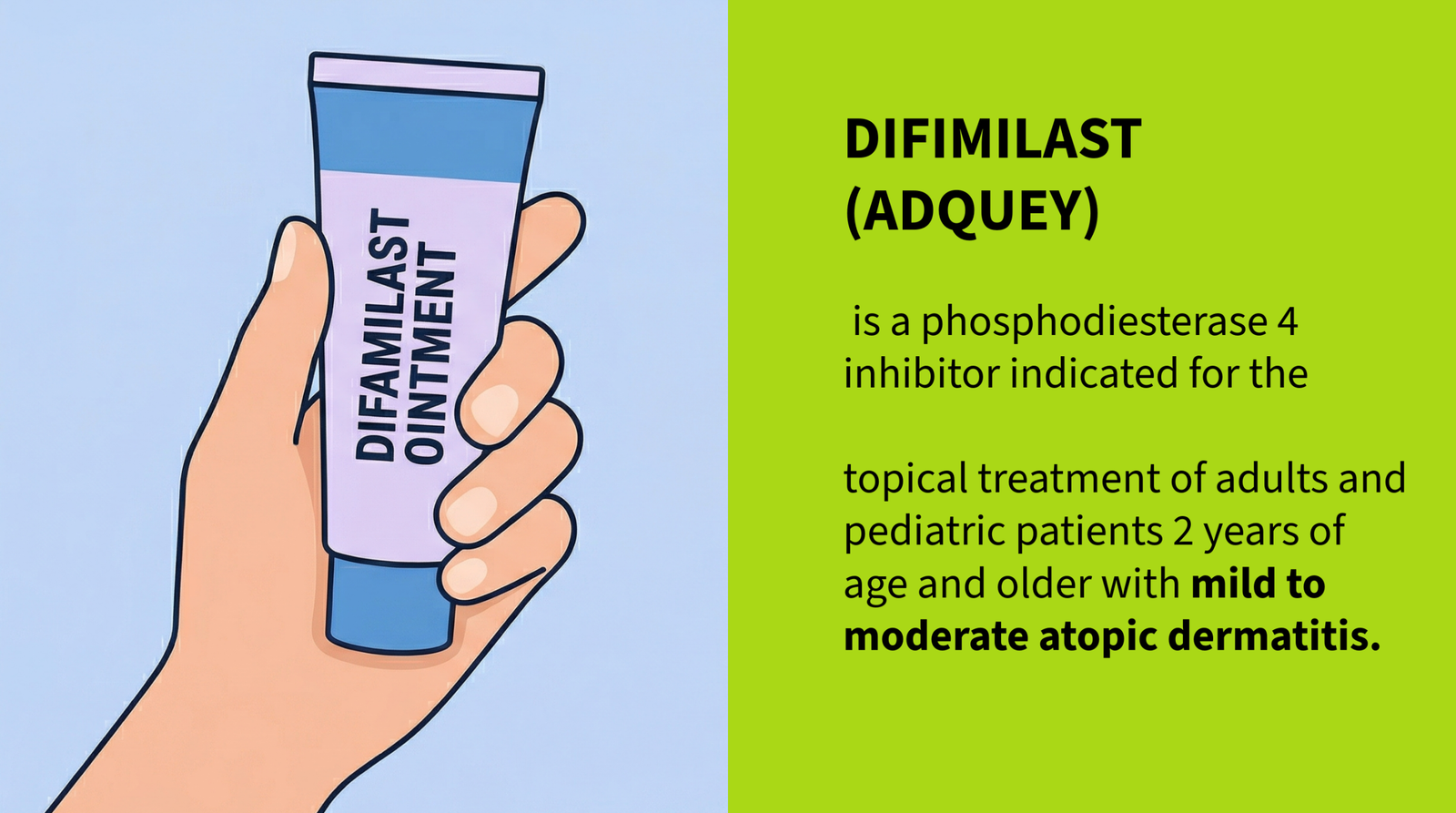
Indication
Mild to Moderate Atopic Dermatitis
Adults & pediatric patients ≥2 years
Mechanism
PDE-4 Inhibitor
Topical new molecular entity
Dose & Schedule
1% BID
Thin layer topically, twice daily
Phase 3 Program
2 Pivotal Trials
N=612 total (3 trials incl. Phase 2 supportive)
Mechanism of Action: Difamilast is an inhibitor of phosphodiesterase-4 (PDE-4), a major cyclic adenosine monophosphate (cAMP)-metabolizing enzyme. Inhibition of PDE-4 leads to intracellular accumulation of cyclic AMP, which in turn decreases production of various cytokines and chemokines involved in the inflammatory cascade underlying atopic dermatitis. The specific mechanism(s) by which difamilast exerts its therapeutic action in atopic dermatitis is not well defined.
| Trial Name | NCT Number | Design | N Randomised | Duration | Comparator(s) | Primary Endpoint |
|---|
| Trial 1 (271-12-205) | NCT02068352 | R/DB/PC; Phase 2; multinational (US, AUS, POL) | 121 | 8 weeks | Difamilast 0.3%, Vehicle | IGA Success at Week 4 |
| Trial 2 (271-102-00007) | NCT03908970 | R/DB/PC; Phase 3; Japan | 364 | 4 weeks | Vehicle | IGA Success at Week 4 |
| Trial 3 (271-102-00008) | NCT03911401 | R/DB/PC; Phase 3; Japan | 251 | 4 weeks | Difamilast 0.3%, Vehicle | IGA Success at Week 4 |
| Trial 4 (271-102-00002) | Not reported | R/DB/PC; Phase 2; Japan | ~73 | 4 weeks | Difamilast 0.3%, Vehicle | IGA Success |
| Trial 5 (271-15-001) | Not reported | R/DB/PC; Phase 2; Japan | ~200 | 8 weeks | Difamilast 0.3%, Vehicle | IGA Success |
| MEDI-MM36-301 | Not reported | R/DB/PC; Phase 3 (terminated early); US | 153 of 336 planned | 4 weeks | Vehicle | IGA Success at Week 4 |
| Drug (INN + Brand) | Target | Formulation | US Approval Date | Approved Population |
|---|
| Crisaborole (EUCRISA) | PDE-4 Inhibitor | 2% ointment | December 2016 | ≥2 years, mild to moderate AD |
| Roflumilast (ZORYVE) | PDE-4 Inhibitor | 0.05% / 0.15% cream; 0.3% foam | July 2022 / 2023 | ≥2 years (cream); ≥6 years (foam) |
| Tacrolimus (PROTOPIC) | Calcineurin Inhibitor | 0.03% / 0.1% ointment | December 2000 | ≥2 years; moderate to severe AD |
| Pimecrolimus (ELIDEL) | Calcineurin Inhibitor | 1% cream | December 2001 | ≥2 years, mild to moderate AD |
| Difamilast (ADQUEY) ▶ | PDE-4 Inhibitor | 1% ointment | February 2026 | ≥2 years, mild to moderate AD |
| Parameter | Detail |
|---|
| Proprietary Name | ADQUEY™ |
| INN / Generic Name | Difamilast |
| Code Names | OPA-15406; OPC-271; MM36; Moizerto® (Japan) |
| Manufacturer | Acrotech Biopharma Inc., East Windsor, NJ 08520 USA (Made in Canada) |
| Original Developer | Otsuka Pharmaceutical Co., Ltd. (Japan) |
| Pharmacologic Class | Phosphodiesterase 4 (PDE-4) Inhibitor |
| Dosage Forms & Strengths | Ointment 1% (10 mg difamilast per gram); white to off-white ointment |
| NDC(s) | 72893-017-08 (27 g tube); 72893-017-09 (85 g tube) |
| Storage | 20°C–25°C (68°F–77°F); excursions permitted to 15°C–30°C (59°F–86°F); store away from direct sunlight, heat, and moisture; keep tube tightly closed |
| Inactive Ingredients | Mineral oil, paraffin, propylene carbonate, white petrolatum, white wax |
| Molecular Formula & MW | C₂₃H₂₄F₂N₂O₅ · MW 446.44 g/mol |
| Chemical Name | N-({2-[4-(Difluoromethoxy)-3-(propan-2-yloxy)phenyl]-1,3-oxazol-4-yl}methyl)-2-ethoxybenzamide |
| Boxed Warning | None |
| PI Revision Date | February 2026 |
Trial Summary: Baseline characteristics are presented for the three pivotal/supportive trials (Trial 1 — multinational Phase 2, Trial 2 — Phase 3 Japan adults/adolescents, Trial 3 — Phase 3 Japan pediatric). All trials enrolled subjects with IGA score 2 (mild) or 3 (moderate) and affected BSA ≥5% to ≤40%. Concomitant treatment for atopic dermatitis was prohibited.
| Parameter | Difamilast 1% (N=182) | Vehicle (N=182) |
|---|
| Median age (range), years | 30 (range 15–65) | Not reported separately |
| Male sex | 54% (Trial 2 overall) | — |
| Race | 100% Asian | 100% Asian |
| Ethnicity | 100% Not Hispanic or Latino | 100% Not Hispanic or Latino |
| IGA 2 (mild) at baseline | 15% | 15% |
| IGA 3 (moderate) at baseline | 85% | 85% |
| BSA affected (excl. scalp) | ≥5% to ≤40% | ≥5% to ≤40% |
| Parameter | Difamilast 1% (N=85) | Difamilast 0.3% (N=83) | Vehicle (N=83) |
|---|
| Median age (range), years | 7 (range 2–14) | Not reported separately | Not reported separately |
| Male sex | 58% (Trial 3 overall) | — | — |
| Race | 100% Asian | 100% Asian | 100% Asian |
| Ethnicity | 100% Not Hispanic or Latino | — | — |
| IGA 2 (mild) at baseline | 15% | — | 15% |
| IGA 3 (moderate) at baseline | 85% | — | 85% |
| BSA affected (excl. scalp) | ≥5% to ≤40% | ≥5% to ≤40% | ≥5% to ≤40% |
| Parameter | Difamilast 1% (N=43) | Difamilast 0.3% (N=41) | Vehicle (N=37) |
|---|
| Median age (range), years | 30 (range 10–67) | Not reported separately | Not reported separately |
| Female sex | 56% (Trial 1 overall) | — | — |
| White | 73% | — | — |
| Black or African American | 20% | — | — |
| Asian | 4% | — | — |
| Hispanic or Latino | 18% | — | — |
| IGA 2 (mild) at baseline | 29% | — | 29% |
| IGA 3 (moderate) at baseline | 71% | — | 71% |
| BSA affected (excl. face, neck, head) | ≥5% to ≤40% | ≥5% to ≤40% | ≥5% to ≤40% |
Primary Endpoint: Proportion of subjects achieving IGA success, defined as an IGA score of 0 (clear) or 1 (almost clear) with ≥2-grade improvement from baseline, at Week 4. Analysis used non-responder imputation (NRI) — subjects with missing IGA scores were imputed as failures. FWER controlled across co-primary endpoints in the Japanese Phase 3 trials.
Difamilast 1% BID (N=182)
Δ +25.9% (95% CI: 17.5, 34.4) · p <0.001
Difamilast 0.3% BID (N=83)
1% vs Vehicle: Δ +28.7% (95% CI: 15.0, 42.5) · p <0.001
Difamilast 0.3% BID (N=41)
1% vs Vehicle: Δ +18.2% (95% CI: 5.0, 31.5) · p=0.017
Δ −0.2% (95% CI: −13.2, 9.0) · p=0.702 — NOT SIGNIFICANTEarly termination limits meaningful interpretation. FDA review concluded this does not preclude substantial evidence of effectiveness based on other completed trials.
Trial 2 (Adults/Adolescents ≥15 yrs) — IGA Success Rate (%) by Week
N=182 per arm · Primary endpoint: Week 4 · Digitized from FDA Medical Review Figure 13 (Ref ID: 5743278)
Source: FDA Multi-Disciplinary Review, NDA 219474 (Ref ID 5743278), Figure 13. Week 0 = 0% by definition.
Trial 3 (Pediatric 2–14 yrs) — IGA Success Rate (%) by Week
N=85/83/83 · Three arms incl. difamilast 0.3% · Digitized from FDA Medical Review Figure 14 (Ref ID: 5743278)
Source: FDA Multi-Disciplinary Review, NDA 219474 (Ref ID 5743278), Figure 14.
A consistent dose-response relationship was observed across all Phase 2 trials: the difamilast ointment 1% group had a higher response rate than 0.3%, and both active treatment groups outperformed vehicle.
| Trial | Difamilast 1% IGA Success, n/N (%) | Difamilast 0.3% IGA Success, n/N (%) | Vehicle IGA Success, n/N (%) | p-value (1% vs Vehicle) |
|---|
| Trial 271-12-205 (Multinational, ≥10 yr, 8 wk) | 9/43 (20.9%) | 6/41 (14.6%) | 1/37 (2.7%) | 0.017 |
| Trial 271-15-001 (Japan, ≥15 yr, 8 wk) | 15/67 (22.4%) | 10/67 (14.9%) | 6/66 (9.1%) | 0.033 |
| Trial 271-102-00002 (Japan, ≥2 yr, 4 wk) | 10/25 (40.0%) | 9/24 (37.5%) | 2/24 (8.3%) | 0.011 |
In open-label trials of both Japanese and US subjects, 857 adult and pediatric subjects continued twice-daily treatment with difamilast 1% for up to 52 weeks. The safety profile was consistent with the controlled trials. Application site adverse reactions that led to drug discontinuation are reported in the Safety tab.
No Boxed Warning. ADQUEY carries no boxed warning per the approved prescribing information.
Safety Population (Controlled)
532
Subjects in Trials 2 & 3 (4 weeks)
Long-Term Exposure
857
OL extension up to 52 weeks
Treatment Duration (Controlled)
4 Weeks
Trials 2 and 3
Most Common ADR (≥1%)
Nasopharyngitis
6% difamilast vs 4% vehicle
- Avoid areas of infected skin when applying difamilast. The PI specifies avoiding skin that is infected; application site adverse reactions including folliculitis were observed.
- Not for ophthalmic, oral, or intravaginal use. Use on skin only.
- Breastfeeding women: do not apply directly to nipple or areola; avoid inadvertent infant skin contact with treated areas.
- Pregnancy: insufficient human data to evaluate drug-associated risk. Animal data showed embryo-fetal toxicity at doses far exceeding clinical exposure (see §4.8).
| Adverse Reaction | Difamilast 1% (N=267) n (%) | Vehicle (N=265) n (%) |
|---|
| Nasopharyngitis | 16 (6%) | 10 (4%) |
Less common (<1%) adverse reactions: application site folliculitis, contact dermatitis, application site rash, molluscum contagiosum.
General disorders and administration site conditions: Application site swelling has been identified during post-approval use of difamilast. Because these reactions are reported voluntarily from a population of uncertain size, their frequency cannot be reliably estimated and a causal relationship cannot always be established.
Pain (application site)Led to drug discontinuation in open-label extension subjects.
Pruritus (application site)Led to drug discontinuation in open-label extension subjects.
Vesicles / Blistering (application site)Led to drug discontinuation in open-label extension subjects.
Erythema (application site)Led to drug discontinuation in open-label extension subjects.
Burning (application site)Led to drug discontinuation in open-label extension subjects.
Contact Dermatitis (application site)Led to drug discontinuation in open-label extension subjects.
| Population | Summary |
|---|
| Pregnancy | Insufficient human data to evaluate drug-associated risk of major birth defects or miscarriage. In rats, embryo-fetal toxicity (post-implantation loss, decreased fetal weight, retarded ossification, membranous VSD) at 263× MRHD (SC); NOAEL 30× MRHD. In rabbits, increased supernumerary lumbar vertebra at 14× MRHD; NOAEL 3× MRHD. Background risk of major birth defects in US: 2–4%; miscarriage: 15–20%. |
| Lactation | No data on presence in human milk, effects on breastfed infant, or milk production. In lactating rats (single SC dose 3 mg/kg), milk/blood radioactivity ratios: Cmax 13.7; AUC∞ 5.4. Advise breastfeeding women not to apply directly to nipple or areola; avoid infant skin contact with treated areas. |
| Pediatric (≥2 years) | Safety and effectiveness established. Supported by 5 vehicle-controlled trials including 236 subjects aged 2 to <17 years (119 difamilast, 117 vehicle). Not established in patients <2 years of age. |
| Geriatric (≥65 years) | Only 2 subjects ≥65 years enrolled across all clinical trials. Insufficient data to determine if elderly respond differently from younger adults. |
| Renal Impairment | No substantial PK differences observed with mild or moderate renal impairment (cross-study analysis). Effect of severe renal impairment (eGFR <30 mL/min) on difamilast PK is unknown. |
| Hepatic Impairment | No substantial PK differences observed with mild or moderate hepatic impairment. Effect of severe hepatic impairment (Child-Pugh Class C) is unknown. |
Carcinogenicity (Rat, Dermal)No test article-related neoplastic findings in male or female rats in 2-year dermal study; doses up to 3% ointment at 0.008 mL/cm² (4× MRHD based on AUC).
Carcinogenicity (Mouse, Dermal)No test article-related neoplastic findings in male or female mice in 2-year dermal study; doses up to 3% ointment at 0.008 mL/cm² (4× MRHD based on AUC).
GenotoxicityNot genotoxic in: in vitro bacterial reverse mutation (Ames) test; in vitro mammalian cell mutation test in mouse lymphoma cells; in vivo rat bone marrow micronucleus test.
Reproductive Toxicity (Rat)Irregular estrus, sperm abnormalities, increased preimplantation loss, decreased copulation/fertility index at 116–263× MRHD (SC). NOAEL for fertility: 20× MRHD (males); 30× MRHD (females).
Reproductive Toxicity (Rabbit)Increased supernumerary lumbar vertebra (skeletal variations) at 14× MRHD (SC). NOAEL: 3× MRHD. No embryo-fetal structural abnormalities at ≤3× MRHD.
Cardiac Safety (QTc)ADQUEY ointment is not expected to cause clinically significant QTc interval prolongation at the recommended dosages.
Cmax — Adult (Day 29)
0.76 ng/mL
±1.16 ng/mL SD; BSA mean 6±3%; ~0.9 g/application BID
AUC₀₋₁₂ — Adult (Day 29)
6.10 ng·h/mL
±8.85 ng·h/mL SD; 31 adult subjects; mild-moderate AD
Cmax — Pediatric (Day 15)
16.9 ng/mL
±21.9 ng/mL SD; BSA mean 44±13%; ~4.3 g/application BID
AUC₀₋₈ — Pediatric (Day 15)
86.2 ng·h/mL
±79.6 ng·h/mL SD; 31 pediatric subjects; moderate-severe AD
Protein Binding
99%
Not concentration-dependent (in vitro)
Pediatric vs Adult PK
1.3–1.9×
Higher trough conc. in pediatric patients (dose-corrected; Days 1 and 15)
Adult (mild-moderate AD): In 31 adult subjects with mean ± SD BSA involvement of 6 ± 3% (range 3–19%), applying approximately 0.9 g ADQUEY ointment 1% BID for 4 weeks. On Day 29: Cmax = 0.76 ± 1.16 ng/mL; AUC₀₋₁₂ = 6.10 ± 8.85 ng·h/mL.
Pediatric (moderate-severe AD): In 31 pediatric subjects with mean ± SD BSA involvement of 44 ± 13% (range 25–80%), applying approximately 4.3 g BID for 2 weeks. On Day 15: Cmax = 16.9 ± 21.9 ng/mL; AUC₀₋₈ = 86.2 ± 79.6 ng·h/mL. Plasma concentrations were quantifiable in all subjects. Systemic concentrations were at steady state by Day 15 with no evidence of accumulation.
Difamilast serum protein binding is 99% and is not concentration-dependent in vitro. Volume of distribution following topical application has not been separately characterized.
| Metabolite | Pathway | Enzyme | Activity Status |
|---|
| Metabolite 1 | O-deethylation | CYP3A4 | Not reported |
| Metabolite 2 | Hydroxylation | CYP1A2 | Not reported |
| Metabolite 3 | Enzymatic hydrolysis | Not specified | Not reported |
After both single dosing and twice-daily administration of difamilast ointment 1% in healthy Japanese subjects for 2 weeks, difamilast and Metabolite 1 were undetectable in urine. The urinary excretion ratios of all other metabolites were <0.1% of the administered dose. Terminal half-life following topical application has not been separately characterized in the PI.
| Population Factor | Finding |
|---|
| Age (2–70 years) | No substantial differences in PK based on cross-study analyses |
| Sex | No substantial differences in PK |
| Race | No substantial differences in PK |
| Mild or moderate renal impairment | No substantial differences in PK |
| Severe renal impairment (eGFR <30 mL/min) | Effect unknown; no dedicated study conducted |
| Mild or moderate hepatic impairment | No substantial differences in PK |
| Severe hepatic impairment (Child-Pugh C) | Effect unknown; no dedicated study conducted |
| Pediatric vs adult (dose-corrected trough) | 1.3–1.9× higher in pediatric patients on Days 1 and 15, respectively |
No clinical drug interaction trials conducted with topical difamilast. All data below are from in vitro studies only. Clinical significance of these in vitro findings for topical difamilast is expected to be low given minimal systemic absorption.
| System | Finding | Clinical Implication |
|---|
| CYP Substrate | Difamilast is a substrate of CYP3A4 and CYP1A2 | Theoretical interaction with strong CYP3A4/1A2 inhibitors or inducers; clinical relevance low with topical use |
| CYP Inhibition (1A2, 2A6, 2B6, 2C8, 2C9, 2C19, 2D6, 2E1, 3A4) | Not expected to inhibit at clinically relevant concentrations | No dose adjustments anticipated for co-administered CYP substrates |
| CYP Induction (1A2, 2B6, 2C9, 3A4) | Low induction expected at clinically relevant concentrations | No clinically significant induction anticipated |
| BCRP (substrate) | Difamilast is a substrate of BCRP | Theoretical interaction with strong BCRP inhibitors; clinical relevance low with topical use |
| P-gp, OATP1B1, OATP1B3 (substrate) | Not a substrate | No transporter-mediated interaction expected |
| Transporter Inhibition (P-gp, BCRP, OAT1/3, OCT1/2, OATP1B1/B3, MATE1/2-K) | Not expected to inhibit at clinically relevant concentrations | No dose adjustments anticipated |
Difamilast is an inhibitor of phosphodiesterase-4 (PDE-4), a major cyclic adenosine monophosphate (cAMP)-metabolizing enzyme. Inhibition of PDE-4 leads to intracellular accumulation of cAMP and decreased production of various cytokines and chemokines. PDE-4 inhibition attenuates Th2-predominant inflammatory responses associated with atopic dermatitis by reducing cAMP degradation in immune cells. The specific mechanism(s) by which difamilast exerts its therapeutic action in atopic dermatitis is not well defined per the PI.
The pharmacodynamics of ADQUEY ointment in the treatment of atopic dermatitis is not known per the PI. ADQUEY ointment is not expected to cause clinically significant QTc interval prolongation at the recommended dosages (cardiac electrophysiology assessment).
Approved Dose
1%
Difamilast ointment 1%
Route
Topical Only
Not ophthalmic, oral, or intravaginal
Frequency
Twice Daily
BID, to affected areas
Contraindications
None
No identified contraindications
Standard Dosing
- Apply a thin layer of ADQUEY to the affected areas twice daily
- Rub in completely until no longer visible on skin
- No loading dose; no titration schedule required
- No dose adjustment based on age within approved range (≥2 years)
- No dose adjustment for mild or moderate renal or hepatic impairment
Dose Modifications
- Renal impairment (mild/moderate): No adjustment required
- Renal impairment (severe, eGFR <30 mL/min): Effect unknown; use with caution
- Hepatic impairment (mild/moderate): No adjustment required
- Hepatic impairment (severe, Child-Pugh C): Effect unknown; use with caution
- Geriatric (≥65 years): Insufficient data; no specific adjustment recommended
- Pediatric (<2 years): Safety and effectiveness not established — do not use
Preparation & Administration
- Wash hands after application (patient or caregiver)
- Avoid areas of infected skin (red, warm, swollen, or painful)
- Do not apply in or near eyes, mouth, or vagina
- Breastfeeding women: do not apply directly to nipple or areola; avoid infant skin contact with treated areas
- No reconstitution required (topical ointment)
Storage & Handling
- Store at 20°C–25°C (68°F–77°F)
- Excursions permitted to 15°C–30°C (59°F–86°F)
- Store away from direct sunlight, heat, and moisture
- Keep tube tightly closed after each use
- Keep out of reach of children
None. ADQUEY has no identified contraindications per the approved prescribing information (PI §4).
| Parameter | Recommendation |
|---|
| Application technique | Apply a thin layer to affected areas twice daily; rub in completely until no longer visible on skin |
| Hand washing | Wash hands after applying; instruct caregiver to wash hands if applying on behalf of patient |
| Infected skin | Avoid areas of skin that are infected |
| Restricted sites | Not for use in or near eyes, mouth, or vagina (not for ophthalmic, oral, or intravaginal use) |
| Breastfeeding / nipple area | Do not apply directly to nipple or areola; avoid infant skin contact with treated areas |
| Concomitant emollients | Not addressed in PI; no restriction stated |
| Parameter | Detail |
|---|
| Application Number | NDA 219474 |
| Application Type | 505(b)(1) — Standard Review |
| Applicant | Acrotech Biopharma Inc., East Windsor, NJ 08520 USA |
| Original Developer | Otsuka Pharmaceutical Co., Ltd. (Japan) |
| Submission Date | February 13, 2025 |
| PDUFA Goal Date | February 13, 2026 |
| Actual Approval Date | February 2026 (review completed February 10, 2026) |
| Review Division | Division of Dermatology and Dentistry / Office of Inflammation and Immunology (DDD/OII) |
| Review Type | Standard |
| Breakthrough Therapy Designation | No |
| Fast Track Designation | No |
| Orphan Drug Designation | No |
| Advisory Committee | Not convened |
| Japan Approval | September 27, 2021 (Moizerto® Ointment); marketed June 1, 2022 |
| Medical Review Ref ID | 5743278 |
| PI Ref ID | 5745225 |
October 25, 2011
IND 112973 Filed — Otsuka Pharmaceutical
US development initiated. First-in-human Phase 1 trial (271-11-202) authorized: tolerability, safety, and PK in 32 healthy adults (single and multiple doses).
November 2013 – September 2014
FDA Pediatric Guidance & BSA Limits Established
FDA guidance on pediatric development (Nov 2013). FDA required BSA treatment limit of ≤40% with discontinuation if exceeded (Sep 2014).
March 23, 2016
Final CAC Report — Carcinogenicity Study Design
Recommendations for 2-year dermal carcinogenicity studies in mice and rats with specific dose requirements.
October 11, 2016
IND Transferred to Medimetriks Pharmaceuticals
Sponsorship transferred; US development continues under Medimetriks Pharmaceuticals.
October 31, 2018
End-of-Phase 2 Meeting
Comprehensive Phase 3 program discussion. FDA agreed on proposed dose (1%), timepoint for efficacy evaluation, safety database size, and primary endpoint (IGA success). FDA required prospective assessment of depression/suicidal ideation using PHQ-9 and C-SSRS.
March 25 – December 28, 2019
Japanese Phase 3 Trials Completed
Trial 271-102-00007 (≥15 yrs; Mar–Dec 2019) and Trial 271-102-00008 (2–14 yrs; May–Dec 2019) both completed in Japan. Both met primary endpoint (IGA success at Week 4; p<0.001).
September 11, 2020
Type C Meeting — Modified Development Program
FDA advised that a single US Phase 3 trial (MEDI-MM36-301) could serve as supportive evidence alongside completed Japanese Phase 3 data. FDA expressed concerns about safety database adequacy.
July 23, 2021
US Phase 3 Trial MEDI-MM36-301 Initiated
Medimetriks Pharmaceuticals submits US Phase 3 trial. Trial later terminated early for “business reasons” after enrolling 153 of 336 planned subjects.
September 27, 2021
Approved in Japan — Moizerto® Ointment
Difamilast ointment 1% approved by Japanese regulatory authority. Marketed in Japan from June 1, 2022.
December 30, 2021
IND Transferred to Acrotech Biopharma LLC
Sponsorship transferred to Acrotech Biopharma. No pre-NDA meeting held; Acrotech proceeds directly to NDA submission.
February 13, 2025
NDA 219474 Submitted
Acrotech Biopharma Inc. files 505(b)(1) NDA for ADQUEY® (difamilast) ointment 1%. Proposed indication: mild to moderate atopic dermatitis in adults and pediatric patients ≥2 years.
February 2026
FDA Approval — ADQUEY™ (difamilast) Ointment 1%
Approved as proposed. Indication: topical treatment of adults and pediatric patients 2 years and older with mild to moderate atopic dermatitis. No boxed warning; no contraindications. PI Ref ID: 5745225.
Adequacy of Efficacy Evidence — Foreign vs. US DataThe pivotal evidence base consisted of two Japanese Phase 3 trials and one US/multinational Phase 2 dose-ranging study. The FDA review team accepted the Japanese Phase 3 data as providing substantial evidence of effectiveness, notwithstanding the early termination of the US Phase 3 trial MEDI-MM36-301 for business reasons.
US Phase 3 Trial Early Termination (MEDI-MM36-301)The US Phase 3 trial was terminated after enrolling 153 of 336 planned subjects, yielding a non-significant result (p=0.702). The FDA concluded this did not preclude a demonstration of substantial evidence of effectiveness given the consistency of findings across the completed Japanese trials and multinational Phase 2 data.
Safety Database AdequacyFDA expressed concerns at the September 2020 Type C meeting regarding safety database size. The final safety database included 532 subjects in controlled trials and 857 subjects in open-label extensions up to 52 weeks. The review team accepted this as adequate for the proposed indication.
Depression and Suicidal Ideation MonitoringAt the End-of-Phase 2 meeting (October 2018), FDA required prospective assessment of depression and suicidal ideation using PHQ-9 and C-SSRS instruments, given the PDE-4 inhibitor class. Monitoring was conducted in the clinical program; no safety signal was identified in the labelling.
Note: Specific PMR/PMC identifiers, study types, and formal objectives were not explicitly enumerated in the PI (Ref ID 5745225). The following reflects information available from the PI and Medical Review summary.
| Domain | Detail |
|---|
| PMR/PMC Identifiers | Not reported in PI (Ref ID 5745225) |
| Long-term safety follow-up | Open-label extension data (857 subjects, up to 52 weeks) incorporated into submission. No additional PMR for long-term safety identified in PI. |
| Domain | Note |
|---|
| Benefit-Risk Conclusion | The FDA review team concluded Acrotech Biopharma provided substantial evidence of effectiveness via two pivotal Japanese Phase 3 trials. Benefit-risk assessment was favorable given a clean safety profile, no boxed warning, and no contraindications. |
| Labelling Negotiation | Indication text approved as proposed: topical treatment of adults and pediatric patients 2 years of age and older with mild to moderate atopic dermatitis. No restrictions on duration of use included. |
| Statistical Issues | Missing data handled by NRI (non-responder imputation). No material statistical issues identified per medical review. |
| Pharmacovigilance | Standard post-marketing surveillance. Application site swelling identified as postmarketing adverse reaction (§6.2). |
| Source Documents | FDA PI Ref ID: 5745225; FDA Medical Review Ref ID: 5743278; NDA 219474 |